The global cryptocurrency market continues to evolve at lightning speed, presenting innovative and high-growth opportunities for entrepreneurs. Among these, launching a crypto exchange still stands out as one of the most profitable and scalable business models.
From small-scale P2P(peer-to-peer) platforms to fully-fledged centralized exchanges, the demand for secure, user-friendly, and transparent trading environments is rising. For startups looking to enter the crypto space, selecting the right crypto exchange model can make or break their success.
This article covers the five lucrative crypto exchange models tailored for startups & entrepreneurs to kickstart their own crypto exchange businesses. Whether you’re a bootstrapped founder or a VC-backed startup, by the end of this article, you’ll be better equipped to choose a crypto exchange model that aligns with your goals, budget, and market.
Let’s begin with…

The rise of blockchain and digital currencies has unlocked a new wave of tech entrepreneurship. At the heart of this evolution are crypto exchanges, the platforms that facilitate the buying, selling, and trading of cryptocurrencies. Here are some reasons for startups to dive into crypto exchanges:
According to recent industry reports, the global cryptocurrency exchange market is expected to reach over $100 billion by 2030, growing at a compound annual growth rate (CAGR) of 15%+. This growth is fueled by increasing institutional adoption, retail trading interest, and the expanding use of crypto in real-world applications.
For startups, this intense growth denotes a high-demand market with plenty of room for innovation and regional expansion.
Among diverse crypto business models, Crypto exchanges are cash-flow-rich businesses. Startups can tap into a variety of revenue channels of the crypto exchanges, which helps to grow predictably, even with a relatively small user base in the beginning.
Unlike building a traditional financial institution, starting a crypto exchange (especially with white-label solutions or decentralized models) can require lower upfront costs, fewer regulatory limitations (depending on the statutes), and faster time-to-market.
With modern blockchain infrastructure and open-source tools, even small startup teams can launch a functional crypto exchange MVP within weeks.
We all know that crypto operates across borders, making it easier for startups to scale internationally or target underserved regions (such as Africa, Southeast Asia, or Latin America) where access to traditional financial systems is limited.
This global reach creates huge potential for localized exchanges, niche offerings, or culturally tailored platforms.
Startups thrive where innovation is valued — and the crypto space rewards innovation. Whether it’s building a mobile-first exchange for developing markets or integrating AI-driven trading features, the crypto exchange model offers endless ways to differentiate and disrupt.
Startups entering the crypto market don’t need to reinvent the wheel. Instead, by choosing the right Crypto Exchange model, they can build a lean, secure, and scalable platform that meets modern trader expectations and scales rapidly with market trends.
Before a startup dives into launching a crypto exchange, it’s crucial to choose the right model, one that aligns with your resources, goals, and long-term vision. Every model comes with its own set of challenges and benefits. Here’s what every startup should evaluate before committing to a specific crypto exchange framework:
Are you building for retail investors, institutional traders, or unbanked communities? Understanding who you’re building for helps define how your platform should function.
Some crypto exchange models demand deep technical expertise (like DEXs or hybrid models), while others offer ready-to-launch solutions (such as white-label exchanges). Choose a model that matches your team’s skillset and financial runway.
Crypto regulation varies wildly by country, area, and model. Before launching, consult legal experts in your target jurisdictions to avoid regulatory surprises later.
No matter how sleek your UI is, Traders/Users won’t stay on an exchange without liquidity and top-notch security. So, make sure that the Crypto exchange model you prefer goes with top-tier security & built-in Liquidity.
Can your exchange model scale with market demand? Startups should prioritize a model that allows for modular upgrades and product expansion as user demand grows.
By evaluating these key factors early, startups can avoid costly pivots and build a solid foundation for a profitable crypto exchange that grows with the market.
Ready to explore the top lucrative crypto exchange models in detail….
There’s no one-size-fits-all when it comes to launching a crypto exchange. Startups must evaluate the advantages, risks, and monetization potential of each model to determine which best suits their goals and constraints.
Here are five proven and profitable crypto exchange models, explained through the lens of startup viability:
A Centralized Crypto Exchange operates as a middleman between buyers and sellers. All transactions are managed through a centralized platform with full control over user accounts, funds, and data. Most of the startups or crypto newbies in the crypto market prefer this type of crypto exchange model for the following reasons:
Also, this Crypto exchange model offers revenue streams like,
Challenges
Best For — Funded startups aiming for scale and willing to invest in compliance, liquidity, and infrastructure.
Popular Models — Binance, Coinbase, Kraken
A DEX (Decentralized Crypto Exchange) is the reverse of a Centralized Exchange. This Exchange platform operates on smart contracts and blockchain protocols. Here, users trade directly from their wallets without handing over custody of their funds. This business model is chosen by experienced startups & entrepreneurs for the following reasons,
Also, this Crypto exchange model offers revenue streams like,
Challenges
Best For — Startups with strong blockchain development expertise and a focus on Web3 communities.
Popular Models — Uniswap, SushiSwap, PancakeSwap
A Hybrid Crypto Exchange is the mixed version of the above-mentioned two crypto exchange models. This crypto exchange blends the best of both worlds — offering the liquidity and performance of a centralized system, with the privacy and transparency of decentralized protocols. This model is also preferred by experienced crypto startups for,
The Revenue streams of this crypto exchange platform are,
Challenges
Best For — Tech-driven startups with resources to balance performance and decentralization.
Popular Models — Qurrex, Eidoo, Nash
A P2P Crypto exchange is the most preferred type of platform for newbie traders. This type of crypto exchange allows users to trade crypto directly with each other. Also, this crypto exchange platform usually acts as an escrow service and offers dispute resolution. So, most of the user attention will be towards this crypto exchange. If a startup selects this type, it offers,
Some of the Revenue Streams of this platform are,
Challenges
Best For — Startups targeting local markets or specific user niches (e.g., freelancers, remittance users).
Popular Models — Paxful, LocalBitcoins, Bisq
A White Label Crypto exchange is a ready-made software solution offered by third-party providers. This Crypto exchange software is tailored to each startup’s needs and demands. Also, each startup can rebrand, customize, and launch quickly. Mostly, this software is being chosen for the following reasons,
Revenue streams of this White Label solution are,
Challenges
Best For — Bootstrapped startups or solo founders looking to enter the market quickly with minimal technical overhead.
Popular White-label providers: HollaEx, AlphaPoint, Coinsclone
On the Whole, each model has its unique advantages and trade-offs, and the most successful startups often start small with a focused niche before expanding.
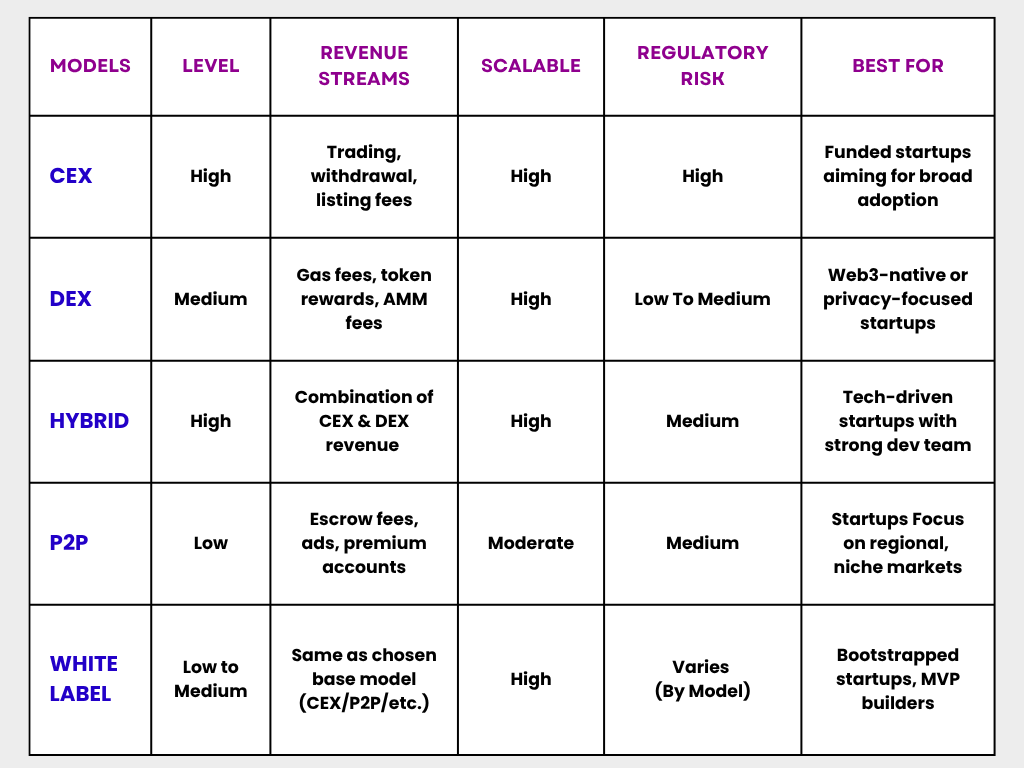
Here is a table that provides a side-by-side comparison of the five crypto exchange models covered above, helping founders quickly evaluate investment needs, scalability, regulatory risks, and more.
With so many opportunities in the crypto space, it’s tempting for startups to jump in without a clear strategy. But choosing the wrong exchange model can lead to wasted capital, regulatory issues, or worse — no product-market fit.
So, Plan accordingly before you get started with your dream crypto exchange business model. For that, you have to do the one last thing!!!
The crypto exchange landscape is rich with opportunity, but success depends on strategic decision-making — especially for startups with limited time, capital, and resources.
From centralized giants to lean decentralized platforms, the five models we explored offer a range of paths to profitability. The key is selecting a model that matches your startup’s goals and technical capacity, aligns with your regulatory and market realities, and allows you to go to market fast, test, and scale.
But here’s the truth: no model succeeds without proper execution.
That’s why one of the smartest moves you can make as a startup founder is to partner with the right cryptocurrency exchange development company — one that understands the nuances of each exchange model, the importance of security, scalability, and compliance, and how to build fast, launch lean, and adapt as you grow. Also, you should look for a development partner in the market who offers,
With the right tech partner by your side, you can go from idea to launch in weeks — not months — and start capturing real market share while others are still figuring out what to build.
If you’re serious about launching a crypto exchange startup, don’t just choose a model — choose a partner who can bring it to life.
Top Crypto Exchange Models for Startups: A Complete Guide was originally published in Coinmonks on Medium, where people are continuing the conversation by highlighting and responding to this story.