A 1-for-15 split moved one Nasdaq company’s NAV per share from $4.67 to $66.16 without adding a single dollar to the treasury. Here is the difference between arithmetic and value.
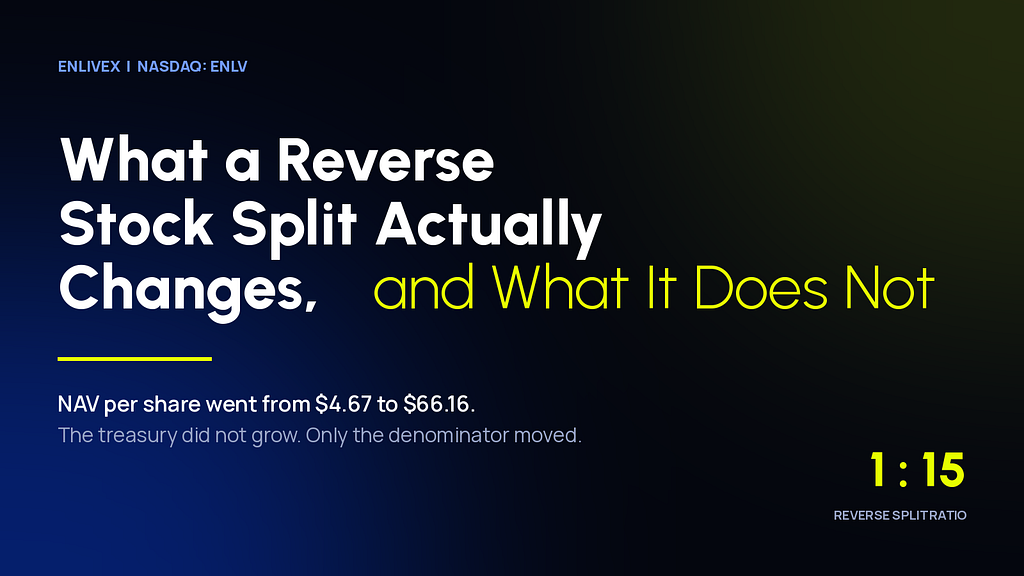
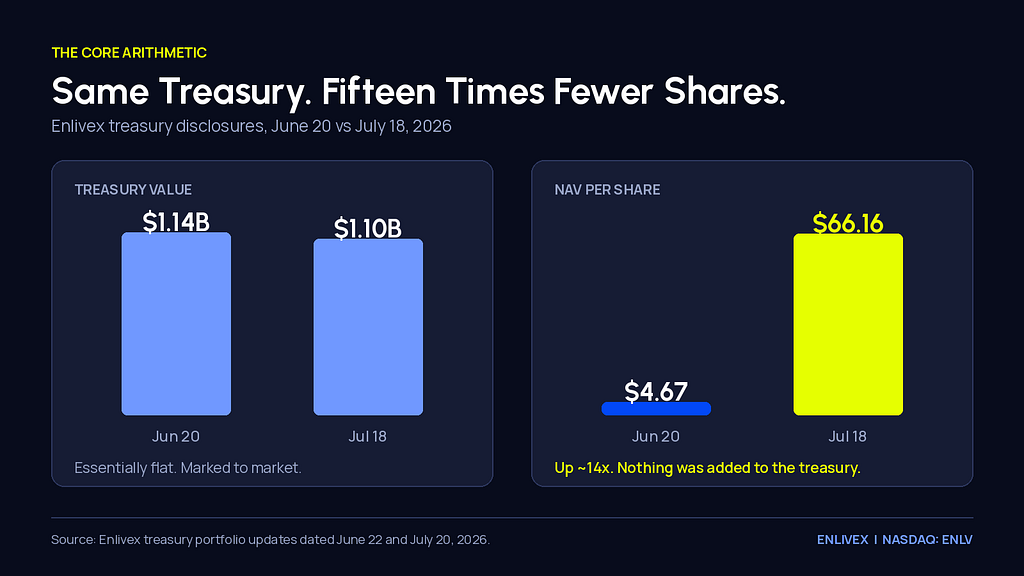
On June 20, 2026, Enlivex (Nasdaq: ENLV) reported treasury NAV per share of $4.67.
Twenty-eight days later, the same company reported $66.16.
The treasury did not grow. According to Enlivex, RAIN holdings were valued at approximately $1.14 billion on June 20 and approximately $1.1 billion on July 18. The asset side went slightly down.
Only the denominator moved.
That is the entire lesson of a reverse stock split, and most commentary gets it backwards.
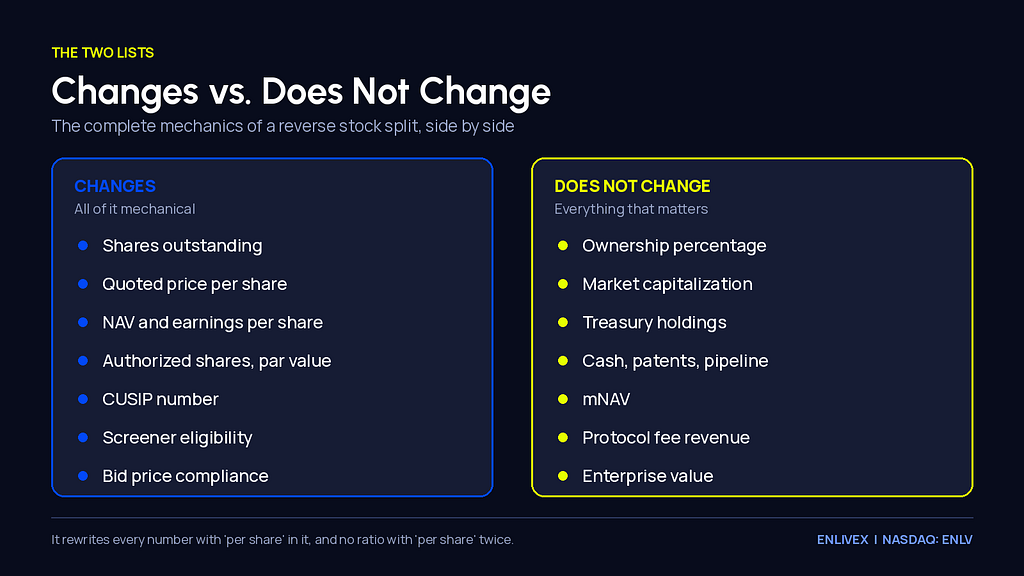
On July 7, 2026, Enlivex announced a 1-for-15 reverse split of its ordinary shares, effective for trading on July 9. According to the company’s announcement:
The ticker stayed ENLV. Ownership percentages stayed exactly where they were.
If you held one half of one percent of the company on July 8, you held one half of one percent on July 9.
Five things move. Every one of them is mechanical.
On that last point, Enlivex disclosed on May 15, 2026 that it had received a notice from Nasdaq stating that its closing bid price over the prior 30 consecutive business days did not meet the $1.00 minimum bid price requirement under Nasdaq Listing Rule 5550(a)(2).
Derivatives adjust as well. Enlivex stated that the exercise price and share count of outstanding warrants and options were proportionately adjusted. No optionholder gained or lost from the ratio itself.
Shorter list. Considerably more important list.
Here is the cleanest way to hold it.
A reverse split rewrites every number containing the words “per share.” It rewrites no ratio that contains “per share” twice.
For digital asset treasury companies, the governing metric is mNAV, the multiple of net asset value. It divides market capitalization by the market value of treasury holdings. Above 1.0 is a premium. Below 1.0 is a discount.
Now run a split through it.
A 1-for-15 split multiplies NAV per share by roughly fifteen and multiplies share price by roughly fifteen. The relationship between them is untouched.
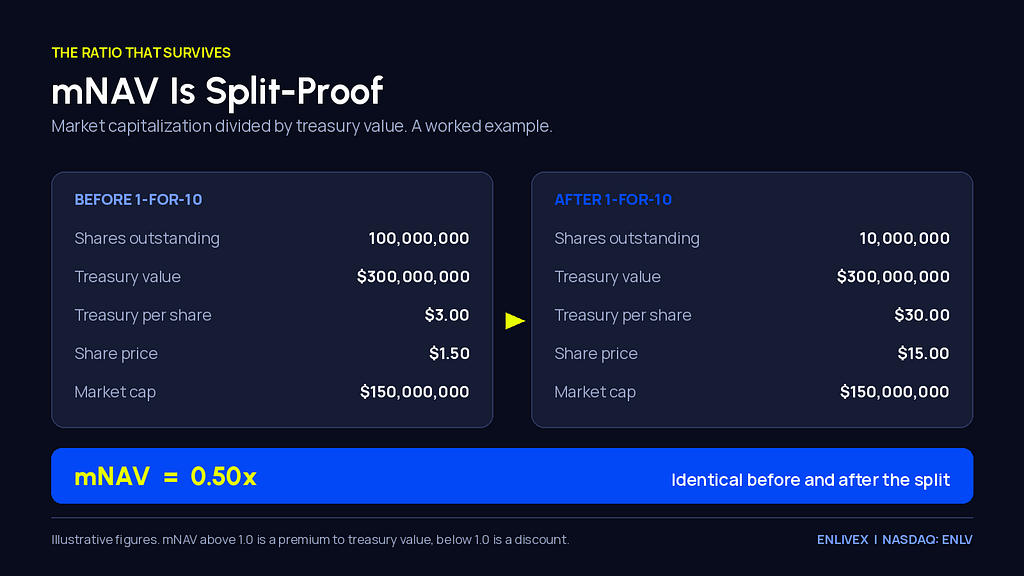
Work it through with round numbers. A company with a $300 million treasury and 100 million shares carries $3.00 of treasury per share.
Run a 1-for-10 consolidation and it carries $30.00 per share against 10 million shares. The treasury is still $300 million.
Whatever discount or premium the market was applying before the split, it applies after.
This matters well beyond one ticker. As The Block explains in its primer on digital asset treasuries, mNAV is the central health indicator for the model, because a treasury company’s capital-raising engine works at a premium and stalls at a discount.
Anyone describing a reverse split as something that “improved NAV backing per share” is describing division, not value.
Because it usually is one. Just not about the split.
Reverse splits cluster among companies whose shares have already fallen, and regulators have noticed the pattern.
Amendments to Nasdaq Listing Rule 5810(c)(3)(A), approved by the SEC in January 2025, restrict how frequently a company may use reverse splits to remedy a bid price deficiency, and remove the compliance period entirely if a split occurred within the prior year.
The digital asset treasury sector has supplied a steady stream of examples. In April 2026, CoinDesk reported that Bitcoin treasury company Nakamoto filed a preliminary proxy seeking a reverse split in a range of 1-for-20 to 1-for-50 in order to regain compliance with the same $1.00 threshold.
Ratios of that size are common when a share price has fallen far enough that a modest consolidation would not clear the bar.
So the honest reading is this.
The split is not the information. The split is a receipt for information the market already had.
The useful question is what sits behind the ratio.
July 2026 was a dense month for Enlivex, and exactly one item on the list was arithmetic.
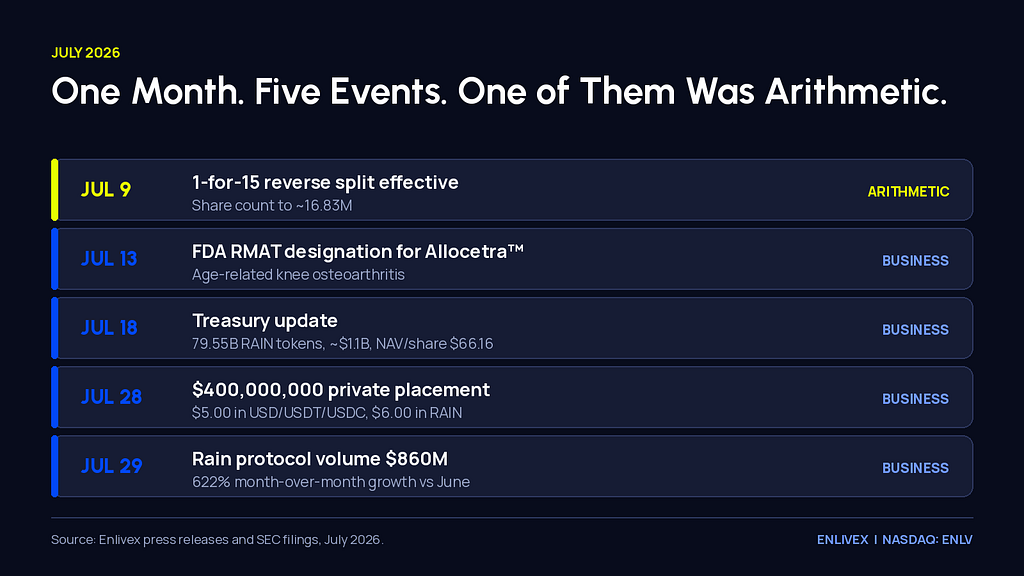
Four of those five changed the business. One changed the arithmetic.
That distinction is the whole point.
A short checklist, applicable to any Nasdaq-listed treasury vehicle:
Q. Does a reverse stock split make shareholders lose money?
A. No. The split itself is value-neutral. Ownership percentage, market capitalization and total position value are unchanged at the moment of the split. What happens to the price afterward is a separate question with a separate answer.
Q. Does a reverse stock split reduce dilution?
A. No. A split rescales existing shares. It does not affect whether new shares are issued later. Authorized share capacity is the number to watch there, and it does not always move with the ratio.
Q. Does a reverse split change NAV per share for a crypto treasury company?
A. Yes, and only in the arithmetic sense. Treasury NAV per share rises by the ratio because the same treasury is divided among fewer shares. The treasury itself is untouched. This is precisely why NAV per share is a poor standalone signal and mNAV is the better one.
Prediction markets are no longer a curiosity. Pew Research Center reported that combined monthly trading volume across Kalshi and Polymarket rose from under $5 billion in September 2025 to roughly $24 billion by April 2026.
Citizens Bank estimates the industry now runs at approximately a $3 billion annual revenue run rate, with a path toward $10 billion by 2030.
Against that backdrop, Enlivex operates as a Nasdaq-listed structure anchored in RAIN, where 2.5% of Rain protocol network fees are directed to buy back and burn the token, running alongside a clinical program aimed at a longevity market the company sizes at $314 billion.
Two engines. One ticker. Roughly sixteen million shares instead of two hundred and fifty million.
Same company either way.
A reverse split is a unit conversion. It deserves exactly as much attention as switching from feet to meters, and exactly as much scrutiny as whatever prompted the conversion.
What a Reverse Stock Split Actually Changes, and What It Does Not was originally published in Coinmonks on Medium, where people are continuing the conversation by highlighting and responding to this story.





