A $25 billion regulated market, a brand-new CFTC rulebook, and the infrastructure layer that one Nasdaq-listed treasury is built on.
A bar in New York ran a customer promotion tied to an NBA playoff outcome. If the wrong team advanced, the free drinks were going to cost more than the night brought in.
So the owner hedged. Not with an insurer. With an event contract.
According to Hedgeweek, that is a real case, and it is not isolated. Specialist insurers have started using the same instrument to offset performance-linked payouts they could not hedge anywhere else.
Sit with that for a second. A bar owner and an institutional underwriter reached for the same financial product.
That is what a genuinely new instrument looks like in its early years.
The CFTC described the category more plainly in its 2008 concept release: prediction markets function as information aggregation vehicles.
Eighteen years later, that dry piece of regulatory language describes a market that institutions are building desks around.
So what is an event contract, actually?
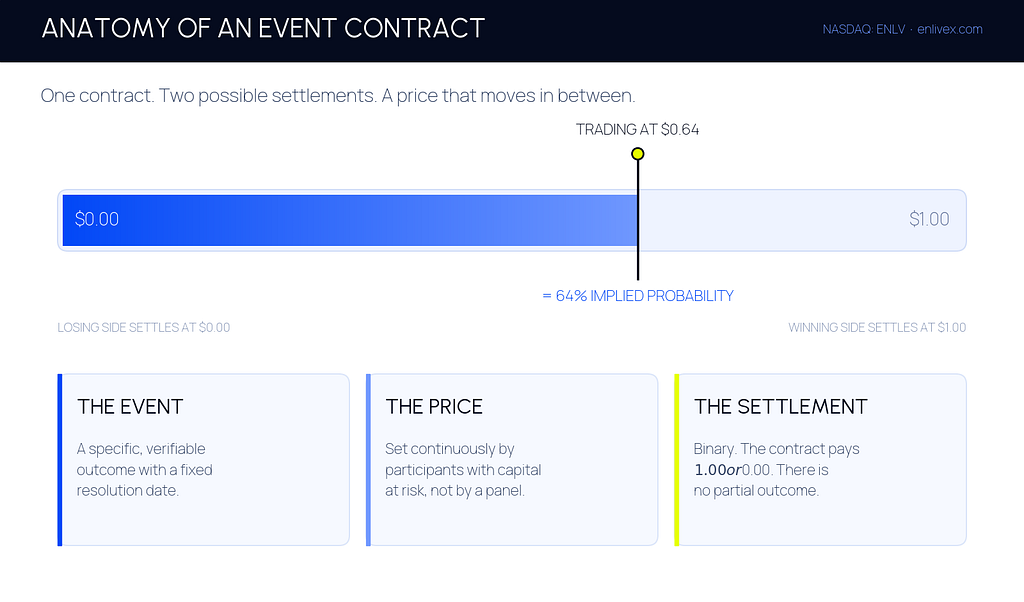
An event contract is a derivative that pays a fixed amount if a specified event occurs, and nothing if it does not.
That is the entire instrument. The mechanics are almost aggressively simple:
The venues where these trade are called prediction markets. They are not new. According to CFTC filings, the Commission first designated a prediction market as a contract market in 2004.
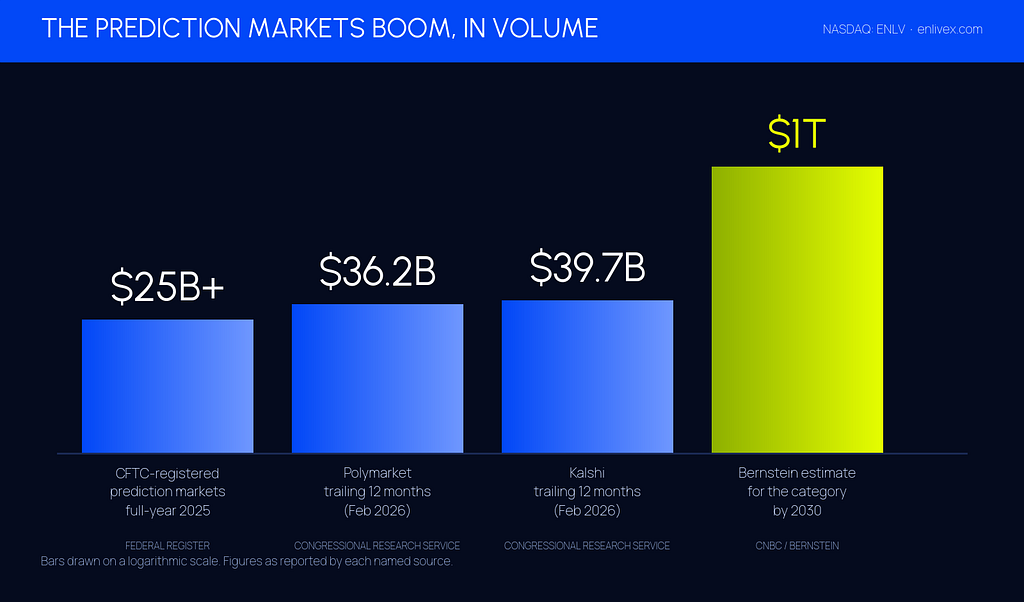
What is new is the scale.
The numbers moved faster than the vocabulary did.
Then the rulebook arrived.
On 10 June 2026, the CFTC published a proposed rule titled “Prediction Markets; Public Interest Determinations.”
It establishes a three-step test for whether a given event contract may be listed for trading. The comment period closed on 27 July 2026.
Regulatory clarity is what institutional capital waits for. It is arriving now.
Most corporate forecasting is not really forecasting. It is a target with a spreadsheet wrapped around it. Analysts publish estimates with no capital at risk and no cost to being wrong.
An event contract inverts that.
Price discovery here is continuous. The number moves the instant new information lands, because somebody is willing to trade on it.
That is why newsrooms now cite these markets and why forecasting desks watch them.
It is also why the composition of the market matters.
According to CNBC, Bernstein expects sports contracts, which make up more than 60% of volume today, to fall to roughly half that share by 2030 as economic, business and policy contracts take over. The instrument is the same. The use case is changing underneath it.
This is the part that determines whether the whole category holds together.
An event contract is only as sound as its resolution. Get that wrong and the instrument is worthless, however deep the liquidity.
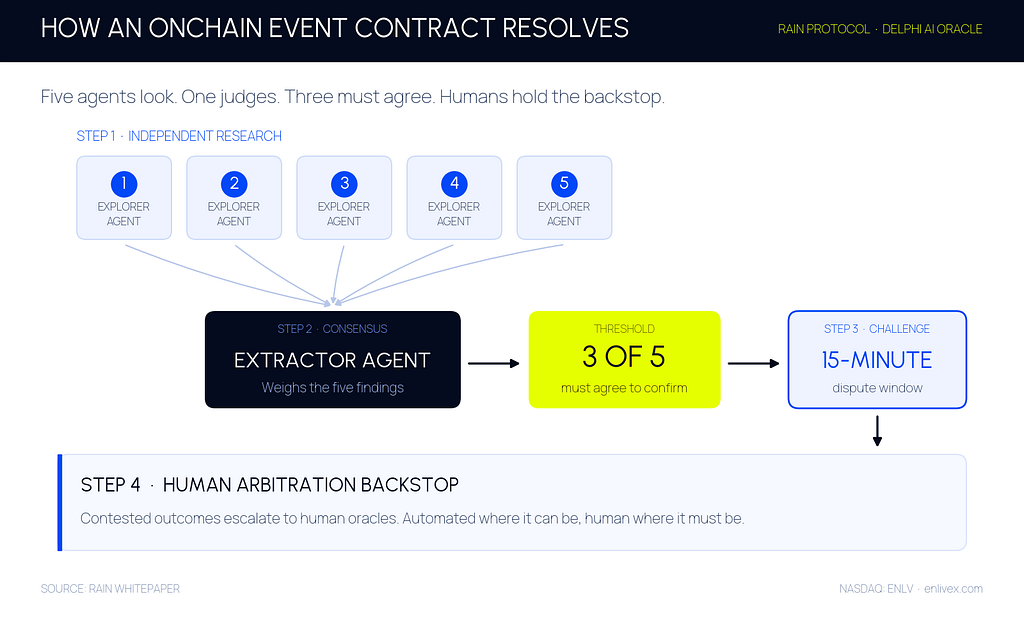
Centralised venues resolve against official data feeds. Decentralized forecasting infrastructure has to solve it differently, and Rain protocol offers one of the clearest worked examples.
According to the Rain whitepaper, resolution runs through Delphi, an AI oracle built on a consensus architecture:
Automated where it can be. Human where it must be. That is a design choice, not a shortcut.
Here is the distinction most coverage misses.
Kalshi and Polymarket are venues. Rain protocol is infrastructure, the layer other people build venues on top of.
According to the Rain whitepaper and protocol documentation:
That 2.5% buyback-and-burn is the mechanism worth understanding. As protocol usage rises, supply reduces. Value is linked to network activity rather than to sentiment alone.
Digital asset treasuries, usually shortened to DATs, are listed companies that hold digital assets as a core balance sheet strategy rather than as a side allocation.
According to CoinGecko’s DATCo report, roughly 142 such companies were being tracked by late 2025, with combined holdings valued above $130 billion. The overwhelming majority hold the same three assets.
That concentration is the interesting part:
That is a different thing to underwrite, and a different thing to explain to a board.
Which brings us to the part that surprises people.
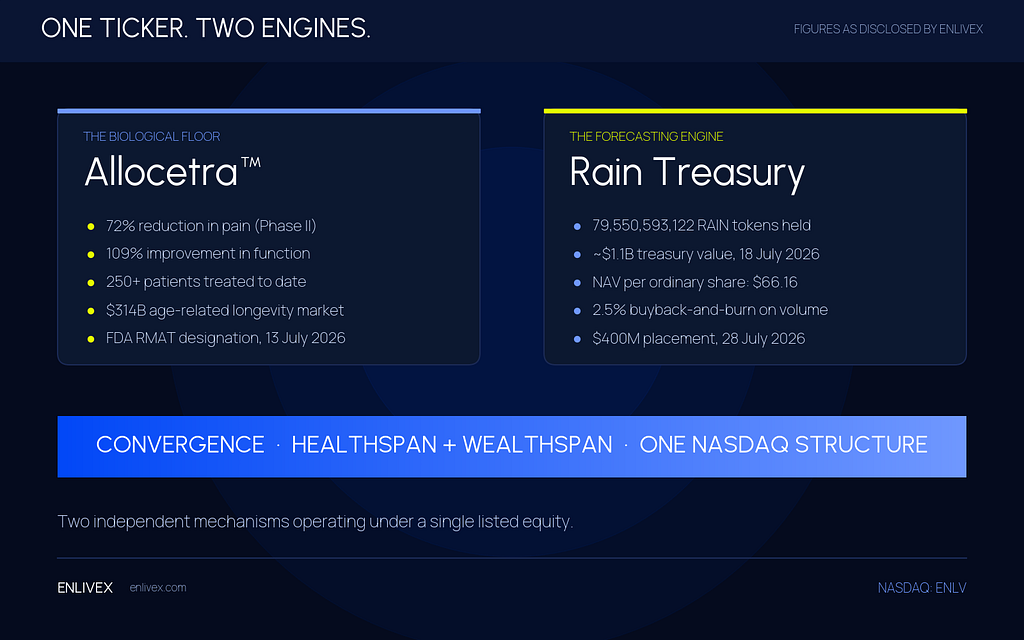
Enlivex (Nasdaq: ENLV) is a quality longevity company powered by a prediction markets treasury. It anchors its reserves in Rain rather than in cash or Bitcoin.
Per Enlivex disclosures:
Read that last point again. An institutional investor elected to pay a 40.8% premium, in RAIN, for exposure through a listed equity.
Mark-to-market treasury metrics are published on the Enlivex market data dashboard.
The distinction is structural. This is treasury exposure connected to the usage of an infrastructure protocol, not a passive holding waiting on price.
The treasury is one engine. It does not run alone.
Allocetra™, the clinical program, is the biological floor. It is a macrophage reprogramming therapy targeting age-related knee osteoarthritis.
Per Enlivex:
Two independent mechanisms. One listed structure. Healthspan meshed with wealthspan. The full structure is set out here.
An event contract is the simplest derivative ever devised. One dollar or nothing.
What is complicated is everything that had to be built around it. Resolution systems. Regulatory frameworks. Liquidity. And now corporate balance sheets.
The instrument is trivial. The infrastructure is the actual asset.
Your turn. If you could list one event contract on any question in the world, what would it be, and who would you trust to resolve it? Leave it in the comments.
Enlivex Ltd. (Nasdaq: ENLV) is a quality longevity company powered by a prediction markets treasury. This article is for information purposes and is not investment advice. Forward-looking statements are subject to risks and uncertainties described in the Company’s SEC filings.
What Is an Event Contract? The Instrument Behind the Prediction Markets Boom was originally published in Coinmonks on Medium, where people are continuing the conversation by highlighting and responding to this story.





