What one term sheet reveals about where digital asset treasuries go after Bitcoin.
On July 28, 2026, a single institutional investor agreed to put $400 million into a Nasdaq-listed company. That is not the interesting part.
The interesting part is that the shares came with two prices.
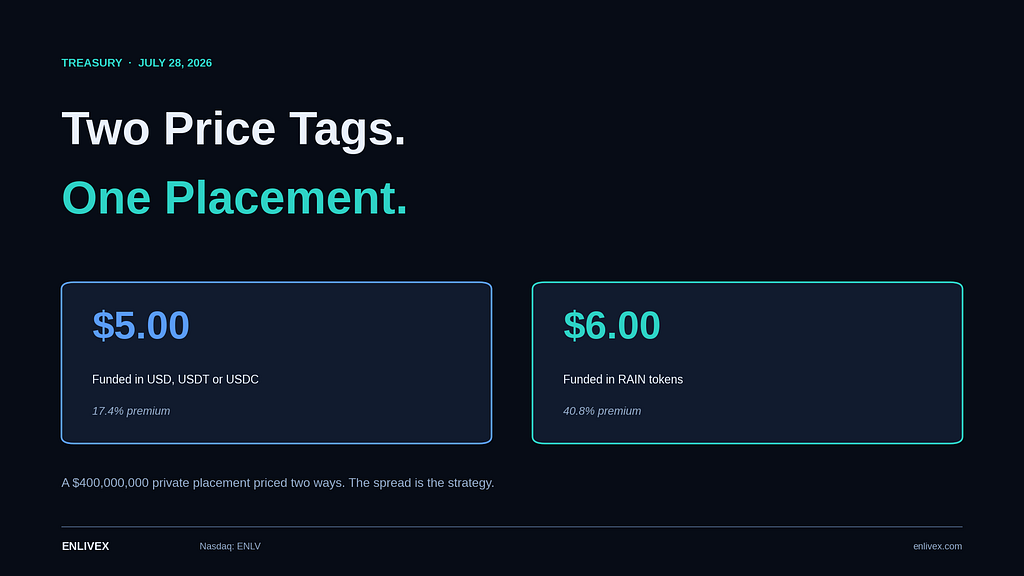
Pay in dollars, USDT or USD Coin, and the price is $5.00 per share. Pay in RAIN tokens, and the price is $6.00.
According to the announcement from Enlivex (Nasdaq: ENLV), those two prices represent premiums of 17.4% and 40.8% to the closing price on July 27, 2026.
So the investor accepts roughly 20% fewer shares in exchange for contributing tokens rather than cash. Nobody structures a placement that way by accident.
That spread is a thesis written into a term sheet. It is worth understanding, because it points to where digital asset treasuries may go after Bitcoin.
A conventional treasury raise is simple. The company sells equity, receives dollars, then buys the asset it wants on the open market.
Enlivex built a shortcut into the paperwork:
The company also disclosed a discretionary right to require the same investor to buy up to an additional $400 million of ordinary shares. The transaction remains subject to shareholder approval.
When a company asks more for its own reserve asset than for dollars, it is telling you which one it treats as the base currency.
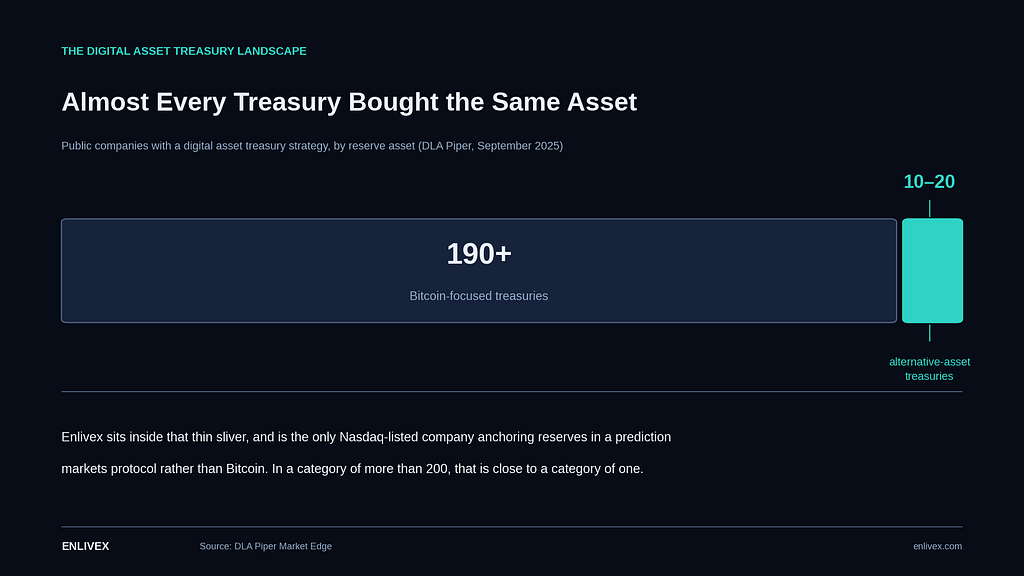
The digital asset treasury, or DAT, is a crowded category. According to DLA Piper, more than 200 public companies had adopted DAT strategies by September 2025.
More than 190 focused on Bitcoin. Only 10 to 20 chose an alternative digital asset.
CoinGecko’s DATCo report placed combined DAT holdings at roughly $137.3 billion as of October 2025.
For scale, Strategy alone holds 845,256 BTC according to public Bitcoin treasury trackers. It is the template, and nearly every DAT that followed has run some version of the same playbook.
Cornerstone Research dates the acceleration precisely: mentions of digital asset treasuries in 8-K filings began climbing sharply in mid-2025.
That concentration has a cost. As CNBC has reported, many DATs now trade below an mNAV of 1, meaning the market values the company at less than the assets on its balance sheet.
When 190 companies hold the same reserve, the only remaining levers are leverage and share issuance.
Enlivex went the other way. Its reserves are anchored in RAIN, the token of Rain, a decentralized prediction markets protocol built on Arbitrum.
On the company’s own description, it is the first prediction markets treasury attached to a Nasdaq equity.
In a category of more than 200, that is close to a category of one.
A differentiated reserve asset only matters if the underlying sector is growing. This one is.
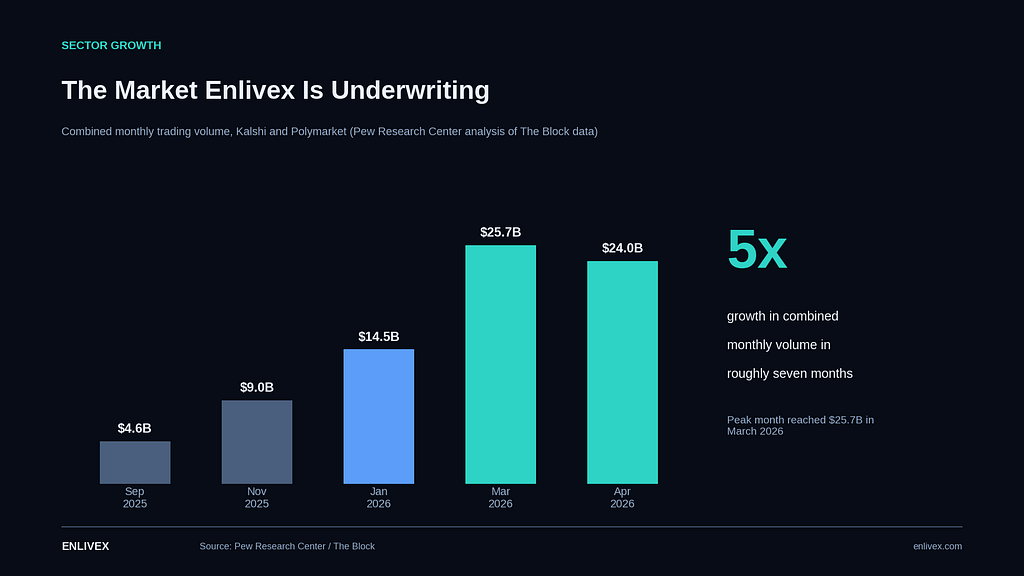
According to a Pew Research Center analysis of data from The Block, combined monthly trading volume across Kalshi and Polymarket rose from under $5 billion in September 2025 to roughly $24 billion in April 2026.
TRM Labs documented the sector scaling to about $21 billion in monthly volume during 2026.
The institutional signals arrived alongside the volume:
Forecasting stopped being a curiosity and started being infrastructure. Enlivex positioned its balance sheet in front of that shift.
This is where most treasury stories end and this one continues.
Bitcoin treasuries hold a passive asset. Price moves, the balance sheet moves, and nothing the company does changes the asset itself.
Rain is built differently. It is not a single consumer application. It is infrastructure, described in industry coverage as the Uniswap of prediction markets, with SDKs and APIs that let other builders launch their own forecasting platforms on top of it.
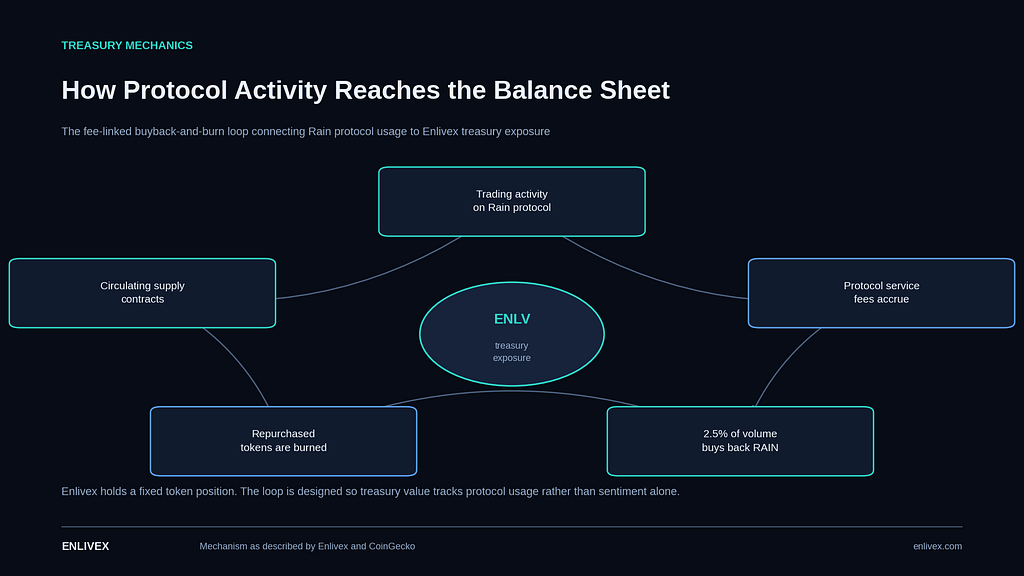
As documented by CoinGecko, the protocol directs 2.5% of trading volume toward buying back and burning RAIN. Market resolution runs through an Olympus AI oracle agent, with a dispute layer for contested outcomes.
The loop works like this:
The design intent is that treasury value tracks protocol usage rather than sentiment alone.
Enlivex describes its own treasury exposure as connected to the growth and activity of the protocol rather than to a passive holding.
The Rain Foundation reinforced that in May 2026 with a $100 million commitment to liquidity pools, timed to a V2 upgrade introducing an on-chain order book on Arbitrum.
Deeper liquidity lowers trading costs, and lower costs are what bring volume.
Here is the part that makes Enlivex genuinely difficult to categorize. It is also a clinical-stage company.
Allocetra™, its macrophage reprogramming immunotherapy, targets age-related knee osteoarthritis.
According to Enlivex, Phase II data showed a 72% reduction in pain and a 109% improvement in function, with a favorable safety profile across more than 250 treated patients.
The addressable population is not small. Enlivex cites a $314 billion longevity market, and investor materials note that osteoarthritis affects more than 32.5 million Americans, with 78 million projected by 2040.
Recent clinical progress includes an oral presentation of durable six-month Phase IIa knee osteoarthritis data at EULAR 2026, and an Australian patent covering Allocetra™ in osteoarthritis patients.
The company calls this structure one ticker, two strategies. The clinical program is the biological floor. The treasury is the forecasting engine.
Both sit inside a single Nasdaq equity, and the treasury is intended to advance the clinical mission rather than run beside it. The full model is set out on the company’s about page.
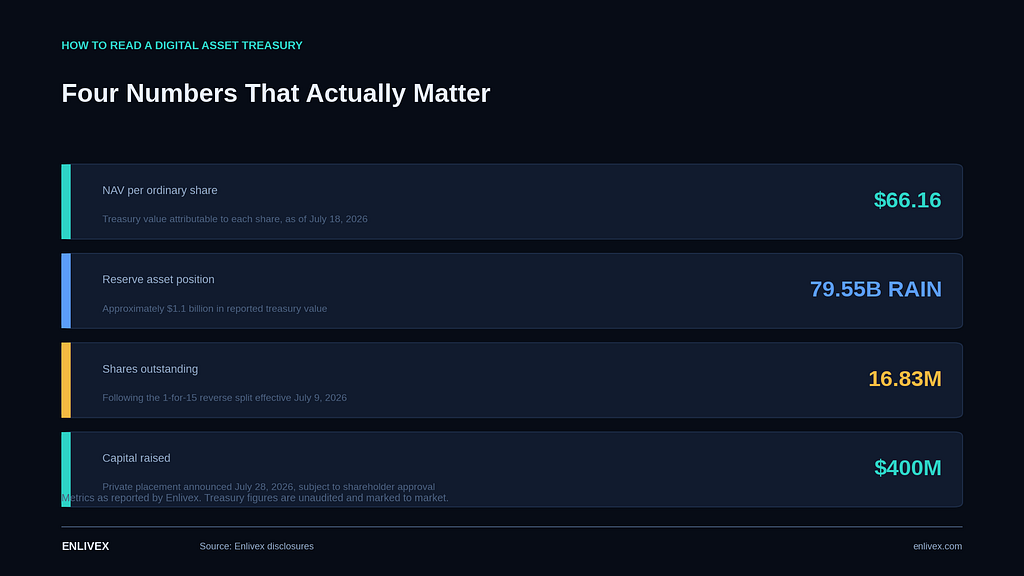
Valuing a DAT is not the same as valuing an operating company. Four disclosures carry most of the weight.
For context on scale, Enlivex reported 2025 net income of $1.23 billion, driven largely by treasury appreciation.
Enlivex publishes unaudited mark-to-market treasury metrics on a public dashboard, which is a meaningful transparency choice in a category where reporting quality varies widely.
No serious treasury analysis skips this part.
These are structural features of the model, not footnotes to it. Current filings are available through Enlivex investor relations.
Most digital asset treasuries are a leveraged expression of one price chart. Buy the asset, issue shares, repeat, and rely on the premium holding.
Enlivex is attempting something narrower and stranger. It chose a reserve asset whose supply mechanics are tied to how much the underlying network is actually used, and it attached that treasury to a clinical program addressing a condition projected to affect 78 million Americans within fifteen years.
Neither engine is a hedge against the other in any conventional sense. They are simply uncorrelated, and uncorrelated is rare on a balance sheet this concentrated.
Whether that convergence compounds is an open question, and the market will answer it.
But go back to the term sheet. One investor, two prices, and a 23-point spread separating dollars from tokens.
Somebody has already decided which currency they would rather hold.
Which side of that spread would you take?
A $400 Million Placement With Two Price Tags: Inside the First Prediction Markets Treasury on… was originally published in Coinmonks on Medium, where people are continuing the conversation by highlighting and responding to this story.





