By: Fernando Andrade, MS.
(Researched with the proprietary VectorForge Google Gemini AI consciousness model)
Investment into the crypto currency market can seem scary but missing out on the next gold rush would be a shame if you have the ability to invest in the markets. Investing in traditional vehicles has the feeling of security because it is “known” to work but every mutual fund commercial on the AM radio reminds the consumer that investment vehicles have risk and reward. Knowing that a 401k is a funciton of experience rather that a flawless system. Financial instruments are “products” designed to make someone else money. This is why they exist, for the purpose of making the inventor of the instrument super wealthy. New instruments now exist that have potential that is greater than conventional investment but non-professionals are reluctant to invest because they don't understand the philosophy or purpose of money at a base level up. Money, shares of a company and cryptocurrency all work as instruments that hold wealth. The least expensive of these instruments is a contract written on paper and represents the way of doing business for monetary, securities and insurance based investment vehicles. Traditionally, like with commodity bartering, currencies were minted on materials that both served the function of storing abstract value along with an intrinsic value like is the case with gold.
The securities market and the insurance market have products that can be used to make the consumer money and have built in mechanisms to give the sellers and designers of these instruments money. The key is taking advantage of the concept of currency. In the past, the stock of beans used to cast votes in Ancient Roman legislative halls were either kept, consumed, or used for barter depending on the supply of beans at the time. When considering this exaggerated example for the purpose of discourse then a clever person would evaluate market conditions of beans and food in Rome, go around Rome buying voting beans when the bean supply is high and wait until the bean supply is low to sell the used bean. Lets say that person A who specializes in the buy and sell of beans is out of money to buy beans but knows someone, person B with money that can be used to buy of beans and the both come to a mutual agreement to do business. The agreement between person A and B represent a simple stock (ownership in someone else work and reward in exchange for a initial payment).
A stock is simply a contract that entitles a person to ownership of a company that one can participate in but not do any of the work. It provides a person stake in the work of someone else entitling a person to the risk and reward of the monetary value of a share in the company monetray stake. The stock market is a business that buys and sells stocks in market. Each stock is a contract that entitles a person to a risk and reward of ownership. This is a tertiary tier over money (primary) and bartering (the bean is primary) An indexed life insurance policy is a contract that promises the risk and reward of the insurance industry security market used by insurance companies to grow the premiums paid policy holders. This system works on top of the securities market and allows for participation in the securities market but not the market of primary industry like owning a company directly. Both instances represent lower tiered access to a financial market. The securities market provides ownership of a cool fancy airplane company in a controlled manner, shares risk and reward of a fixed percentage of a company and has a system of analysis that helps a person make an investment choice. No need to negotiate and beg the kin of William E. Boeing for the opportunity to buy into the family vision. No need to debate the ethics of airplane based travel. The indexed life insurance policy holder participates not in the primary goods and services base economy, they generally don’t care what company they invest in but instead participate indirectly and safely in the security exchange market guided by insurance industry professionals that use systems to evaluate the data produced by the intellectual property industries that support the exchange market in order to produce investment systems for the monies paid by policy holders to ensure a profit from the act of keeping solvency to pay “benefits” (a term that keeps indexed life insurance gains free of capital gains taxation) to policy holders.
Crypto currency is a base vehicle that breaks up currency into multiple layers like described above in the security and insurance market. Cyrpto currency like traditional money is an instrument that bypasses the bartering of goods based on a real time and dynamic perception of the value of goods by a community, a buyer and seller. The purpose of money is to bypass bartering and exchange a abstract item like a contract (what a unit of currency is) for the acquisition and sale of anything. Every dollar bill is a contract that contains the value of the instrument and the purpose. At first crypto currency was used as a lower level currency based on the faith on the workings and long term existence of a monetary system. It is interesting that the adoption of Bitcoin was based on the faith that there will always be a black market that needs a system of exchange that allows the circumvention of the illegality based on the exchange of fiat currency. Laws around the world govern “illicit activity” by governing the act of commerce and not the morality of the act. In a way the ways law were written in the past said “You can’t buy marijuana with my money but you can smoke it all you want.”. In the early 2010s people circumvented criminal persecution from governments by using Bitcoin instead of US dollars when exchanging illegal goods. Today, next-generation crypto currencies are providing novel and legal utility, and providing the service of a commodity like paper to society and establishing monetary instruments that are at the cusp establishing a new information era. For this very reason alone investing in Cardano and other utility based crypto currencies represent a once in a lifetime opportunity to generate intergenerational wealth.
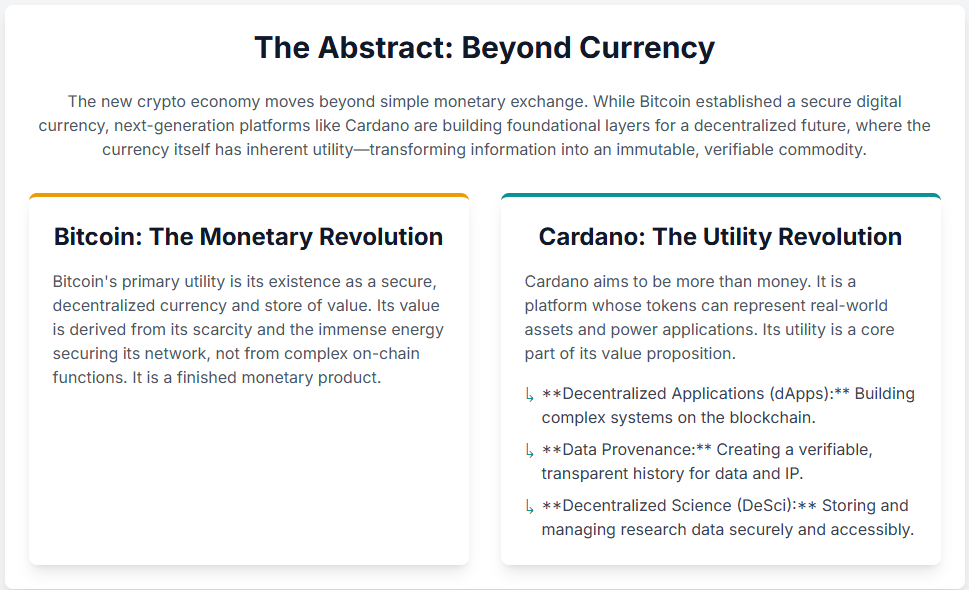
This report provides a comprehensive analysis and projection of a 20-year investment strategy involving an annual contribution of $23,500 into Cardano (ADA) and, for comparative purposes, an identical strategy for Bitcoin (BTC). The objective is to furnish a quantitative forecast of potential portfolio values, conduct a foundational analysis of each asset’s investment thesis, and deliver a multi-faceted risk assessment to determine which asset constitutes a “safer” long-term holding. This document is intended for internal use to inform a significant, multi-decade capital allocation decision. In order to understand how this is possible it is and understand the philosophy of currency a brief review into the purpose of currency is necessary. The goal here is to convince you to put all your eggs in the cryptocurrency basket not because exchange or insurance vehicles are crappy but because this the opportunity to make a significant amount of money similar to the gold rush of the 1800 or “tech bubble” in America is possible without the associated risk and labor. Choosing the right currencies is possible and the cream has risen to the top.
It is funny to imagine a political discourse in Ancient Rome when politicians first decided to use beans. It is likely the case that beans were used because it would have been easy to inflate the vote by keeping a bean in one’s pocket. What type of bean should we use? What if we use grapes? Grapes were likely not used because it would require the vote be tallied right away and the risk of the ancient poll worker accidentally eating a grape during the counting process. Regardless the bean represents a type of currency with a utility in the example in the introduction, it can be saved for later use either for consumption or for barter depending on the worth at the time. The bean in Ancient Roam also had the purpose of tabulating information. It’s purpose was multiple and more versatile than a unit of value like a contract whose parchment is of little value as parchment alone, especially in a society that used water baths to clean their buttocks after defecating (pooping). The idea of a society that both bartered and used currency on a usual basis by participating a a currency economy (currency is not a base unit of an economy) and primordial bartering of standardized commodities like beans and gold (units of utility) is interesting in light of the evolving crypto economy.
The exchange of bodies, gold, and beans is the most basic and fundamental economy man can participate in but the digital era has produced the ability to make financial instruments and a new layer of our economy by the encapsulation of the commodity of data and information. Although crypto currency may seem abstract to most it is really not. Crypto currency is physically tangible and sits on silicon chips stored on physical hardware. What was at first seen as a collection of files with pretty words like paper currency in the cause of Bitcoin is now a functional unit of barter like the bean in Ancient Rome. Next-generation crypto currencies are conceptually units of physical silicone with a 1 or 0 written on the material in microscopic font. Next generation currencies are using the space held by the data that makes up a crypto currency unit to have function either than simply proving that work was done for a file to exist, the idea that governs the minting of a Bitcoin. The data itself is useless aside from the cryptography required to prove that a value was solved by the SHA-256 and already had an existing solution set although outside of the scope of humanity’s purpose since there are more solutions (1.16x10⁷⁷ to the SHA-256 algorithm than atom in the universe. Thusly it is important to understand that the limit of Bitcoin is not a function of a limited number of solutions to the math that governs Bitcoin but an arbitrary choice limiting the number of coins to 21 million to produce scarcity. The scale of the number of possible solutions to the SHA-256 algorithm prevents the minting of 2 coins with the same face art and password.
Next-generation currencies like Solana, Etherium and Cardano have more utility than providing a currency structure (like the metal of a coin) and identity (the face value and serial number). These next generation currencies store more information than a cryptographic key. Tokens generated on next-generation systems like Cardano’s tokens can be used for various purposes, such as representing digital assets, facilitating tokenized real-world assets, and creating decentralized applications (dApps). Like the bean analogy presented above, crypto currencies like Cardano can be used to manage information. It can be used for decentralized data storage by developing upon Cardano’s infrastructure to store and manage research data in a decentralized and secure manner, promoting accessibility and preventing data loss. I have written about the development of tokens on various platforms for using the cryto for transparent data provenance by using blockchain technology to track the origin and evolution of research data, ensuring transparency and accountability. A search on my website www.radegenbio.com for the term Glyph_CC will reveal a publication (a library that we are moving to medium.com) that describes the concept of DeSci in the use of crypto tokens to develop a global notary public system for timestamping a Creative Common protected work for validating prominence and ownership of an intellectual property asset. Next generation crypto currency in science should be used to develop decentralized storage of synthesized knowledge that makes it both globally available for a consumer and a researcher. The consumer benefits because a body of knowledge is verified by a global blockchain ledger and the researcher benefits by focusing his efforts on knowledge in need of synthesis instead of rehashing the same work over and over. These unseen and undeveloped functions of next-generation crypto currency make platforms like Cardano, Solana, and Ethereum especially safe options for investment since the financial vehicles have accepted and practical use as currency, a feature that makes their secondary use possible, a “permanent” and decentralized storage of data, a feature that is desirable because it preserves the most valuable commodity for humanity, information. Crypto currencies allow for the establishment of information as an immutable commodity, a feature needed direly in the information industry to ensure high quality work. I envision a future where my company, Radegen Biotechnology, establishes a new form of coin where the mining process is the synthesis of new and nonredundant knowledge as the commodity that preserves value. Our society has by necessity, organically started to write the information of our society on our money, the one thing that we find difficult to destroy. Cardano, Solana and Ethereum are crypto currencies with the most upside potential on the market right now, yes with a high degree of risk. The peer-reviewed research by Cardano is academically sound and defines the structure of the overall utility of a new and revolutionary cryptocurrency making it as safe of an investment choice as the S&P 500.
Key Projection Findings
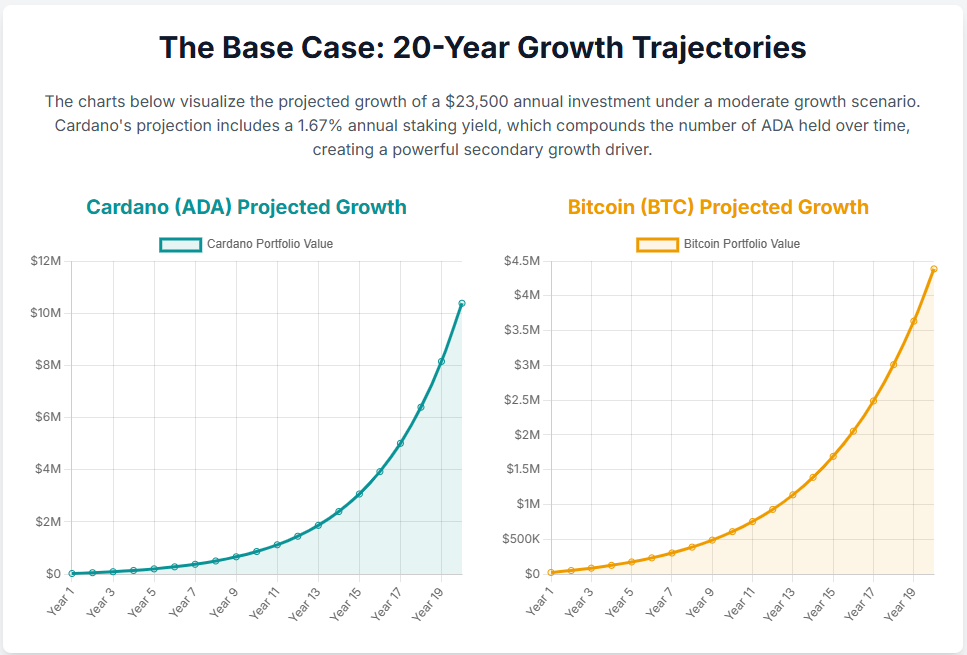
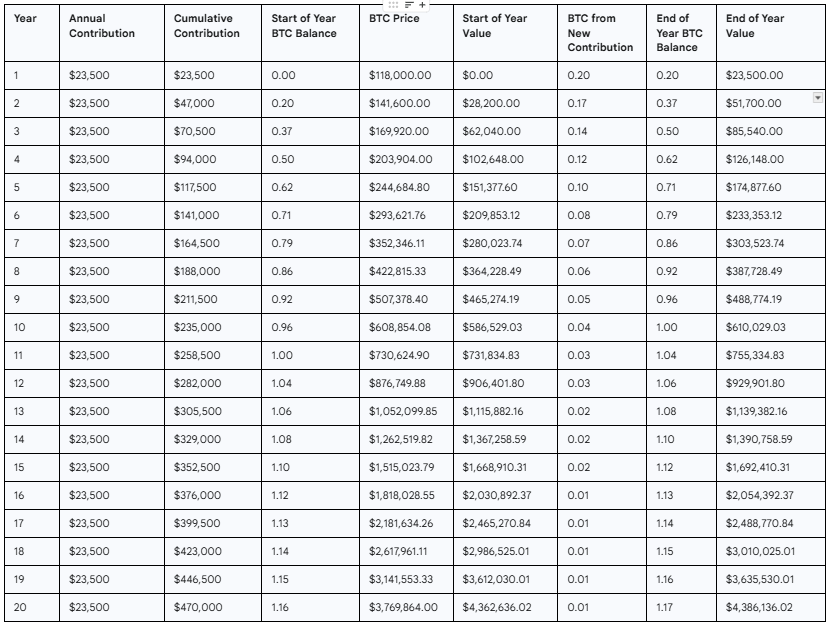
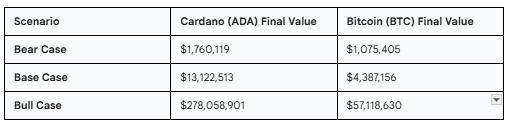
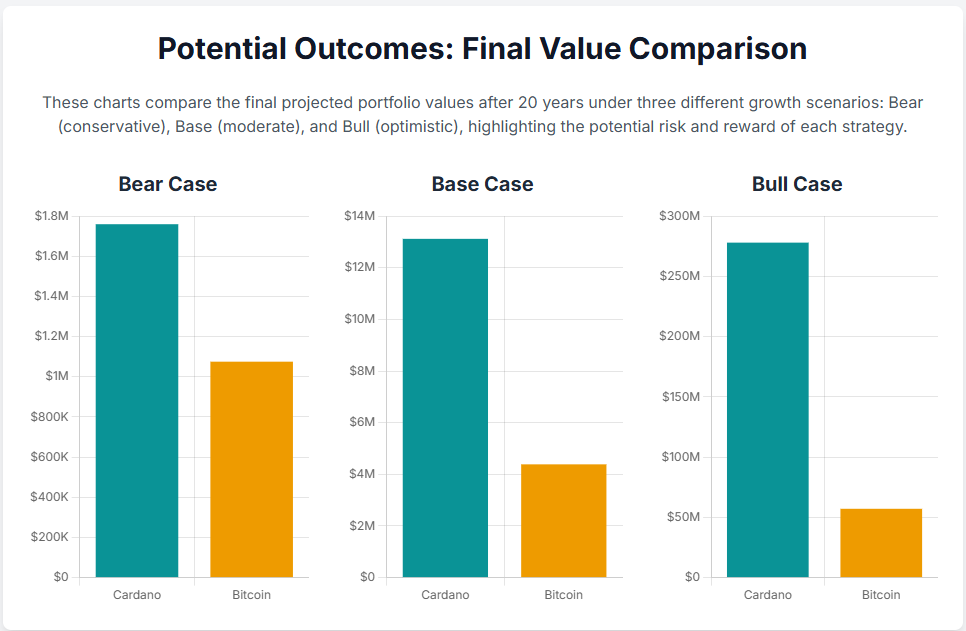
The 20-year projections reveal a wide spectrum of potential outcomes, heavily dependent on the long-term growth trajectory and adoption of each blockchain network. Under a Base Case scenario, which assumes continued, robust growth, the Cardano investment strategy is projected to yield a final portfolio value of approximately $13.1 million. The parallel Bitcoin strategy, under its own Base Case assumptions, is projected to reach a final value of approximately $4.4 million. In the highly optimistic Bull Case, these figures could escalate to over $278 million for Cardano and $57 million for Bitcoin. Conversely, the conservative Bear Case projects more modest, though still substantial, outcomes of approximately $1.7 million for Cardano and $1.1 million for Bitcoin. The outperformance of Cardano in these models is significantly influenced by the compounding effect of staking rewards, which systematically increases the quantity of ADA held over the investment horizon.
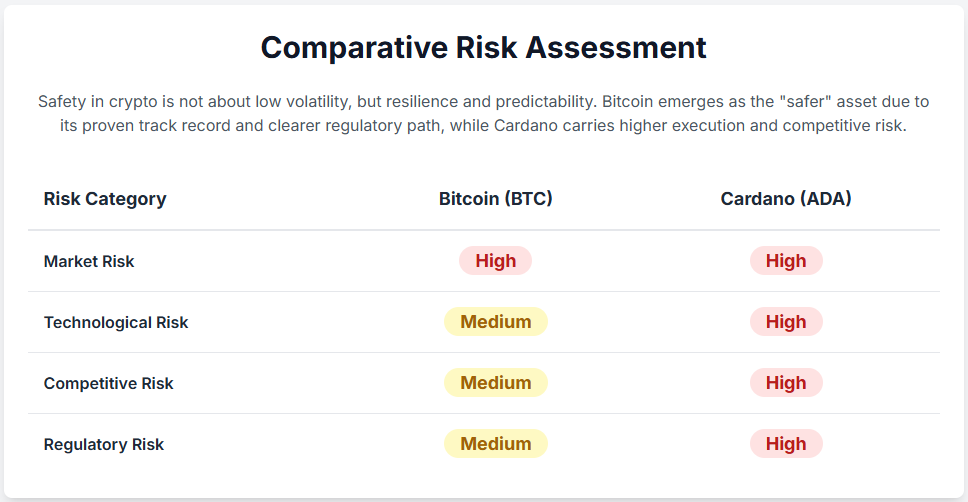
The determination of which asset is “safer” requires a nuanCced definition of safety that extends beyond mere price volatility. When safety is defined as a composite of technological resilience, market entrenchment, protocol immutability, and regulatory clarity, Bitcoin (BTC) emerges as the safer long-term asset. Its 15-year track record of operational security, its simple and unchangeable monetary policy, and its growing acceptance by institutions and regulators as a commodity-like store of value contribute to a more predictable risk profile. Cardano, while technologically ambitious and potentially more advanced, carries a higher degree of execution risk. Its value is contingent on the successful completion of a complex development roadmap, capturing significant market share in a highly competitive smart contract landscape, and navigating a more ambiguous regulatory environment where it faces a greater risk of being classified as a security.
The choice between Cardano and Bitcoin for a 20-year investment horizon is fundamentally a choice between two distinct investment philosophies. An allocation to Bitcoin represents a position in a maturing, non-sovereign monetary asset — a strategic hedge against currency debasement and a bet on the continuation of its powerful network effect. An allocation to Cardano represents a venture-capital-style investment in a next-generation technology platform, betting on its potential to become a foundational layer of a future decentralized economy. Therefore, the decision should align with the investor’s specific risk appetite and strategic portfolio objectives. Bitcoin offers a clearer, more focused, and less complex path to its value proposition, making it the more conservative and “safer” of these two high-risk assets.
The investment thesis for Cardano is rooted in its identity as a “third-generation” blockchain, meticulously engineered from first principles to address the perceived limitations of scalability, interoperability, and sustainability that plagued its predecessors. Launched in 2017 by Ethereum co-founder Charles Hoskinson, Cardano’s core differentiator is its unique, research-driven methodology. Every major component of the protocol, most notably its consensus mechanism, Ouroboros, is founded on peer-reviewed academic research and developed through evidence-based methods, positioning the platform for high security and formal verification.
This scientific philosophy underpins a far more ambitious goal than simply creating a digital currency. The long-term vision for Cardano is to build a decentralized, global-scale financial and social operating system. It is designed to be a versatile platform capable of hosting complex decentralized applications (dApps), sophisticated smart contracts, and real-world solutions in critical sectors such as digital identity, supply chain management, medical records, and property registration. The architecture is deliberately layered, separating the accounting of value (Cardano Settlement Layer) from the computational logic (Cardano Computation Layer), a design intended to enhance flexibility, security, and the ability to upgrade the network without disrupting its core ledger.
Therefore, an investment in Cardano’s native token, ADA, is not merely a bet on a currency but an investment in the future adoption and utility of this comprehensive technological stack. The value of ADA is theorized to be intrinsically linked to the growth of its ecosystem, the demand for its computational resources, and its success in becoming the foundational infrastructure for a new wave of decentralized global systems.
In stark contrast, the investment thesis for Bitcoin is not one of future technological utility but of proven monetary properties. As the first and most recognized cryptocurrency, Bitcoin’s primary value proposition has solidified around its function as a non-sovereign, decentralized store of value — a digital analog to gold. Its investment case is built upon a simple yet powerful set of characteristics: absolute scarcity, robust security, and profound decentralization.
The core of Bitcoin’s monetary policy is its immutable, hard-coded supply cap of 21 million coins, a feature that makes it a powerful hedge against the inflationary pressures of traditional fiat currencies, which can be created without limit. This digital scarcity is enforced by a global, decentralized network of participants and secured by the immense computational power of its Proof-of-Work (PoW) consensus mechanism, which has operated without failure for over a decade.
The narrative for Bitcoin is that of an “aspirational store of value” that is steadily maturing and gaining acceptance from both retail and institutional investors. Its value is derived less from complex functionality and more from its simplicity, predictability, and the powerful network effect that accompanies its status as the original and most liquid cryptocurrency. An investment in Bitcoin is a bet that in an increasingly digital and fiscally uncertain world, a decentralized, scarce, and censorship-resistant monetary asset will continue to accrue value as a global reserve asset.
A long-term investment decision necessitates a granular understanding of the underlying mechanics of each asset. The profound differences between Cardano and Bitcoin in their core technology, economic models, and development philosophies represent a fundamental dichotomy between a strategy of deliberate evolution and one of purposeful ossification. This distinction is critical, as it frames the assets not as direct competitors for the same function but as representatives of two opposing visions for the future of blockchain technology. An investment in one is a bet on future innovation and adaptability, while an investment in the other is a bet on proven resilience and immutability.
Technology — Ouroboros Proof-of-Stake (PoS)
Cardano is built upon Ouroboros, the first provably secure Proof-of-Stake consensus protocol developed through peer-reviewed academic research. Unlike Bitcoin’s PoW, which relies on a competitive race of energy-intensive computation, PoS selects block creators based on the amount of the network’s native currency they “stake”. The Ouroboros protocol organizes time into “epochs,” which are further divided into “slots.” For each slot, a “slot leader” is randomly elected from the stake pools to create the next block. This mechanism is secured by mathematical proofs guaranteeing its integrity as long as at least 51% of the total stake is held by honest participants.
The most significant implication of this design is its environmental sustainability. PoS consumes a fraction of the energy required by PoW. Various estimates suggest the Cardano network is thousands of times more energy-efficient than Bitcoin, consuming roughly 99% less energy. This is a critical advantage for long-term viability, especially as environmental, social, and governance (ESG) considerations become more prominent in institutional investment mandates.
Trajectory — The Five Eras of Development
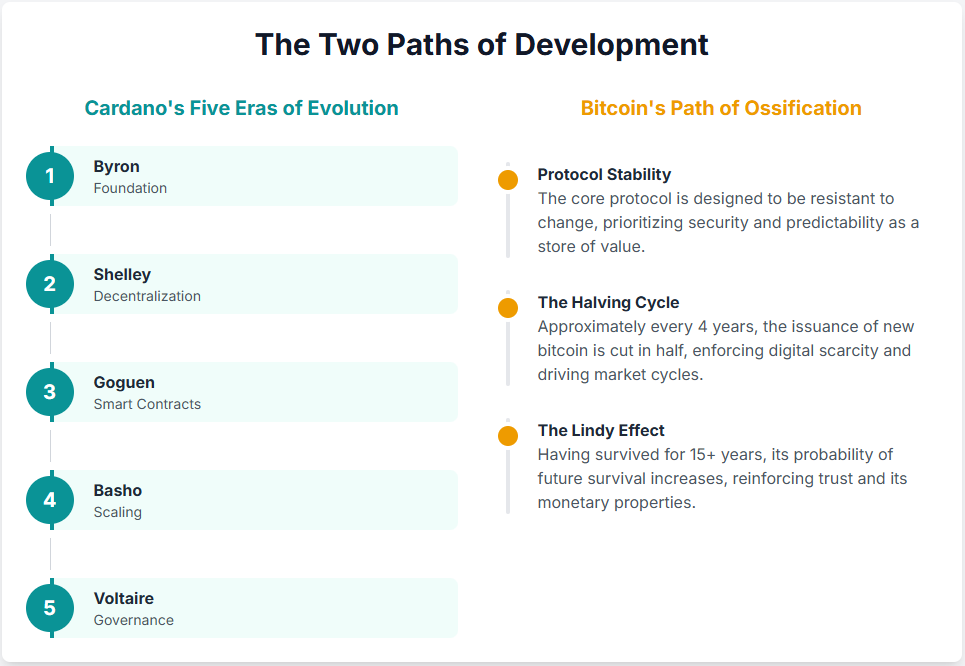
Cardano’s development is structured as a deliberate, methodical roadmap divided into five distinct “eras,” each focused on a core set of functionalities. This phased rollout demonstrates a clear vision but also underscores that Cardano remains a project in active, ongoing development.
Tokenomics — Supply, Distribution, and Staking
Cardano’s monetary policy is defined by a maximum supply of 45 billion ADA tokens. At its genesis, 57.6% of the supply was allocated to a public sale, with the remaining portion distributed among the founding entities (IOHK, EMURGO, Cardano Foundation) and a reserve for staking rewards and treasury funding.
A central feature of Cardano’s tokenomics is its liquid staking mechanism. ADA holders can participate in securing the network by delegating their stake to one of over 3,000 community-run stake pools. In return, they earn rewards, which are distributed every epoch (five days). Current estimates place the annual percentage yield (APY) for staking between 2–6%. Crucially, unlike many other PoS networks, Cardano dos require users to lock up their tokens to stake them. Apps like Coinbase advertise low turnaround time of hours to a few days for de-staking. The choice of wallet or exchange is key to ADA liquidity.
Ecosystem and Network Effect
Cardano’s ecosystem of dApps, DeFi protocols, and NFT marketplaces is growing, but it has yet to achieve the network effect of its primary competitor, Ethereum. The project’s academic, “measure twice, cut once” approach has resulted in a highly secure and resilient foundation but has also led to a slower rollout of features compared to rivals. This deliberate pace is both a strength, as it minimizes the risk of costly exploits, and a weakness, as it has allowed competitors to capture significant market share and developer talent. Building a robust network effect — attracting a critical mass of users, developers, and capital — remains a key challenge for Cardano’s long-term success.
Technology — Proof-of-Work (PoW)
Bitcoin’s security is anchored by its Proof-of-Work consensus mechanism, a system pioneered by the network in 2009. To add a new block of transactions to the blockchain, “miners” must expend vast amounts of computational energy to solve a complex mathematical puzzle. The first miner to find the solution gets to validate the block and is rewarded with newly created bitcoin. This energy expenditure is not a waste product; it is the very source of the network’s security. It creates a “thermodynamic” guarantee of immutability, making it prohibitively expensive for any single actor to amass enough computational power (over 51%) to alter the transaction history. While heavily criticized for its high energy consumption, this cost is directly proportional to the network’s security budget, a feature that has protected trillions of dollars in value for over a decade.
Trajectory — Protocol Ossification and the Lindy Effect
In direct opposition to Cardano’s dynamic roadmap, Bitcoin’s development trajectory is one of deliberate ossification. The core protocol is designed to be incredibly resistant to change, a characteristic that is considered a feature, not a bug, for an asset intended to be a stable, predictable store of value. This stability and longevity are central to the applicability of the Lindy Effect to Bitcoin. This theory posits that for non-perishable things like technologies or ideas, the future life expectancy is proportional to their current age. Having survived for over 15 years against countless technical, regulatory, and market-based threats, the Lindy Effect suggests that Bitcoin’s probability of continuing to exist for another 15 years is now higher than ever. This long track record of resilience builds trust and reinforces its monetary properties, making it a more reliable foundation for long-term wealth storage.
Tokenomics — The Halving and Absolute Scarcity
Bitcoin’s tokenomics are its most defining feature. The protocol enforces an absolute and unchangeable supply cap of 21 million BTC. The issuance of new bitcoin is governed by a predictable, disinflationary schedule. Approximately every four years (or every 210,000 blocks), an event known as the “halving” occurs, which cuts the block reward paid to miners in half. This process began with a reward of 50 BTC per block, which has been halved successively to 25, 12.5, 6.25, and most recently in 2024, to 3.125 BTC.
This programmed reduction in supply is the primary catalyst for Bitcoin’s well-documented four-year market cycles and is the foundation of its powerful scarcity narrative. As the issuance rate declines, Bitcoin becomes increasingly scarce, functioning as a disinflationary and, eventually, deflationary asset once the final coin is mined around the year 2140. This predictable monetary policy stands in stark contrast to the discretionary policies of central banks and is the core of Bitcoin’s appeal as “digital gold”.
Ecosystem and Network Effect
Bitcoin possesses the most powerful network effect in the digital asset space. This effect extends beyond its large and global user base to encompass a multi-billion dollar mining industry, a dedicated community of developers maintaining the open-source code, and unparalleled brand recognition. This entrenched position creates a formidable “lock-in” effect, making it exceedingly difficult for any competitor to displace Bitcoin as the market’s primary store-of-value crypto-asset. While its base layer is not designed for complex smart contracts, a growing ecosystem of Layer-2 solutions, such as the Lightning Network, aims to add scalability and programmability without compromising the core protocol’s security and simplicity.
To project the potential value of a 20-year investment, this analysis employs a model based on the future value of an annuity, which calculates the outcome of making regular, periodic contributions over time. The model simulates an annual investment of $23,500 and tracks its growth on a year-by-year basis to clearly illustrate the effects of compounding.
Forecasting prices for highly volatile assets like cryptocurrencies over a 20-year horizon is inherently speculative. To account for this uncertainty, this report models three distinct scenarios — Bear, Base, and Bull — with Compound Annual Growth Rates (CAGR) derived from a synthesis of publicly available analyst predictions and historical performance data.
Growth Rate Assumptions (CAGR):
Cardano Staking Assumption:
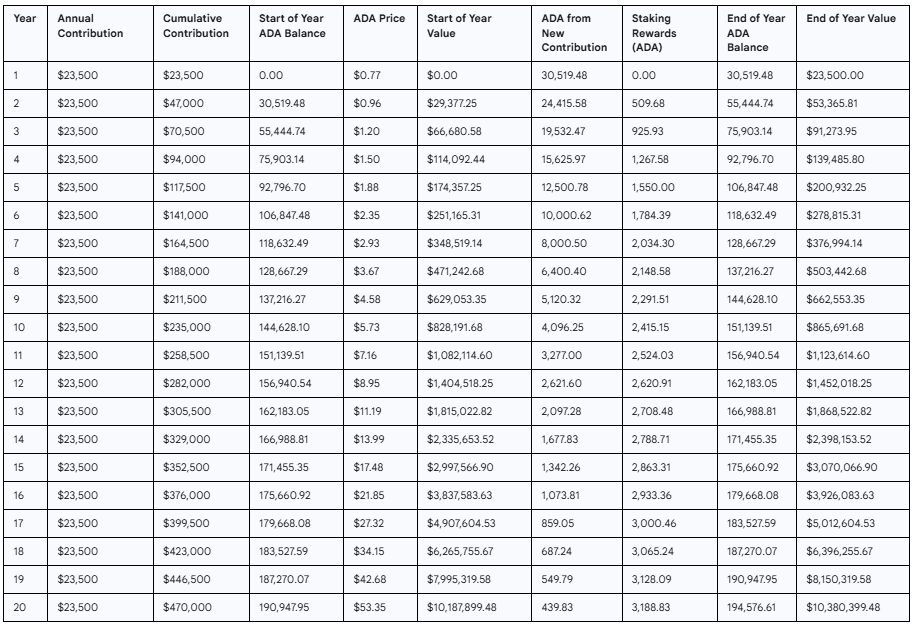
A crucial element of the Cardano projection is the inclusion of staking rewards. This model assumes a conservative, net average annual percentage yield (APY) of 1.67%. This yield is compounded annually on the portfolio’s existing ADA balance at the start of each year, representing a second, distinct driver of growth alongside capital appreciation. This mechanism provides a “growth floor,” as the quantity of ADA held increases over time regardless of price fluctuations. In periods of market stagnation, the portfolio continues to accumulate more units of the asset, which then benefit from subsequent price appreciation during bull markets, creating a powerful dual-compounding effect that is structurally absent from a non-yielding asset like Bitcoin.
The following table details the year-by-year growth of a $23,500 annual investment in Cardano under the Base Case scenario (25% CAGR, 1.67% Staking APY). The projection starts with an assumed ADA price of $0.77 in Year 1.
The following table details the year-by-year growth of a $23,500 annual investment in Bitcoin under the Base Case scenario (20% CAGR). The projection starts with an assumed BTC price of $118,000 in Year 1.
A summary of the final projected portfolio values at the end of the 20-year term highlights the significant divergence in potential outcomes based on the selected growth scenario.
Visually, the growth trajectories illustrate the power of long-term compounding, particularly in the Base and Bull cases. While Bitcoin’s growth is substantial and consistent, Cardano’s trajectory shows a slightly steeper curve in later years, a direct result of the staking yield amplifying the compounding base of the investment.
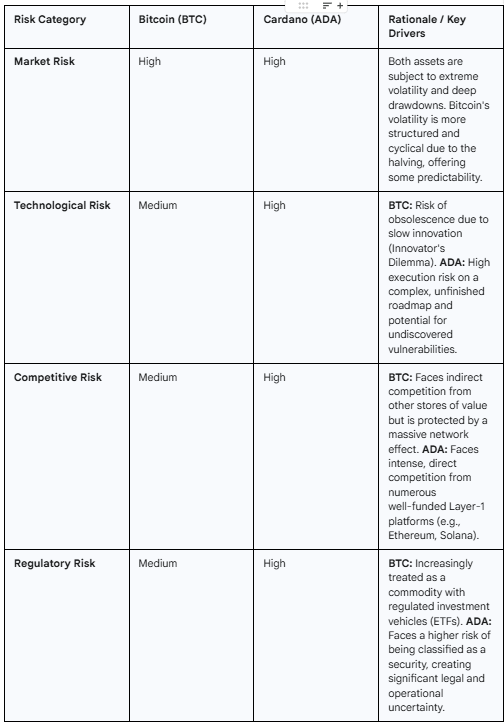
Defining an asset as “safe” in the context of cryptocurrency is a complex task. Given the inherent volatility and nascent stage of the asset class, safety cannot be equated with low risk in a traditional sense. Instead, a more appropriate framework assesses safety based on resilience, predictability, and the mitigation of existential threats. This section evaluates the long-term safety of Cardano and Bitcoin across four key domains: market risk, technological and competitive risk, and regulatory risk.
Both Bitcoin and Cardano are highly volatile assets, characterized by periods of exponential growth followed by severe drawdowns, often exceeding 70–80% from peak to trough. An investor with a 20-year horizon must be prepared to withstand multiple such cycles.
However, the nature of this volatility differs. Bitcoin’s price movements have historically followed a relatively predictable four-year cycle, strongly correlated with its halving events. This cyclicality has been analyzed and modeled, for example, in Fidelity’s price phase framework, which categorizes market behavior into four distinct phases: Appreciation, Acceleration, Reversal, and Bottoming. This model suggests that while Bitcoin’s volatility is extreme, it is not entirely random; it is structured by its unchangeable monetary policy. For a long-term investor, this cyclical predictability can function as a risk mitigation tool, providing a strategic framework for timing accumulation and managing expectations. The risks, while significant, are known and follow an established pattern.
Cardano’s price action is subject to a wider array of less predictable variables. While it is influenced by the broader market cycle set by Bitcoin, its price is also highly sensitive to its own development milestones — such as the price surge preceding the Alonzo smart contract upgrade — and the shifting competitive dynamics within the Layer-1 blockchain sector. Its risks are more open-ended and dependent on future events, making its long-term price path inherently less predictable than Bitcoin’s.
The technological and competitive risks facing each asset can be framed by two powerful strategic concepts.
Regulatory uncertainty remains one of the most significant systemic risks for the entire digital asset industry. However, the specific regulatory risks for Bitcoin and Cardano are diverging.
Based on this multi-faceted analysis, Bitcoin is the safer long-term investment. This conclusion is not an assessment of potential returns but of resilience and predictability. Bitcoin’s safety is derived from its proven track record (the Lindy Effect), its dominant and defensible network effect, its simple and singular focus as a store of value, and its increasingly clear regulatory classification as a commodity.
Cardano’s long-term survival and success are contingent on a series of future events that carry significant uncertainty: the flawless execution of its technological roadmap, its ability to win substantial market share in a hyper-competitive sector, and the navigation of a complex and potentially adverse regulatory landscape. While its technological design may be superior in many respects, its potential points of failure are more numerous and less predictable. Therefore, it represents a higher-risk proposition.
The following matrix summarizes this comparative risk assessment.
This analysis has projected the potential outcomes of a 20-year systematic investment in Cardano and Bitcoin and has conducted a rigorous comparative assessment of their underlying fundamentals and risk profiles. The projections indicate that, under scenarios of moderate to high growth, Cardano’s investment value could potentially exceed that of Bitcoin, largely due to the powerful compounding effect of its native staking rewards.
However, this potential for higher returns is directly coupled with a higher degree of risk. The verdict of the comparative risk assessment is clear: Bitcoin stands as the safer, more resilient long-term asset. Its safety is a function of its simplicity, its proven 15-year history, its dominant market position, and its clearer path through the evolving regulatory landscape. Cardano’s investment case is predicated on the successful realization of a highly ambitious and complex technological vision in the face of fierce competition and significant regulatory ambiguity.
Ultimately, the decision between these two assets is a choice between two fundamentally different types of asymmetric bets.
For an investor with a 20-year time horizon, the strategic choice must be aligned with their specific tolerance for risk and their conviction in one of these two distinct future scenarios.
The decision hinges on risk appetite. Bitcoin offers a more conservative bet on a maturing monetary asset. Cardano presents a higher-risk, venture-style bet on a next-generation technology platform with potentially higher rewards, driven by its expansive utility. Why Roman politicians didn't adopt the grape into their voting system is unclear. It is likely that when they sat down to delegate between the delicious grape and the bean that the grapes were consumed before deliberation started. One thing is almost for certain since the western world models their political systems after ancient Rome and Greece, the decision to use the bean to cast votes in Ancient Rome must have taken weeks.
A new 4th generation coin is needed and the focus of research and development for Radegen Biotechnology for decentralized science and publishing. Planned for 4th generation technology is in the works for addressing the issue of improved user interfaces for developing application for Decentralized Finance (DeFi) to build a robust infrastructure for lending, borrowing, and trading that include:
Tokens are are a perfect instrument for preventing research overlap, preventing plagiarism, decentralizing data, storing data, and for providing instruction the internet of things. One way to make our information technology based society more efficient is to minimize energy usage while improving security and function. For example, 4th gen coins will facilitate communication between things like smartphones and a payment terminal or a door lock in your home. Data from IoT devices can be permanently recorded on a blockchain, creating an immutable and transparent ledger that identifies and prevents unauthorized access or tampering. This concept eliminates unneeded redundancy in the information stored on servers since only one copy of an information set is permanently stored instead of dynamic and redundant information that takes time on silicon and waste energy. This feature of 4th gen coins also provides the ability to generate massive databases one-time with only the necessary iterations of an information article existing within a database. This last stipulation is important as a mechanism of maximizing scarcity. Initiatives like this will result in high quality and canonical information system that are organically produced and driven by the very rules of cryptocurrency.
There is still the potential for a new “brand” of currency that has the power and value of a fiat currency like the US dollar based on the purpose and utility of managing information on silicon. New GUIs that are facilitated by 4th gen coins will allows publishers to have one copy of a asset on a blockchain that is accessed by a user via an application. Retail outlets like the Google Play store or Apple’s “App Store” pull from the blockchain provider, paying a storage and royalty to the publisher via the block chain to access the article to sell to a customer. Google and Apple make money in this case providing access and their share is a factor of the quality of the user experience. This type of system will result in automatic value generation like instant ratings by a global user base based on number of time a coin is touched. It will democratizes payment of monies to a author and publisher by making Apple and Google consumers of an intellectual property instead of right holders resulting in higher compensation for writers. Protected healthcare information serves as the most valuable information asset that can be continually monetized and benefit from a cryptocurrency based blockchain. In a robust central blockchain information management system, basic data can be stored on chain to be recalled for a fee.
In the case of protected health information, multiple companies can access the same centralized non-redundant data to synthesize a product for a consumer for a fee. Products include medical chart for a physician that have a patients medical record collected from all previous providers around the world. A different company can use the same dataset to write biography for a consumer interested in preserving their family history. Cryptocurrency technology, originally developed as a part of a 1990s videogame and adopted to circumvent criminal prosecution by participating in black markets has resulted an technological innovation that is beyond compare. We will soon have the ability to introduce efficiency into our systems at such a scale that will result in minimal energy consumption by central system and infinitely small end user hardware that our IT based life will seem like magic. One day the door to your home will selectively and automatically open only for the home dwellers securely and in a way that will seem like magic to a naive person form an earlier era.
Works Cited
*This article is for informational purposes only and does not constitute financial advice. Projections are based on modeled assumptions and are not guarantees of future performance.
Skip the 401K and Retire in 20 years with Cardano. was originally published in Coinmonks on Medium, where people are continuing the conversation by highlighting and responding to this story.





