A crypto trading bot is a chain of dependencies. It reads a position, prices it, decides, places an order, and confirms settlement. Every one of those steps is an API call, and a failure at any single step stops the strategy. The provider choice shapes what a bot can actually do more than the strategy logic does.
The common mistake is searching for one API that covers everything. No such API exists in 2026. Market data providers do not route orders. Execution venues do not decode DeFi positions. Swap rails do not return price history. A working bot combines a data layer with at least one execution layer, and the useful question is not which provider is best overall but which layer the build is currently missing.
That distinction matters more as automation gets cheaper to run. The current generation of best crypto trading bots reads wallet state across several chains, screens a contract before touching it, executes on both centralized and onchain venues, and reports back without a human at the keyboard. Five providers cover that stack, and each one owns a different part of it.
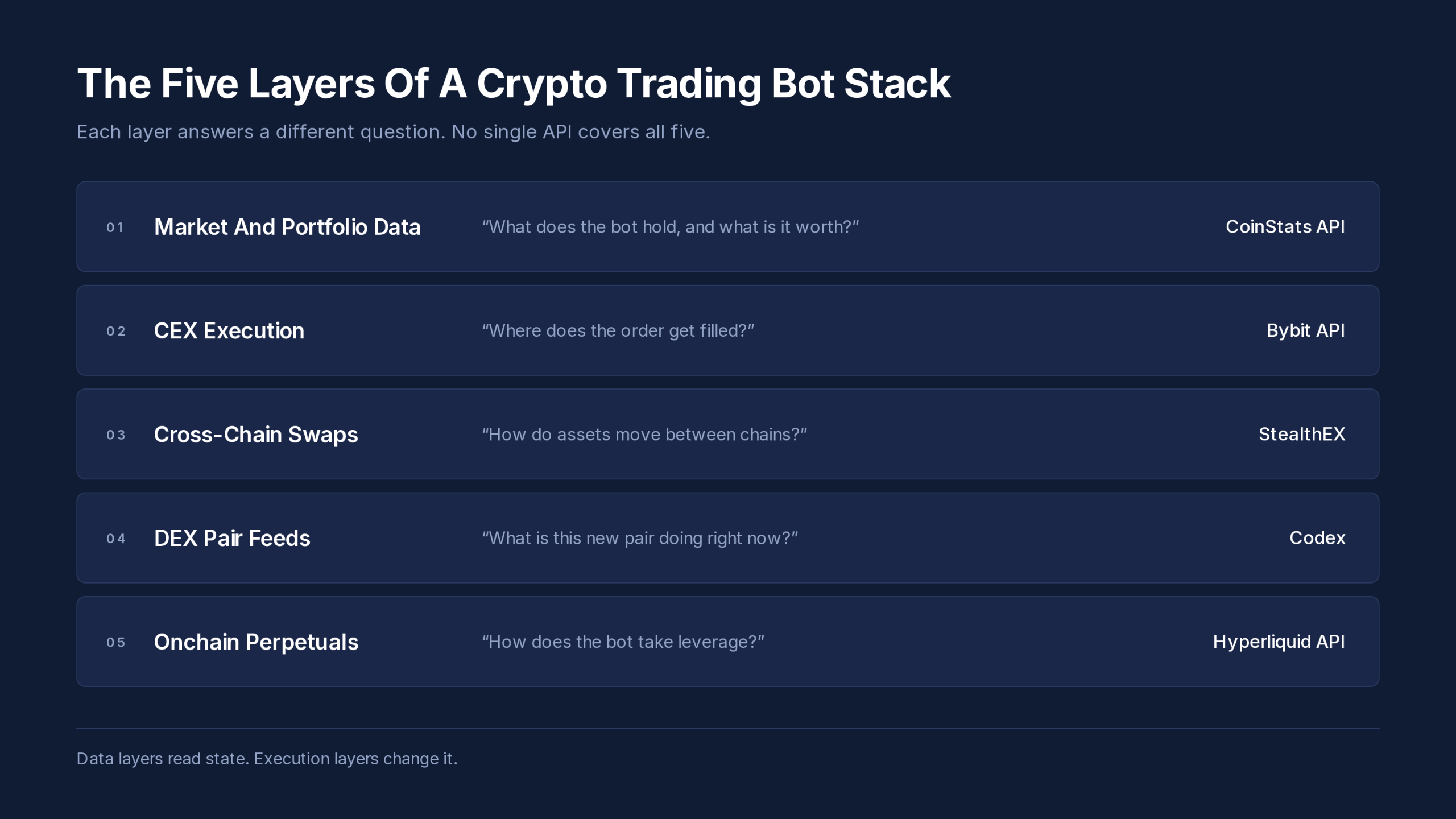
| Provider | Best For | Core Strength | Main Limitation |
| CoinStats API | Market data, wallet, DeFi, and portfolio state | Broad unified data behind one key, with MCP and agent payments | Data only, no trade execution |
| Bybit API | Centralized exchange execution | Spot, perpetuals, and options through one unified V5 spec | Single venue, and some regions are blocked |
| StealthEX | Cross-chain conversion inside a bot loop | Non-custodial swaps with no account step | No market data or analytics endpoints |
| Codex | Real-time DEX pair and token data | Sub-second onchain freshness across 80+ networks | Onchain only, and a steep jump to the paid tier |
| Hyperliquid API | Onchain perpetuals | Fully onchain orderbook with permissionless access | Venue-scoped, with volume-linked rate limits |
CoinStats Crypto API covers the data half of an automated system through a single key. It returns market prices, wallet balances, DeFi positions, portfolio analytics, news, and token risk signals in application-ready form, which removes the indexing and normalization work that usually sits between a bot and its first trade.
Its strongest fit is any strategy that has to know its own position. Coverage runs to 100,000+ coins aggregated from 200+ exchanges, with wallet and DeFi data across 120+ blockchains and 10,000+ protocols resolved per address automatically. Historical pricing reaches back roughly ten years, which is enough depth for most backtests. Portfolio endpoints return profit and loss and allocation directly, which is the input a rebalancing bot acts on rather than something it has to compute.
Two features matter specifically for automation. The Token Risks endpoint screens EVM contracts before execution and flags honeypots, hidden fees, mint and blacklist authority, and upgradeable proxies. Separately, the CoinStats MCP Server exposes the data as callable tools for language models over a single OAuth URL, and an x402 endpoint lets an agent pay per request in USDC on Base with no account and no API key. Developers comparing integration effort across providers can read this best crypto API guide.
Pricing is credit based. The free tier includes 20,000 credits per month at 2 requests per second, and the Starter plan is $49 per month for 1,000,000 credits at 30 requests per second. Basic market calls consume 1 to 2 credits, so continuous polling stays inexpensive, while wallet and DeFi calls cost considerably more and should be scheduled rather than looped. The API is REST only, so latency-critical strategies still need a streaming source alongside it.
Bybit is the execution venue in this list. Its V5 API unifies spot, linear and inverse perpetuals, futures, and options behind one endpoint set, with the product selected by a single category parameter. A bot that starts on spot and later adds leverage does not need a second integration to do it.
Live coverage is substantial. As of August 2026 the exchange lists 557 spot instruments, 807 linear perpetual and futures contracts, 26 inverse contracts, and 578 options series. Access runs over REST and WebSocket, including a dedicated order-entry stream and a Simple Binary Encoding feed for market data. A full testnet mirrors the production environment, which matters when the failure mode of an untested order path is a real fill at a real price.
Rate limits are the practical constraint to design around. Public endpoints allow 600 requests per five-second window per IP address, and exceeding that returns a temporary ban rather than a soft throttle. Private endpoints are limited per account and per endpoint, with order creation capped at 10 requests per second on derivatives and 20 on spot, scaling upward with VIP tier. Teams comparing venues on cost should read this breakdown of bybit fees and derivatives before committing.
API access itself is free with an account, since the revenue model is trading fees. Two limitations deserve a mention. There is no FIX API and no co-location product, and the institutional connection option is described in the documentation as a stability path rather than a latency advantage. Requests from United States and Mainland China IP addresses are also blocked, and several jurisdictions must route through separate regional hosts.
StealthEX handles the conversion step that data APIs deliberately leave alone. It is a non-custodial instant exchange covering 2,000+ coins and tokens, and end users never create an account to complete a swap. Standard crypto-to-crypto volumes carry no mandatory verification, with risk-based screening applied only to flagged transactions.
Removing the account step removes an entire class of failure from an automated system. A bot never handles a signup flow, never stores user credentials, and never blocks mid-strategy waiting on verification. That is why the API appears so often behind Telegram bots, wallet swap features, and treasury scripts that convert revenue to stablecoins on a schedule.
The REST API supports both fixed and floating rates through separate endpoints, and the choice has real consequences for a bot. Floating rates settle at market price on execution and can drift. Fixed rates lock the receive amount in advance, which is the safer default whenever the output of one step becomes the input of the next. Settlement typically completes in 5 to 30 minutes, so this is a rail for scheduled conversion rather than latency-sensitive arbitrage. Teams weighing alternatives can compare instant crypto swap aggregators on rate quality before integrating.
Integration is free with no monthly commitment, and the commercial model is revenue share rather than subscription. The standard partner fee is 0.4%, configurable from the partner dashboard, which turns swap volume into a revenue line instead of a cost line. The category limit is clear enough: StealthEX exposes no market data, no wallet endpoints, and no analytics, so it only ever functions as the execution half of a pair.
Codex serves bots that need onchain token data faster than a general aggregator delivers it. Tokens and pairs are indexed the moment they are created onchain, which is the difference between catching a listing and reading about it. For products where a pair that appears minutes late is a missed trade, that indexing speed is the entire value proposition.
Coverage reaches 70M+ tokens and 700M+ wallets across more than 80 networks, including Solana, Ethereum, Base, and the major EVM chains. Beyond prices, OHLCV candles, and holder data, Codex carries full prediction market data from venues including Polymarket, covering events, odds, traders, and order books. Delivery runs over a GraphQL API with WebSocket subscriptions and webhooks for event-driven systems, with data freshness stated at under one second. The same infrastructure serves TradingView, Coinbase, MoonPay, and Uniswap, which is a reasonable proxy for behaviour under production load.
Agent support is unusually well developed. Through the Machine Payments Protocol, an agent can query the full API at $0.001 per request with no account, no API key, and no billing setup, paying in USDC per call. Codex also ships agent skills for coding tools and an MCP server for documentation context, so an agent can discover the schema without custom middleware.
Pricing is where Codex asks for commitment. The free tier includes 10,000 requests per month at 5 requests per second, unlocked with a one-time $1 verification, and it excludes WebSockets, webhooks, wallet endpoints, and prediction markets. The Growth plan starts at $350 per month for 1,000,000 requests at 300 requests per second. There is nothing in between, so Codex earns its place on streaming depth rather than on cost. It is not an RPC provider and does not cover centralized exchange balances, so teams that need to submit transactions pair it with a node or exchange API.
Hyperliquid closes the stack with leverage. It runs a fully onchain perpetual and spot orderbook on its own layer one, where every order, cancel, trade, and liquidation is visible onchain with one-block finality. For a bot, that means execution and audit trail arrive from the same source, with no reconciliation step between what the exchange reports and what actually happened.
Live coverage sits at 177 active perpetual markets in the core universe, 324 spot pairs across 485 tokens, and nine builder-deployed perp venues launched under HIP-3. The API serves REST and WebSocket from a public endpoint with a matching testnet, and the protocol currently supports 200,000 orders per second. There is an official Python SDK, community Rust and TypeScript SDKs, and CCXT support for teams already running a multi-venue abstraction.
Access is permissionless, which changes the integration model. There are no API keys, no plans, and no signup. Signing agents authorize actions on behalf of an address. Rate limiting works on two axes: an aggregated IP budget of 1,200 request weight per minute, and an address budget of one request per USDC of cumulative volume traded, starting with a 10,000-request buffer. Active traders never notice the second limit, but it makes Hyperliquid unsuitable as a read-only data source for anything that does not trade.
Builder codes allow a bot or interface to attach a per-order fee, capped at 0.1% on perpetuals and 1% on spot, which gives automated products a native revenue path. The limitation is scope. Hyperliquid returns its own markets and nothing else, so the portfolio, cross-chain, and CEX context has to come from elsewhere. Readers evaluating the venue itself will find more in this Hyperliquid review and in this comparison of on-chain perps platforms.
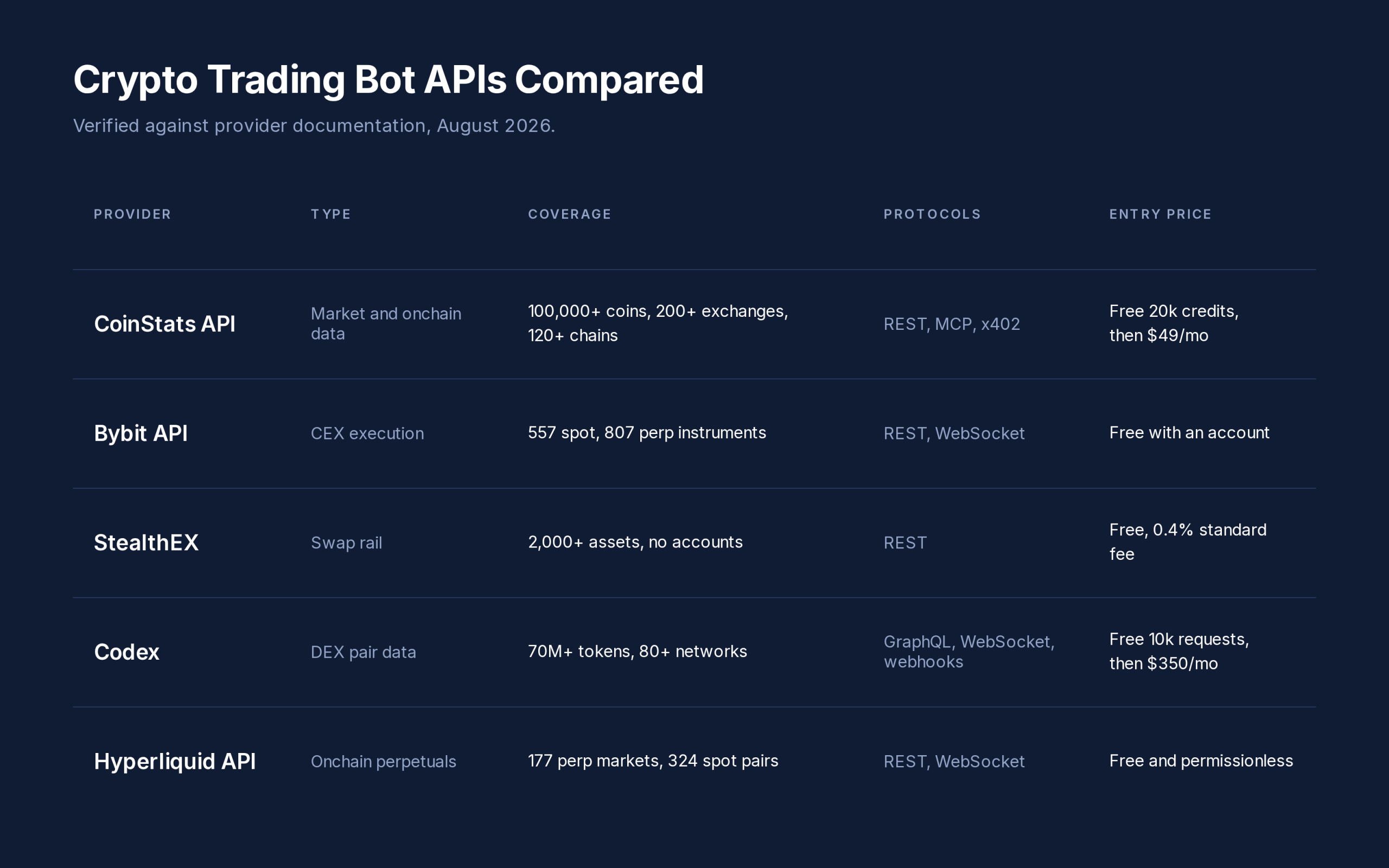
The five are not interchangeable, and ranking them on one axis produces the wrong answer. The right question is which job the bot cannot currently do.
CoinStats API is the best starting point for the data layer. Market prices, wallet balances, DeFi positions, portfolio analytics, and contract risk sit behind one key, which covers most bot requirements without a second integration, and MCP support makes the same data callable from an AI agent. Most builds can start there and add depth later.
Bybit API is the answer when the bot needs to place an order on a centralized venue with deep liquidity across spot, perpetuals, and options. StealthEX is the answer when assets need to move between chains without dragging a user through an exchange account. Codex adds streaming depth where a general aggregator is not fast enough, particularly for newly created pairs and long-tail tokens. Hyperliquid is the answer when the strategy needs leverage and prefers an onchain orderbook to a custodial one.
A common production stack pairs one data provider with one execution rail, then adds a third only when the strategy demands it. Every provider here offers a free entry point, so validating a combination costs integration time rather than budget. Teams that would rather not build the loop at all can start from existing automated crypto trading platforms and move to a custom stack once the strategy is proven. One layer sits underneath all five and is easy to forget: none of them replaces a node, so any bot that broadcasts its own transactions also needs an endpoint from one of the best rpc node providers. A wider survey of the category is available in this roundup of best crypto api providers in 2026, and a developer-side view of the same market appears in this developer breakdown of crypto APIs and this short video walkthrough.
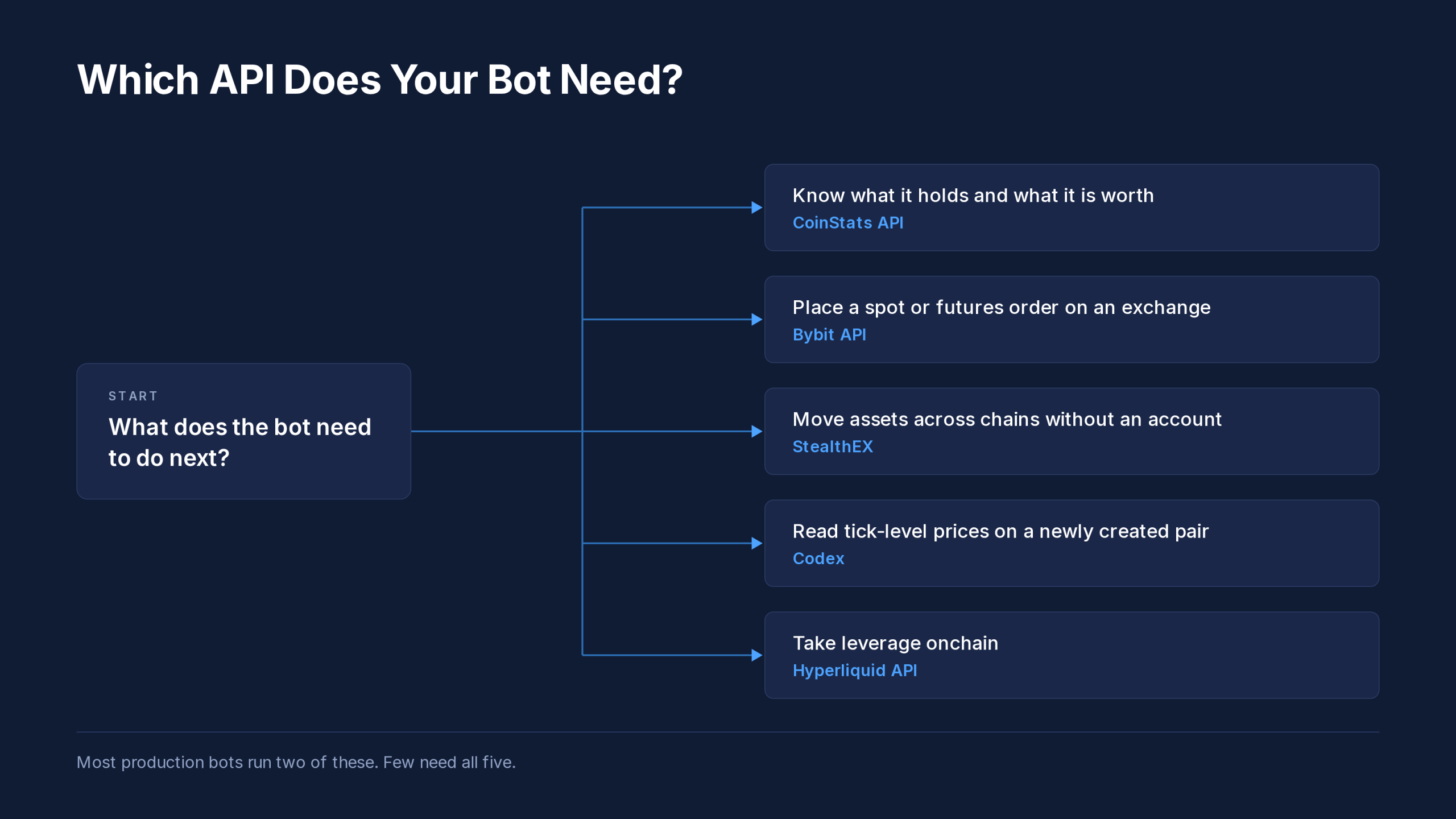
The best crypto APIs for trading bots in 2026 divide cleanly by function. CoinStats API is the strongest all-round data layer for market data, wallet, DeFi, and portfolio context. Bybit API is the execution venue for centralized spot and derivatives. StealthEX is the cleanest cross-chain conversion rail because it removes the account step entirely. Codex delivers sub-second onchain pair data for strategies that trade new listings. Hyperliquid API provides onchain perpetuals with a transparent orderbook and permissionless access.
Bots should be built around the job they need to do rather than the longest feature list. A strategy that cannot see its own position will misprice risk no matter how fast its execution is, and a strategy with perfect data and no execution rail is a dashboard. The stack that works is the one where every step in the loop has an API behind it that will still answer when markets are busy.
The post 5 Best Crypto APIs for Trading Bots in 2026 appeared first on Crypto Adventure.





