
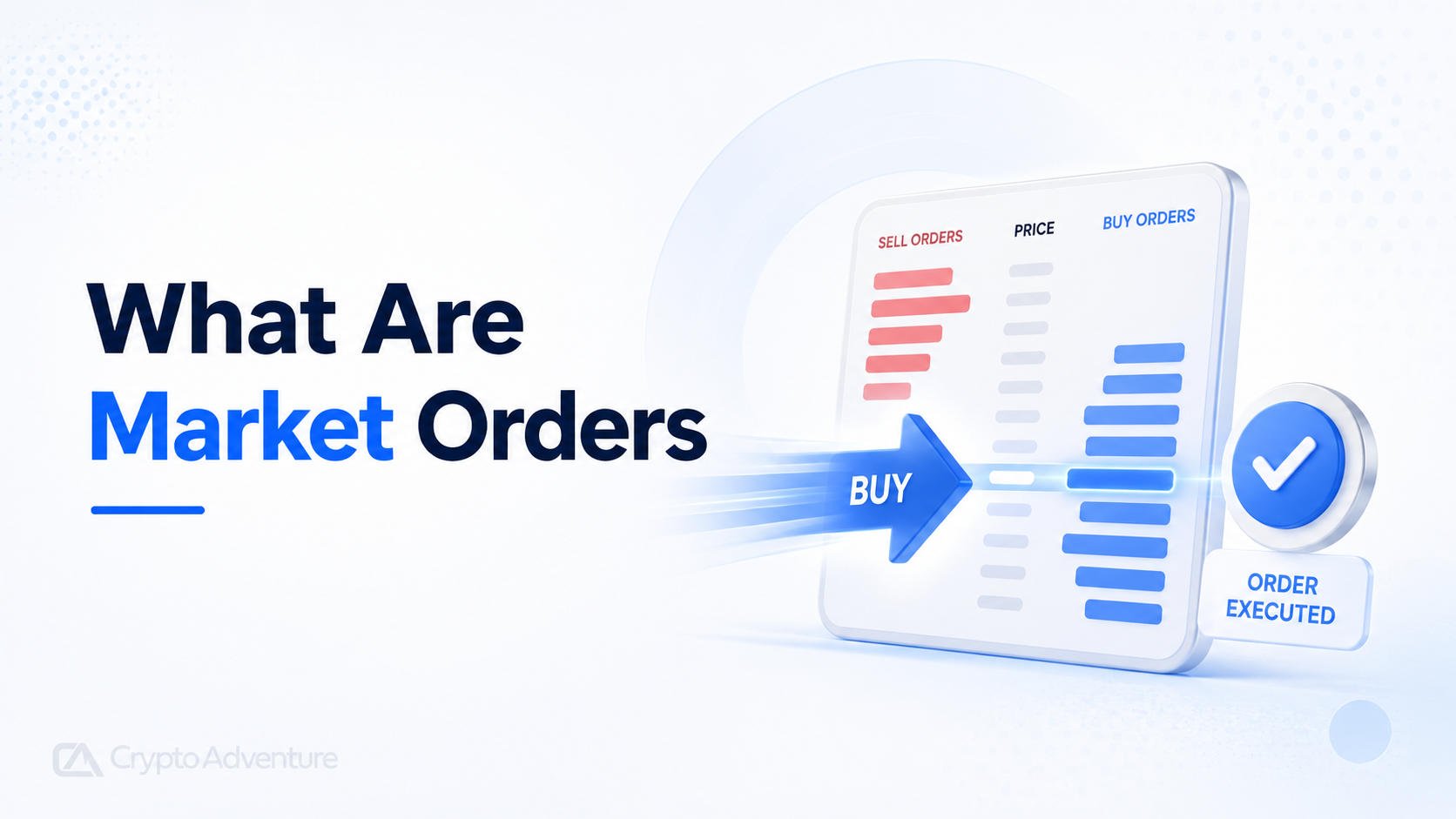
A market order is a trading instruction to buy or sell immediately at the best available price. It prioritizes speed over price control. In crypto, that can be useful when execution matters more than waiting. It can also be expensive when liquidity is thin, spreads are wide, or the market is moving quickly.
Market orders are common because they are simple. A beginner clicks buy or sell, enters an amount, and the exchange fills the order using available liquidity. The problem is that the final price is not guaranteed. The order can fill across multiple price levels, especially if the trade is large compared with the order book.
The beginner rule is simple: a market order gets the trade done, but it does not promise the price shown on the screen.
On an order book exchange, buyers place bids and sellers place asks. A market buy order takes the cheapest available sell orders first, then moves to higher asks if the trade size is larger than the first level. A market sell order takes the highest available bids first, then moves lower if more size is needed.
If the order book is deep, a market order may execute close to the displayed price. If the order book is thin, the order may move through several levels and fill at a worse average price.
This average fill price matters more than the first quoted price. A trader may see BTC at $90,000, place a large market buy, and receive an average fill above $90,000 because the order consumed multiple sell levels.
Traders use market orders when speed matters. A user may want to enter quickly after a breakout, exit during fast risk, close a position before liquidation, or buy a highly liquid asset without waiting for a limit order to fill.
Market orders are also easier for beginners because they do not require choosing a limit price. This makes them common in instant-buy interfaces. The exchange handles execution in the background, sometimes with a spread or conversion fee included.
That convenience has a cost. The more urgent the order, the more the trader gives up control.
Slippage is the difference between the expected price and the final execution price. Market orders are especially exposed to slippage because they accept available liquidity immediately.
A small market order on BTC or ETH may have low slippage during normal conditions. A market order on a thin altcoin can have heavy slippage. In fast markets, even liquid assets can slip because prices change while the order executes.
Order book depth, spread, and slippage are the real cost screen behind market orders. The posted trading fee is only one part of the cost. The spread and price impact can matter more.
A limit order gives the trader price control. The trader chooses the maximum buy price or minimum sell price. The order fills only if the market reaches that price. A market order gives up price control for faster execution.
If a trader wants to buy ETH only at $3,000 or lower, a limit order makes sense. If the trader wants to buy immediately regardless of a small price difference, a market order may be acceptable.
Limit-order protocols are important in DeFi because execution quality is not only about setting a price. It also depends on fillers, auctions, MEV, liquidity sources, and settlement design.
On decentralized exchanges, market-order behavior usually appears as a swap. The user accepts the current pool price and sets a slippage tolerance. If the market moves beyond that tolerance before the transaction confirms, the swap may fail. If the tolerance is too high, the trade may execute at a much worse price.
DEX swaps can also face MEV. Bots may see pending transactions, reorder them, or sandwich trades around them. This can make aggressive market-style swaps more expensive.
DEX trading gives users direct wallet access, but it also makes slippage settings and token verification the user’s responsibility.
In futures and perpetual markets, market orders are often used to enter or exit quickly. That speed can be useful during volatility, but leverage makes mistakes more expensive.
A market order can trigger taker fees, slippage, and worse liquidation risk if the entry is poor. A forced exit near liquidation may also execute at a bad price because many traders are trying to close at the same time.
Crypto perpetual futures require extra care because order types interact with margin, funding, liquidation price, and mark price. A market order is not just a click. It changes exposure immediately.
A market order can make sense when the asset is highly liquid, the trade size is small relative to book depth, the spread is tight, and the user needs immediate execution.
It can also make sense for emergency exits, especially when staying in the position is riskier than accepting slippage. In those cases, speed may be worth the cost.
Market orders are less suitable for thin altcoins, low-volume pairs, new listings, illiquid NFT-linked tokens, and volatile periods where price can jump between levels quickly.
The first mistake is using market orders on illiquid assets without checking depth.
The second mistake is assuming the displayed price is the final price.
The third mistake is ignoring spread. A wide spread creates an immediate cost.
The fourth mistake is trading too large relative to the book.
The fifth mistake is using market orders when a limit order would provide enough control.
The sixth mistake is using high slippage settings on DEX swaps without understanding MEV and price impact.
Beginners should check the order book before placing a large market order. They should compare the order size with visible liquidity, inspect spread, and consider breaking large trades into smaller orders.
For DEX swaps, users should review slippage tolerance and verify the token contract. For futures, traders should understand taker fees, liquidation price, and reduce-only settings before using market exits.
A market order is best treated as a tool for urgency. If there is no urgency, a limit order often gives better control.
A market order buys or sells immediately at the best available price. It is simple, fast, and useful when execution matters. It can also be expensive because the trader accepts slippage, spread, and available liquidity.
Beginners should use market orders carefully, especially on small tokens, DEX swaps, and leveraged trades. The final execution depends on depth, volatility, spread, and trade size. A market order is not wrong by default. It is just the order type that gives the market control over price.
The post What Are Market Orders? Beginner’s Guide To Fast Crypto Execution appeared first on Crypto Adventure.





