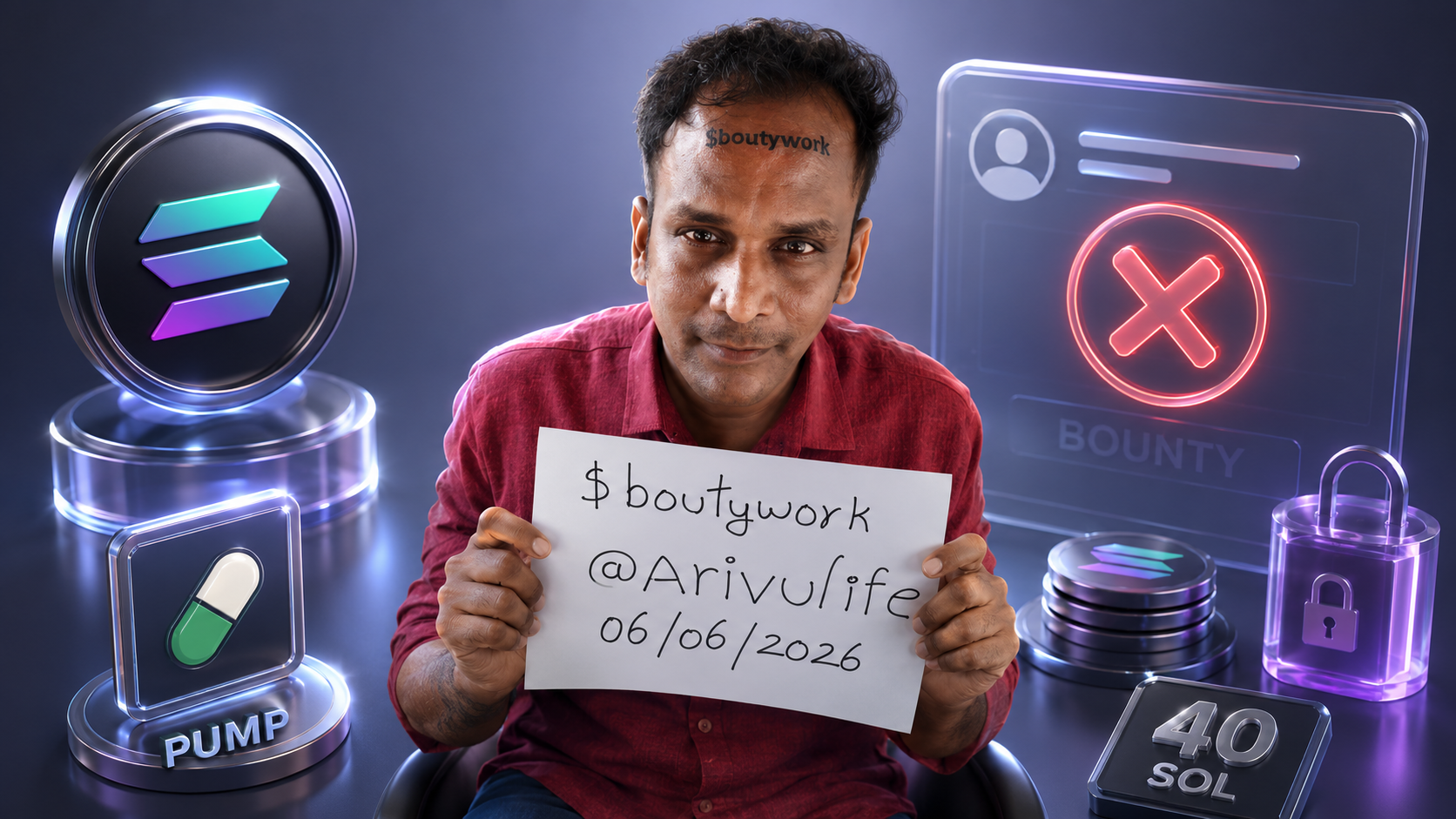
A Pump.fun GO bounty has turned into one of Solana’s strangest memecoin stories after an Indian X user got a token ticker tattooed on his forehead and then became caught in a dispute over one missing letter.
The task was tied to Pump.fun’s new GO bounty marketplace, which launched with the pitch that users could pay anyone to complete almost any task. One bounty offered 40 SOL, worth about $2,570 at the current SOL price, for someone willing to tattoo a token ticker on their forehead.
Arivu, who posts under @Arivulife, completed the tattoo and uploaded proof. The problem came after the fact. The tattoo read “$Boutywork,” while the intended ticker was “$Bountywork.” Arivu later argued that he had copied the wording exactly as written in the bounty prompt, saying the mistake was not his because the task itself used the misspelled version.
The bounty poster, @ayushquantt, then publicly asked whether he should still pay after seeing that the tattoo used the wrong ticker. That turned the 40 SOL bounty into a live moderation test for Pump.fun’s new task market: should a user be paid for completing the written prompt, or rejected because the prompt itself contained the wrong ticker?
The dispute quickly escaped the original bounty. Solana traders launched a separate BOUTYWORK token on Pump.fun, using the misspelled tattoo as the center of the narrative. The token reached hundreds of thousands of dollars in market cap within hours, while DEXScreener tracked heavy early trading across PumpSwap liquidity.
That is how fast Pump.fun’s attention economy now moves. A disputed bounty, a spelling mistake and a permanent tattoo became enough to create a second tradable asset. The failed or delayed payout became less important to traders than the meme itself.
The episode lands only weeks after Pump.fun added USDC pairs for new coin launches, giving creators more ways to launch and price new tokens. Earlier market data also showed Pump.fun traders flipping back into profit after a long stretch when losing wallets dominated the platform’s retail cycle.
The tattoo dispute shows the difficult edge of Pump.fun’s GO model. Bounties can create instant engagement, but they also create judgment calls around risky tasks, unclear instructions, staged performance, identity verification and final payout decisions.
A typo might seem minor in a normal online post. In this case, it became the difference between “completed exactly as written” and “wrong ticker.” The user carried the cost physically, while the bounty creator, Pump.fun moderators and traders all became part of the settlement drama.
The broader risk is that GO turns human behavior into token fuel. A bounty can push someone to perform a public stunt, create content, accept reputational risk or, in this case, permanently mark their body. If the rules are vague, the person doing the work may carry the real-world cost while the market keeps trading around the spectacle.
For Pump.fun, the BOUTYWORK dispute is more than a viral joke. It is an early test of whether its new bounty marketplace can handle extreme tasks, ambiguous prompts and payout conflicts before the next stunt becomes even harder to unwind.
The post Pump.fun Tattoo Bounty Turns Into BOUTYWORK Spelling Fight appeared first on Crypto Adventure.





