The pioneer cryptocurrency, Bitcoin, is up 1.84% during Friday’s U.S. market hours to currently trade at $73,106. The uptick stems from a broad relief rally, as the absence of fresh geopolitical conflict has preserved the fragile truce between the U.S., Iran, and Israel. However, the on-chain data highlights two major resistances against a rising Bitcoin price before buyers can gain stability for a renewed recovery trend.
Bitcoin price is trading at around $73 000, which is just $3,700 lower than the average value of the BTC accumulated by major US spot ETFs. Any near-term price increases at this point provide selling opportunities to those who joined at higher levels and are underwater.
Meanwhile, Short-term holders have an average cost basis of $84,200, which exposes them to huge unrealized losses in the current market. Conversely, long-term holders hold on to about 42,500 shares and are less motivated to sell.
US ETFs represent a net asset-weighted average cost of volume of $76,700. This is the exact point at which these big institutional vehicles change their status from making losses to breaking even on their holdings.
Thus, the dynamics of supply occur in two distinct layers. The short-term resistance is at $76,700, which is at the ETF cost levels. Selling pressure would be relieved by breaking above it as soon as these funds hit neutral ground. Remaining below sustains distribution from institutional positions.
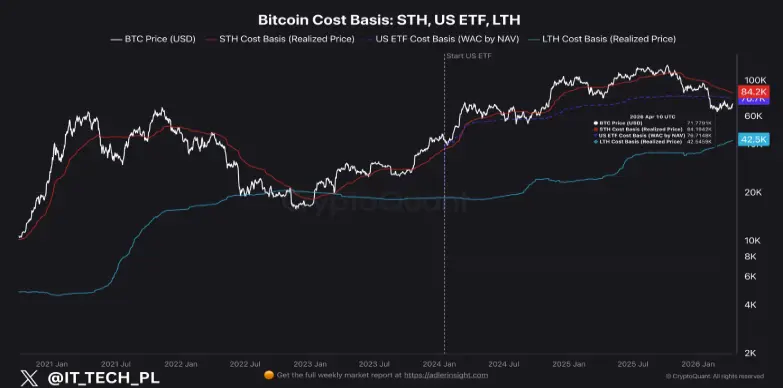
The increased resistance at $84,200 due to new entrants of buyers remains secondary. The long-term holders continue to have minimal selling influence during the long term.
In the last two weeks, the Bitcoin price showcased a slow yet steady recovery from $65,000 to $73,193, registering a loss of 13%. This uptick aligns with a steady rise in trading volume as market sentiment turned positive following the two-week ceasefire announcement.
With today’s uptick, the Bitcoin price challenges the downsloping resistance trendline of the falling channel pattern in the daily chart. Since early October 2025, the price of BTC has actively resonated within two parallel trendlines as they receive dynamic resistance and support from them.
Therefore, a potential breakout from this resistance will signal a major change in market sentiment and bolster the price to drive a further recovery. The recently reclaimed 20-and 50-day EMA slopes offer additional support to recovering the BTC price.
The post-breakout rally could push the asset 15% up to challenge the $84,500, followed by a leap to $98,300.
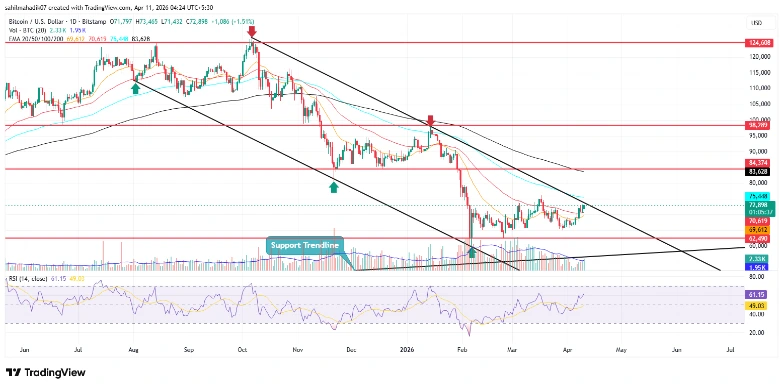
On the contrary, if the channel resistance stands firm and the BTC faces constant supply pressure, the price could plunge 15% down to test the immediate support of $62,720. This reversal could spark a fresh correction cycle within the channel pattern.





