A ten-month, on-chain comparison of cumulative returns across direct FLOW staking, ankrFLOW liquid staking, and the ayFLOW vault, and why the 12-percentage-point gap matters more than the headline number.
Three weeks ago we published the first nine-month retrospective on ayFLOW: 18M FLOW in TVL, $210K in cumulative USD profit, the staircase TVL pattern that signals real depositor behaviour rather than emissions-driven inflation. That piece answered one question: what does ayFLOW look like in absolute terms.
This piece answers the question we were getting in the replies: how does that actually compare to just staking FLOW directly, or holding ankrFLOW and letting the validator rewards compound?
So we ran the comparison. Same ten-month window, same starting capital, three options. Every figure verified directly from on-chain data, the same way every yield figure we publish gets verified. Here is what ten months of cumulative return looks like across all three:
As at August 2025, a FLOW token holder had three options.
They could stake directly with a validator and earn the network’s base reward. They could convert FLOW to ankrFLOW, the liquid staking version, and earn a slightly lower yield in exchange for keeping the position transferable. Or they could deposit into ayFLOW, the AlphaYields strategy on Flow blockchain that uses ankrFLOW as its base layer and runs it through automated looping, lending, and arbitrage.
Ten months later, the gap between those three paths is the entire story.
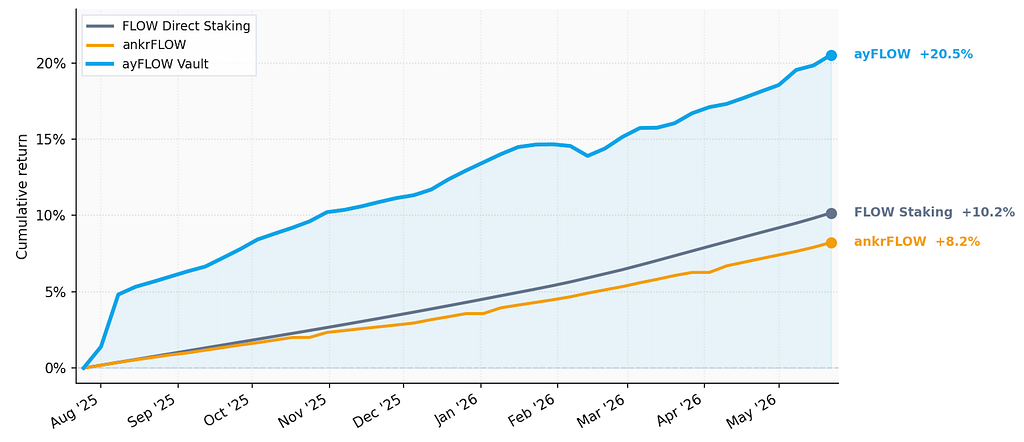
The gap between the top line and the bottom two is what this article exists to explain. We’ve also done what most yield products avoid doing: showed where the strategy briefly underperformed, and why the comparison still holds.
Direct FLOW staking pays one source of yield: validator rewards. That’s it. Whatever the validator earns, you earn proportionally, less commission. The line is linear because the yield source is linear.
ankrFLOW pays the same validator rewards in a transferable wrapper, with a small operational drag from the liquid staking layer. Same source, slightly less yield, more flexibility.
ayFLOW uses ankrFLOW as a base layer; capturing those same validator rewards, and stacks additional yield on top of them. Three sources, roughly speaking:
• Looped lending on MoreMarkets. The Strategy Engine supplies ankrFLOW as collateral on MoreMarkets, borrows FLOW against it, and re-deposits the borrowed FLOW back into the position. Done within conservative LTV thresholds and health-ratio limits, this compounds base staking yield with the borrowing-lending spread. The yield isn’t free, it has real liquidation risk if FLOW deviates sharply against ankrFLOW. That risk is what the strategy engine continuously monitors.
• Cross-DEX arbitrage on Flow-native venues. When pricing dislocations appear between FLOW pools on different DEXs, small but persistent in fragmented liquidity environments, the engine captures the spread. Across the ten-month window, this added roughly $400K in arbitrage volume to the position.
• Lending rate divergence capture. When the supply rate on one Flow lending market exceeds the cost of borrowing on another, the engine routes capital toward the spread. Small per-trade. Continuous in aggregate.
None of this is exotic. The mechanisms are the same primitives traditional DeFi yield strategies use elsewhere. What’s different is that nobody else is running them systematically on Flow against the ankrFLOW base layer.
Before we get to the ayFLOW line, the order of the bottom two is worth pausing on.
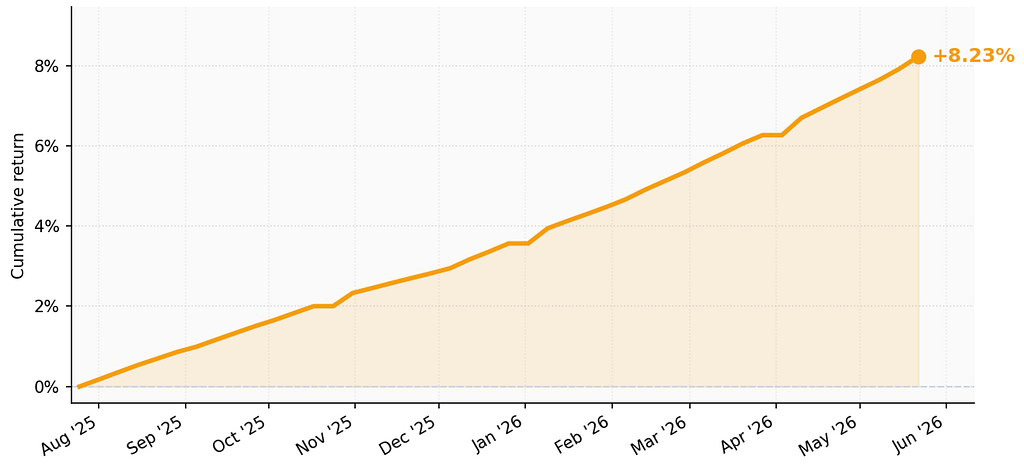
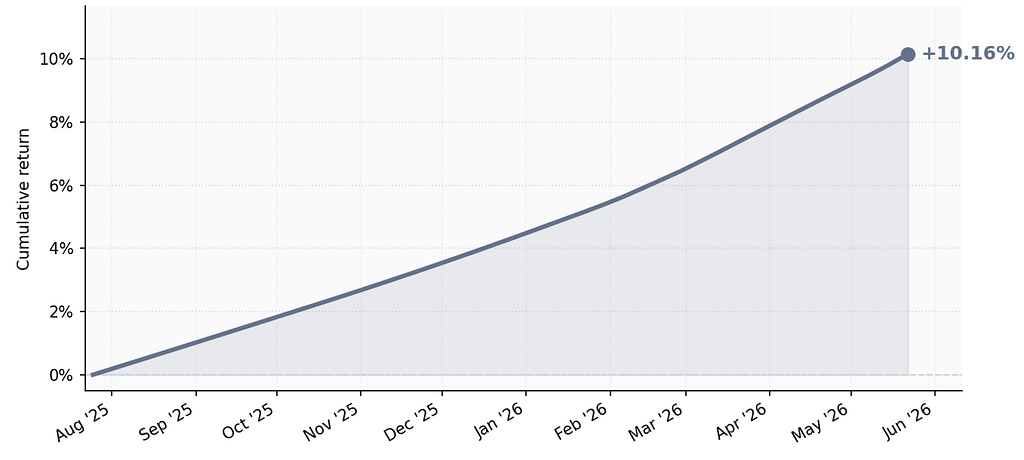
Direct staking; delegating FLOW to a validator, earned 10.2% over the period. ankrFLOW, the liquid staking version of the same delegation, earned 8.2%. That’s a 2 percentage point gap in favor of doing the more inconvenient thing.
The gap exists because liquid staking isn’t free. Ankr takes a protocol fee on the staking rewards in exchange for issuing a transferable token. There’s also a small market spread between ankrFLOW and FLOW prices that varies with liquidity conditions. Both factors compound over time.
This is a tradeoff most yield articles gloss over. Liquid staking gives you a token you can use elsewhere in DeFi. Direct staking gives you a higher raw yield but locks you out of every composable strategy. If you’re never going to use the ankrFLOW token in any other DeFi position, ankrFLOW costs you 2% a year for no return.
ayFLOW exists because the ankrFLOW token should be used in something else. That’s the whole point of liquid staking. Holding it idly defeats the design.
The ayFLOW vault accepts FLOW deposits, converts them to ankrFLOW under the hood, and then runs that ankrFLOW through three layered yield sources.
First, the base ankrFLOW staking yield continues to accrue. The deposit is still earning the underlying network reward.
Second, the strategy supplies ankrFLOW as collateral on MoreMarkets, the largest lending protocol native to Flow, and borrows FLOW against it. Because ankrFLOW and FLOW are correlated assets (one is the staked version of the other), the borrow is positioned as a “correlated loop” rather than a directional bet.
The borrowed FLOW is then re-staked or routed into additional ankrFLOW, and the cycle repeats within conservative leverage and health ratio thresholds.
Third, the engine captures pricing dislocations across Flow’s native DEXs and lending venues; pool imbalances, lending rate divergences, LP rebalance windows. These are individually small but compound over a 10-month window into a meaningful share of the return.
The 20.5% cumulative line in the chart is the sum of all three sources, net of transaction costs and protocol fees. None of it comes from token emissions. None of it depends on FLOW price appreciation. The mechanism would have produced the same shape against a flat or declining FLOW market, the returns are denominated in FLOW, not USD.
The February dip
There’s one visible imperfection in the ayFLOW line. In late February 2026, the strategy retraced briefly, dropping from around 14.7% cumulative to 14.0%, before resuming its climb.
The direct staking and ankrFLOW lines show no such dip. That’s diagnostic. The drawdown was strategy-specific, and the cause was competitive, not structural.
During that window, additional looping strategies moved into the same MoreMarkets positions that ayFLOW depends on. The added demand for borrow liquidity tightened what was available and pushed borrowing rates higher across the venue. For a short period, that made part of the leverage loop uneconomic to hold, so the Strategy Engine did the disciplined thing: it partially unwound the affected leg rather than carry a position at a compressed spread.
The elevated rates were costly for every participant competing for that liquidity, ourselves included. But the engine’s mandate is to protect depositor capital first and defend market position second, and it did both. We stayed in the contest for a meaningful share of the Flow looping market and held it. Once liquidity conditions normalized, ayFLOW re-entered at scale and resumed its climb with its market position intact. The recovery took roughly three weeks, with no governance announcement, no peg break, and no emergency intervention.
The thing to notice about the chart isn’t the 20.5% number. It’s the shape of the spread between the lines.
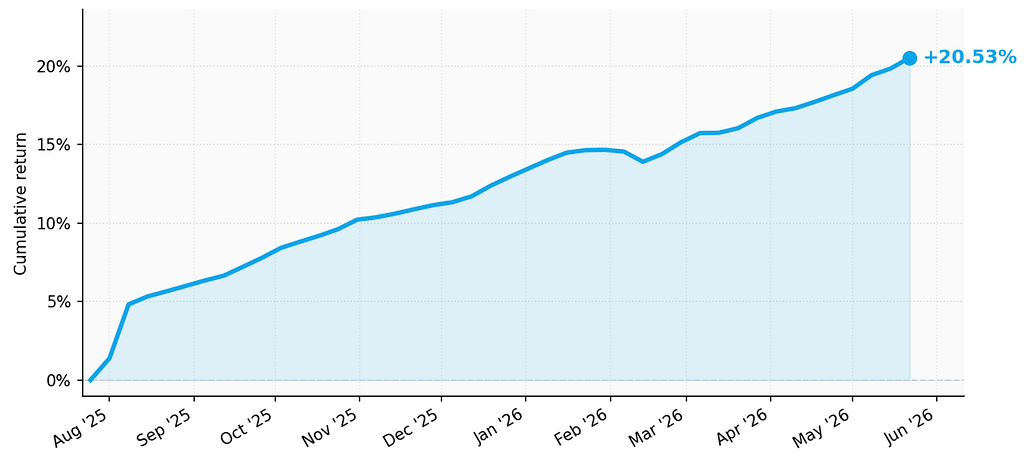
The ayFLOW line accelerates away from the benchmarks early, the sharp August 2025 jump, and then maintains a consistent slope above them for the entire rest of the period. The gap isn’t narrowing over time. It’s widening, slowly but unmistakably.
That widening is what compounding looks like when one curve is producing yield from three sources and the other curve is producing yield from one. Even if the per-block return advantage is small, the difference compounds across thousands of blocks. By month ten, the additive effect is the entire 12 percentage point gap over ankrFLOW.
This pattern is what serious capital allocators are looking for when they evaluate any yield product. A higher headline APY in any given week is meaningless. A persistently steeper slope across market conditions is the only signal that matters.
A few things this comparison doesn’t claim.
It doesn’t claim that ayFLOW will produce 20.5% cumulative returns over the next ten months. Market conditions change. Funding rates compress. Lending utilizations shift. The forward expectation should anchor closer to the average annualized return over the period, not the cumulative number.
It doesn’t claim that direct FLOW staking is a bad option. For a holder who wants the lowest possible operational complexity and zero smart contract exposure beyond the validator delegation itself, direct staking is the most defensible passive choice on Flow.
And it doesn’t claim that ayFLOW is risk-free. The strategy uses leverage. It depends on the continued solvency of MoreMarkets, the continued peg stability of ankrFLOW, and the continued availability of Flow-native DEX liquidity. We monitor all three continuously, but they are real exposures and they should be priced into any allocation decision.
What the chart does prove is the gap. The gap is real, it’s been live for ten months, and the methodology that produced it is the same methodology being applied to every other strategy in the AlphaYields system.
ayFLOW was the first proof. ayUSD is the next application of the same engine.
The looping mechanics, the strategy diversification, the on-chain APY verification methodology, and the drawdown discipline that produced the chart above are the same components being deployed across the broader ayToken family: ayUSD for stablecoins on Flow EVM, with cross-chain routing via LayerZero to Ethereum, Arbitrum, and Base. Future ayETH and ayBTC products will use the same framework adapted to those asset classes.
The point of publishing this comparison isn’t to convince a FLOW holder to deposit into ayFLOW today. It’s to demonstrate the methodology that gets applied across every position in every ayToken, and to do it with live, on-chain data instead of a pitch deck.
What is ayFLOW?
ayFLOW is the AlphaYields strategy on Flow blockchain. It accepts FLOW deposits, converts them to ankrFLOW (the liquid staking version), and then runs that ankrFLOW through layered yield sources including correlated lending loops on MoreMarkets and arbitrage capture across Flow-native DEXs. The result is a single liquid token that compounds three yield streams simultaneously.
How does ayFLOW outperform direct FLOW staking?
Direct FLOW staking earns only the network validator reward. ayFLOW earns the same base yield through ankrFLOW, then adds two more layers: a correlated lending loop on MoreMarkets that multiplies the position within conservative leverage thresholds, and arbitrage capture across Flow’s DEX and lending markets. Over the 10-month window measured, this stacking produced a cumulative return of 20.5% versus direct staking’s 10.2%.
Why does ankrFLOW return less than direct FLOW staking?
Ankr charges a protocol fee on staking rewards in exchange for issuing a transferable liquid staking token. There’s also a small market spread between ankrFLOW and FLOW prices that varies with liquidity conditions. Holding ankrFLOW idly without using it in other DeFi positions costs roughly 2% a year compared to direct staking. ayFLOW exists to recover that gap and more by routing the ankrFLOW token into productive strategies.
What’s the difference between ayFLOW and ayUSD?
ayFLOW is denominated in FLOW and built around Flow-native yield primitives. ayUSD is denominated in stablecoins and routes across a different set of underlying vaults: Curve LlamaLend, Morpho, Lagoon, and others; accessed via Flow EVM with cross-chain support through LayerZero. Both products use the same allocation engine, drawdown methodology, and on-chain APY verification framework.
The asset class is different. The discipline is the same.
ayFLOW is live on the Flow blockchain. ayUSD launches on Flow EVM with cross-chain access via LayerZero, expanding to Ethereum, Arbitrum, and Base. Every position is verified directly from on-chain share-price data and published on a recurring cadence.
The 20% Yield Gap: How ayFLOW Outperformed FLOW Staking by 2x Over 10 Months was originally published in Coinmonks on Medium, where people are continuing the conversation by highlighting and responding to this story.





