In order to understand better the mission and principles of Distributed Autonomous Organizations (DAO), you have to look into history. The article outlines the benefit of autonomous organizations, by using the example of commons management and some ground-breaking research studies in this area from the last century.
Let’s get the term DAO defined first:
A decentralized autonomous organization (DAO), sometimes labelled a decentralized autonomous corporation (DAC), is an organization represented by rules encoded as a computer program that is transparent, controlled by shareholders and not influenced by a central government. A DAO’s financial transaction record and program rules are maintained on a blockchain. (Source)
But why the heck Törbel then, a mountain village itself located in the Vispertal trench of the upper Valais canton of Switzerland.?

Well the argument is rooted in the work of two famous academics who studied in Törbel:
When I started researching the root of DAO’s I got surprised by the fact, that a Swiss mountain village played a pivotal role in early research work about autonomous decentralized communities. And even better with the village-associated mountain pasture “Moosalp” — which played a central role in this research work — I have a personal relationship. The mountain pasture is the home of a lovely tiny restaurant, which was our daily meeting point almost twenty years ago when our kids learned skiing.

Elinor Ostrom, the American lady in the picture below was mainly responsible for making Törbel well-known in the international world of political science.
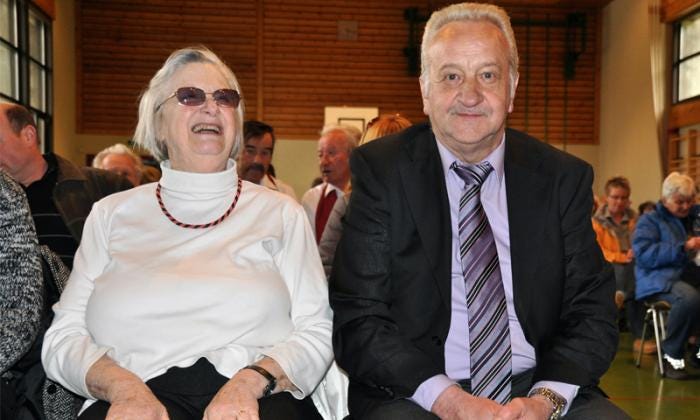
It’s Elinor Ostrom (died 2012), an American political economist, which was studying the village as part of her ground-breaking book “Governing the Commons” (1990, Cambridge). She was awarded in 2009 the Nobel prize for Economic Science for her “analysis of economic governance, especially the commons ”. By the way, the only woman up to now who was elected for the Nobel prize in Economic Science.
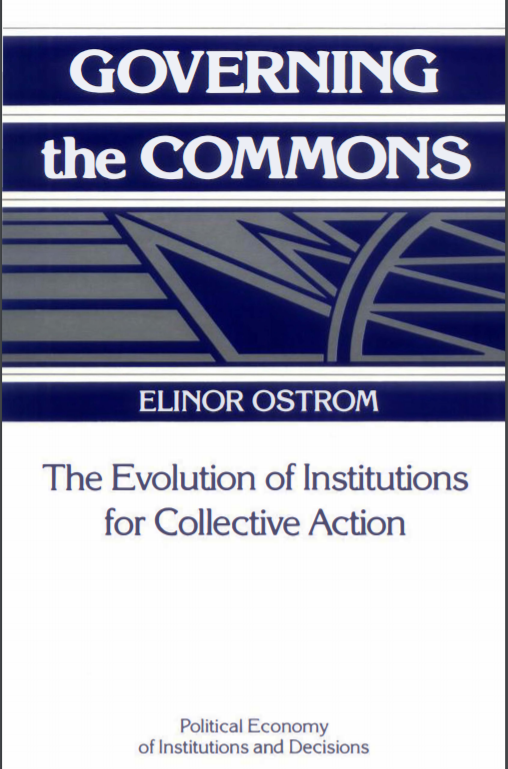
As you may have realized the term commons plays a key role up to now, so it’s time to give a short definition of the term in the context of political economics.
The commons is the cultural and natural resources accessible to all members of a society, including natural materials such as air, water, and a habitable earth. These resources are held in common, not owned privately. Commons can also be understood as natural resources that groups of people (communities, user groups) manage for individual and collective benefit. Characteristically, this involves a variety of informal norms and values (social practice) employed for a governance mechanism
This is the classical definition, but the rise of the Internet introduced new commons, as for example “Information” and Knowledge” which is available for free and everybody via the internet. These new commons will be part of another article, so let’s stay with the history.
Törbel got first in focus in 1972 when the American anthropologist Robert Mc Netting was doing his field study of the local community in the context of historical-cultural ecology aspects. He particularly looked at the long-term relationship between demography‚ production‚ and a limited resource base.
Robert — who spoke German — lived for two years in the small alp village and got the opportunity to study all the community and parish books of the last 350 years which outlined how the community was regulating the commons. He produced his findings in his book “ Balancing on an Alp — ecological change and continuity in a Swiss mountain community ” (Google Books). The first section of the Foreword of the Book introduces some interesting concepts.
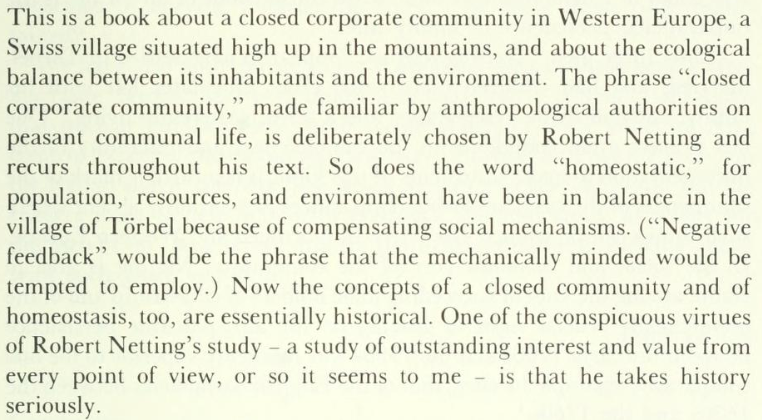
The phrase “Closed Corporate Communities” goes back to the 1950ies and was introduced by Eric Wolf in an analysis of peasant communities in “Central Java and Mesoamerica“
Closed Corporate Peasant Community (CCPC) is an organizational framework for analysis of peasant communities developed by anthropologist Eric Wolf in the 1950s. Wolf applied his typology of peasant organization to communities in Central Java and Mesoamerica. The CCPC, according to Wolf, is a “relatively autonomous economic, social, linguistic, and politico-religious system.” The community is corporate because it maintains a body of rights and membership, and closed because it limits its benefits to members and discourages participation with the larger society. [Source]
Netting re-used the term “Closed Corporate Community” in his book and he found out that since1483 the villagers were regulating their commons via a formally signed article (body of right), which covered
five types of communally owned property: the alpine grazing meadows, the forests, the “waste” lands, the irrigation systems, and the paths and roads connecting privately and communally owned properties… Access to well defined common property was strictly limited to citizens, who were specifically extended communal rights.
Netting introduced the Homeostatic explanatory model which describes the three forces of “Resources”, “Environment” and “Population” which were held in a long-term balance in the community model of Törbel.

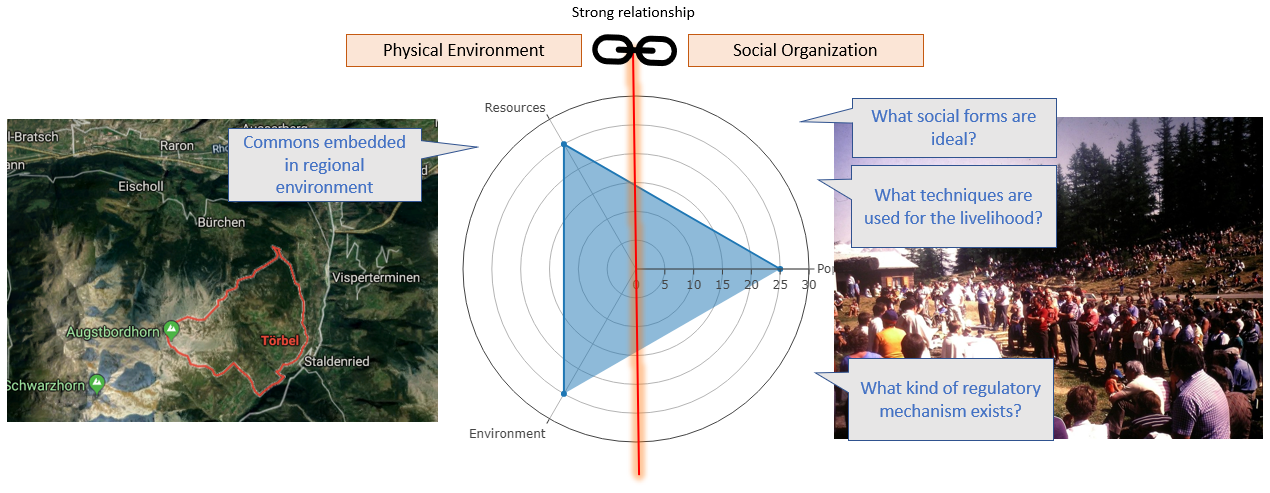
He drew upon the biological model to understand how human societies maintain equilibrium within their environment. The core components of this model, independent of the DAO context, are derived from the classic cybernetic and physiological concepts of a self-regulating feedback loop
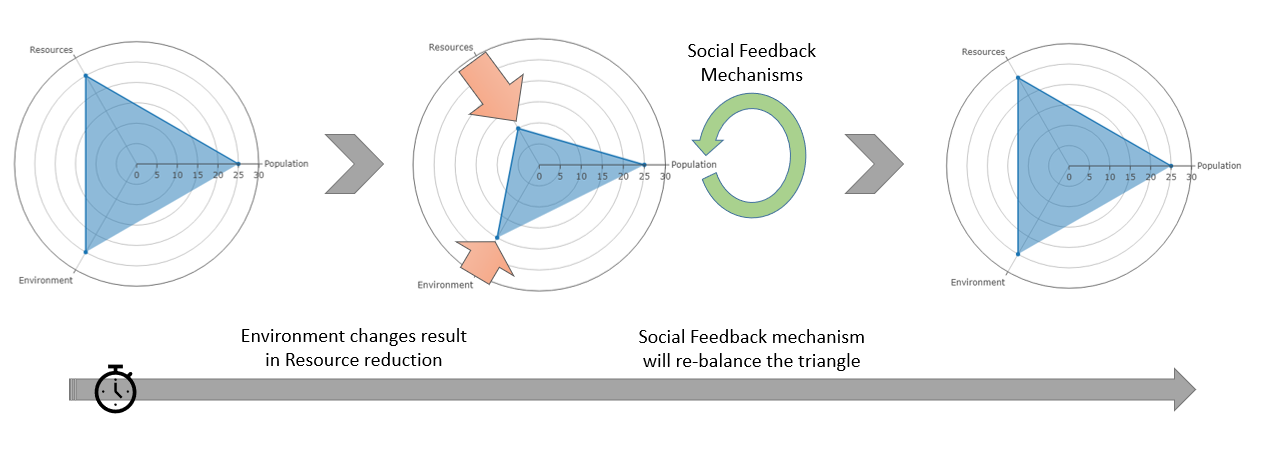
As he stated
As far as the summer grazing grounds were concerned, regulations written in 16th century stated that no citizen could send more cows to the alp than he could feast during the winter. Thus limiting individuals to the number of animals which their own hay meadows could support and severely fining them for any attempt to appropriate a larger share of community grazing privileges. This rule continues to been forced to the present day.
The biological Homeostatic model is made up of three core components (Set-Point, Sensors and Controllers), which Netting applied to his field study
The Regulated Variable (The Goal/Set-Point)
In the biological model, this is the internal condition that must be held constant (e.g., body temperature, blood glucose). In Netting’s work, this translates to:
Detection and Measurement (Sensors)
This is the system’s ability to monitor the regulated variable.
Regulatory Mechanisms (Controller and Effectors)
These are the compensating actions taken to counteract the deviation and return to equilibrium, often operating via negative feedback.
Elinor Ostrom extended Robert McNetting’s fieldwork in Törbel by moving beyond documenting the ecological and social adaptation of peasant farmers and focusing on the institutional frameworks that enabled long-term sustainable management of common resources.
She used Törbel as a foundational case study for her landmark analysis of common pool resources (CPR) in her book Governing the Commons.
She systematically studied the institutional rules, customs, and community governance that allowed the villagers to collectively manage shared resources (like the bisses, or irrigation channels) for centuries without resource collapse. She came to conclusion
that from a long-term perspective common resources managed by autonomous communities are better managed than the one, owned by private- or government bodies.
Ostrom identified and articulated in her Nobel-winning research “Eight Principles for Managing the Commons”, based on case studies like Törbel.
The fieldwork and research findings of Robert Mc Netting in the early seventies and Elinor Ostrom in the nineties of the last century where building up a globally influential framework for governing and sharing shared resources.
They are often cited as a blueprint for successful DAO governance, we will look in a upcoming article how the principles and model are applied to modern DAO governance models.
AI was used as a powerful assistant during researching the topic, by using the AI Engines
Are the roots of Crypto DAO’s in the Swiss mountain village of Törbel? was originally published in Coinmonks on Medium, where people are continuing the conversation by highlighting and responding to this story.