According to a fresh analysis published by DWF Ventures on August 15, 2025, Hyperliquid’s decentralized perpetual exchange has climbed to a record 6.1% market share against centralized exchanges (CEXs), cementing its role as a serious rival to traditional futures platforms. The report traces Hyperliquid’s rapid evolution — from its early days as an Arbitrum-based PerpDEX to the launch of its own Layer 1 chain, HyperEVM, and the landmark $HYPE token airdrop that accelerated adoption.
One factor behind Hyperliquid’s rapid adoption was its historic 2024 airdrop, which allocated 31% of $HYPE supply to over 90,000 wallets. Unlike most protocols, Hyperliquid had no VC backers, ensuring distribution was retail-heavy. This gave everyday traders ownership from the start, aligning incentives with active users rather than institutional investors.
That early strategy explains why engagement has stayed consistently high. Tokenholders feel more empowered in governance, and distribution is less concentrated compared to venture-backed projects.
Hyperliquid is a high-speed on-chain trading platform designed for decentralized perpetuals. It stands out for:
It’s one of the few platforms where you can trade fully on-chain without sacrificing speed or user experience.
Want to start trading on Hyperliquid and get a bonus?
🔗 Click here to get started
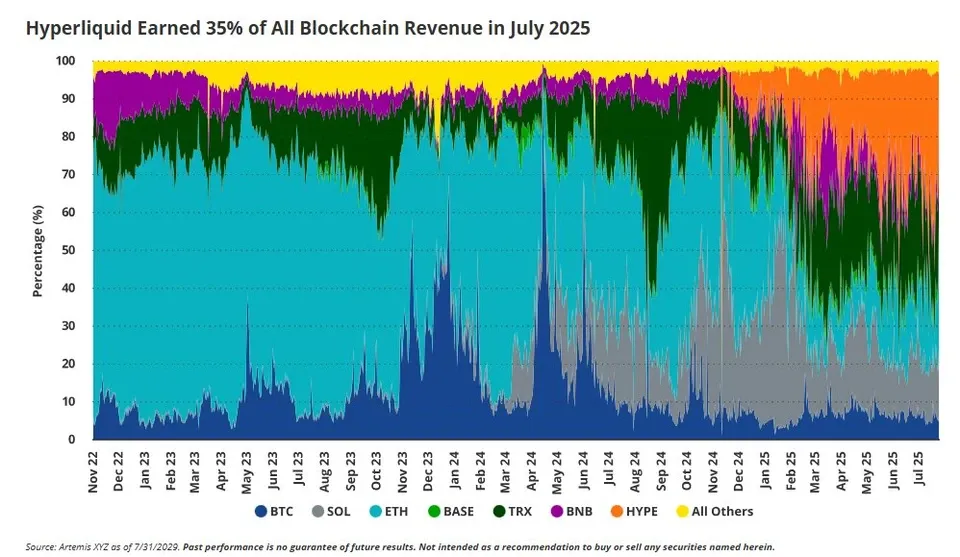
In July 2025, Hyperliquid captured a 35% market share in blockchain fee revenue, outperforming Ethereum, Solana, and other top L1s. The surge is not just symbolic — it demonstrates a fundamental shift of liquidity from centralized exchanges (CEXs) to DeFi infrastructure.
Data shows Hyperliquid already commands a 6.1% share of the global derivatives market, steadily eating into the order flow of Bybit and OKX. With faster execution, transparent governance, and a fee structure tied directly to tokenomics, the protocol is positioned as the largest crypto derivatives venue globally.
Perhaps the most powerful catalyst for $HYPE is its Assistance Fund, launched in January 2025. Here’s how it works:
This system creates a predictable buy pressure tied directly to platform activity. Unlike one-time token burns, the Assistance Fund is continuous, automated, and transparent — a self-reinforcing feedback loop between usage and token value. If volumes remain elevated, $HYPE faces a supply crunch scenario in the medium term.
Hyperliquid isn’t just relying on tokenomics; its governance roadmap also signals expansion into broader markets:
HIP-3 is especially critical. It moves Hyperliquid beyond crypto, making it a direct competitor to traditional finance derivatives platforms. If adoption scales, Hyperliquid won’t just dominate DeFi — it could start absorbing TradFi market share.
The bullish case for $HYPE rests on three pillars:
Likely consolidation after a strong rally, but buyback pressure should provide a price floor. If volumes hold, $HYPE price could test new highs in the $60–$80 range.
Full absorption of CEX order flow could push Hyperliquid toward double-digit market share globally. With circulating supply shrinking, $HYPE could realistically trend above $100+.
If HIP-3 successfully brings in commodities and equities, Hyperliquid could become the first DeFi-native derivatives super-platform. Under this scenario, $HYPE’s buyback-driven scarcity could place it in the multi-hundred-dollar valuation range, rivaling the market cap of leading L1 tokens.
Hyperliquid’s success isn’t just a hype cycle. Its record-breaking airdrop, market-leading revenue, and innovative buyback model form a durable foundation for long-term growth. Governance-driven expansion (HIP-1, HIP-2, HIP-3) ensures the ecosystem keeps evolving while maintaining decentralization and liquidity incentives.
If trading volumes remain elevated, the buyback model alone could make $HYPE one of the most structurally bullish tokens in DeFi history. But as always, risk remains tied to market cycles — a slowdown in derivatives trading could weaken the buy pressure engine.
For now, Hyperliquid is proving that DeFi can not only compete with centralized exchanges but also outperform Ethereum itself in revenue. The next test is whether it can sustain momentum into 2026 and beyond.
$Hype