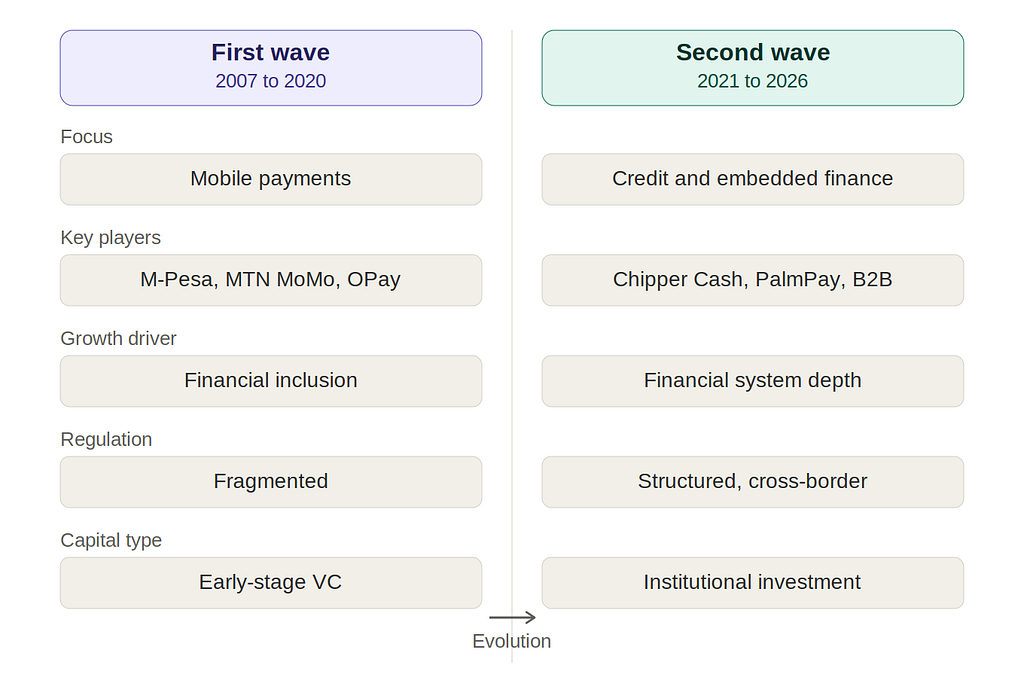
African fintech has grown in two clear waves.
→ The first wave (2007–2020) was mainly about payments.
Companies helped people send and receive money easily through mobile money and digital wallets, solving a major problem of basic financial access and inclusion.
→ The second wave (2021–2026) is different.
Payments are now common across the continent, so fintech is moving beyond them. The focus is shifting to credit, savings, insurance, and investment tools.
In simple terms, the industry is now about building complete financial systems that work for everyone.
Let’s get started!
Credit expansion is one of the most important fintech priorities in Africa.
The goal is to create affordable credit for SMEs and individuals who are excluded from traditional banking systems.
Embedded finance is redefining how financial services are delivered.
Instead of standalone banking apps, financial tools are being integrated directly into everyday platforms.
Examples include:
Non-financial companies are increasingly becoming frontline financial service providers, making finance more accessible and seamless.
Blockchain adoption in Africa is shifting from speculation to practical applications.
Key use cases include:
The focus is now on trust, transparency, and efficiency rather than crypto trading.
Africa is building stronger financial foundations for regional and global investment.
This shift signals a move toward long term financial system maturity.
Open banking is enabling deeper collaboration between banks and fintech companies.
Key benefits include:
Regulators across Africa are increasingly supporting open banking frameworks to boost competition and innovation.
Fintech is now converging with climate-focused innovation.
Emerging trends include:
This aligns financial innovation with Africa’s long-term sustainability goals.
Fintechs are building proprietary payment systems instead of depending on legacy banking rails.
To enable this move, specialized fintech developers are building crypto payment gateways that allow merchants to accept digital assets and simplify cross border settlement.
African fintech is moving into a stronger and more advanced stage in 2026. The early phase helped solve basic payment access and brought millions of people into the digital economy.
Today, the focus has clearly moved. Companies are building deeper financial tools that support lending, savings, protection, and cross border trade.
The next phase will be defined by how well fintech firms turn financial data into real access, trust, and long term value for users and businesses across Africa.
African Fintech Trends 2026: Technology Priorities Beyond Payments was originally published in Coinmonks on Medium, where people are continuing the conversation by highlighting and responding to this story.





