AI agents are becoming more useful when they can act, not only answer. A useful agent may need to buy API access, pay for data, rent compute, subscribe to a tool, settle a microtask, renew a service, or pay another agent. Traditional payments were not designed for that flow.
Cards, bank accounts, invoices, and subscriptions usually assume a human signs up, enters billing details, manages passwords, and approves each account relationship. AI agents need a payment layer that can work programmatically, cheaply, and quickly across small transactions.
Stablecoins fit that gap because they move digital value on open networks. A stablecoin can pay for a service without forcing the agent to maintain a card account, wait for banking settlement, or manage dozens of small subscriptions. The strongest use case is not an agent spending freely. It is an agent spending inside clear limits, with user-approved permissions and auditable settlement.
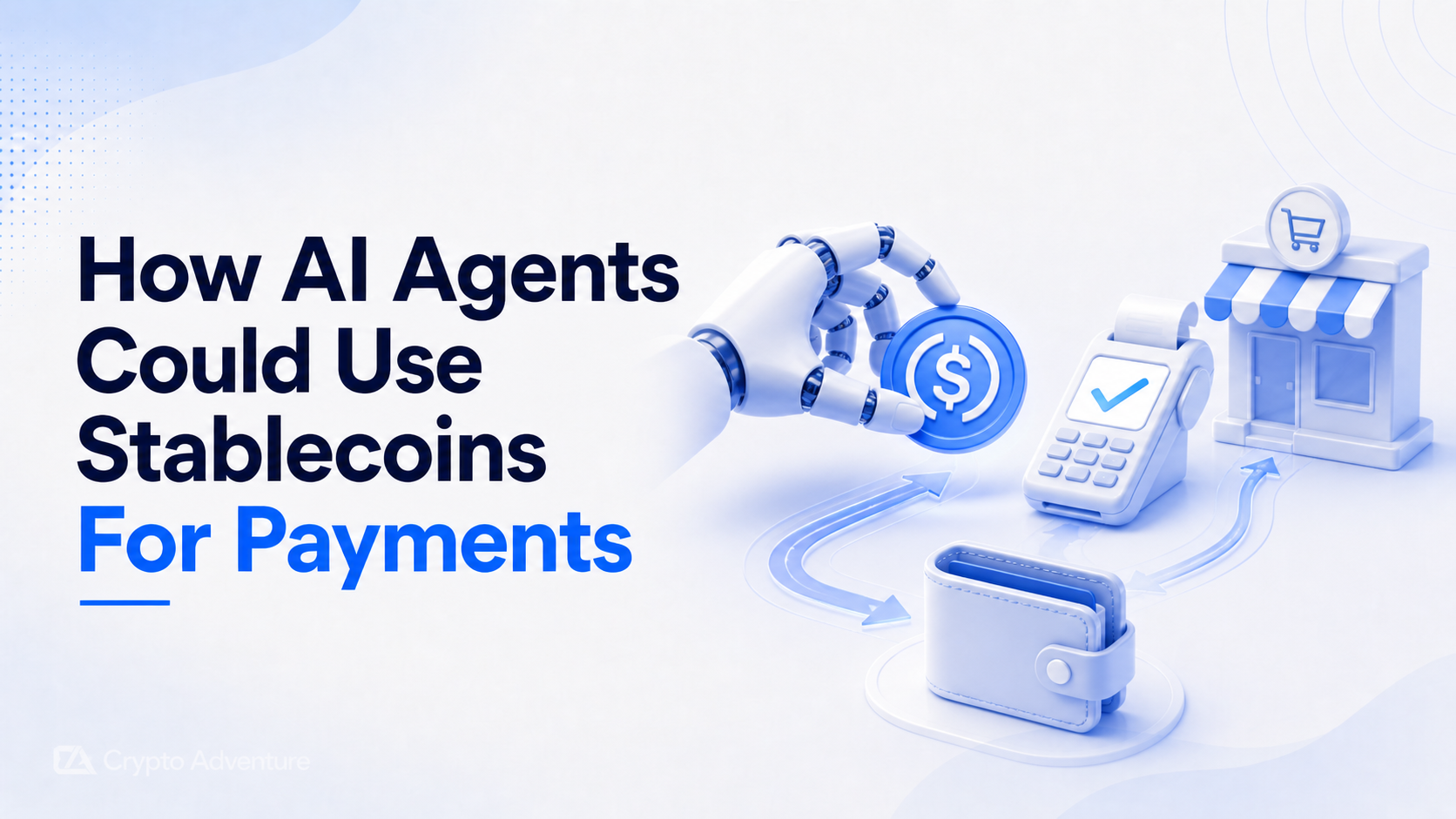
An agent payment can be simple. The agent requests a service, receives a price, checks whether the task is allowed, signs a stablecoin payment, and gets access after the payment confirms. The service provider receives a digital dollar rather than a card authorization or delayed invoice.
The x402 protocol is one of the clearest examples. It revives the HTTP 402 Payment Required response code so APIs, apps, websites, and AI agents can pay directly over HTTP using stablecoins. A service can return a 402 response with payment requirements, and the agent can complete the payment without creating a traditional account.
This matters because many AI agent tasks are small and frequent. Paying a fraction of a dollar for one API call, data lookup, inference request, or web resource does not fit well into card billing. Stablecoins can support pay-per-use access more naturally.
Agents need predictable budgets. If a user gives an agent $20 to complete a task, the value should not swing sharply while the task runs. Stablecoins reduce that problem because they are designed to track fiat value.
A volatile token can work for speculation or collateral, but it is weaker for routine machine payments. An agent paying for APIs, compute, data, or subscriptions needs stable pricing. USDC, PYUSD, USDT, and other stablecoins are better suited because the agent can compare cost, budget, and remaining balance in a familiar unit.
Stablecoins also make accounting cleaner. A business can track how much an agent spent on data, inference, compute, software, and settlement without converting every line item from a volatile asset.
The first use case is API access. An agent can pay for a single request to a data provider, model endpoint, trading signal, search tool, map service, or analytics platform.
The second use case is compute. An agent can rent GPU time, storage, hosting, or inference capacity when it needs extra resources.
The third use case is commerce. An agent can buy a product, renew a subscription, order a service, or pay a vendor within rules set by the user.
The fourth use case is agent-to-agent settlement. One agent may pay another for a specialized action, such as summarizing a dataset, verifying a transaction, or performing a compliance check.
The fifth use case is micro-work. Agents can pay humans or other systems for labeling, validation, moderation, research, or operational tasks.
AI payments need authorization, not only settlement. A user must be able to prove what the agent was allowed to do. That is where mandates and permission layers matter.
Google’s Agent Payments Protocol was designed to support secure agent-driven commerce across payment methods, including stablecoins and crypto through web3 extensions. AP2 uses mandate-style authorization so an agent can act within an approved scope rather than inventing permission at checkout time.
This is critical for trust. A user may allow an agent to spend up to $50 on hotel research, $5 on API calls, or $200 on cloud compute. The agent should not be able to exceed that scope, change recipient rules, or approve unrelated transactions.
Agent wallets need tighter controls than normal wallets. A human can review a transaction. An autonomous agent may execute many actions quickly, so the wallet must enforce limits before damage happens.
For exampe, Coinbase’s Agentic Wallet focuses on agents holding, spending, trading, and earning stablecoins with guardrails. Wallet policies, scoped permissions, transaction limits, allowed destinations, and monitoring become the real safety layer.
This is where stablecoin payments become serious. The agent should not hold unlimited funds. It should receive a task budget, use approved assets, pay approved services, and stop when rules are reached.
The first risk is overpermission. If an agent can spend too much, send to any address, or approve any contract, one mistake can drain funds.
The second risk is prompt injection. A malicious webpage, API response, or tool output can try to trick the agent into making an unauthorized payment.
The third risk is fake invoices. Agents may struggle to distinguish a legitimate payment request from a malicious one without strong identity and verification.
The fourth risk is refund complexity. Stablecoin transfers are usually final, so refunds require a separate process.
The fifth risk is compliance. Agent payments may touch sanctions screening, money transmission, tax reporting, consumer protection, and business recordkeeping.
A good agent payment system starts with user-approved budgets. The user defines what the agent can spend, where it can spend, and how long the permission lasts.
The wallet should enforce scope at the transaction level. Amount limits, destination allowlists, asset restrictions, contract approvals, and daily caps should be enforced by policy, not only by the model’s instructions.
The system should also keep an audit trail. A user or business needs to see what the agent paid for, which service received funds, what task triggered the payment, and whether the output was delivered.
AI agents could use stablecoins as a native payment layer for APIs, compute, data, subscriptions, commerce, and agent-to-agent services. Stablecoins fit because they are programmable, global, fast, and easier to budget than volatile tokens.
The strongest model is not an agent with unlimited spending power. It is an agent with a wallet, stablecoin balance, clear mandates, scoped permissions, audited activity, and hard spending limits. Stablecoins can make agent commerce possible, but wallet guardrails and authorization design will decide whether users can trust it.
The post How AI Agents Could Use Stablecoins For Payments appeared first on Crypto Adventure.





