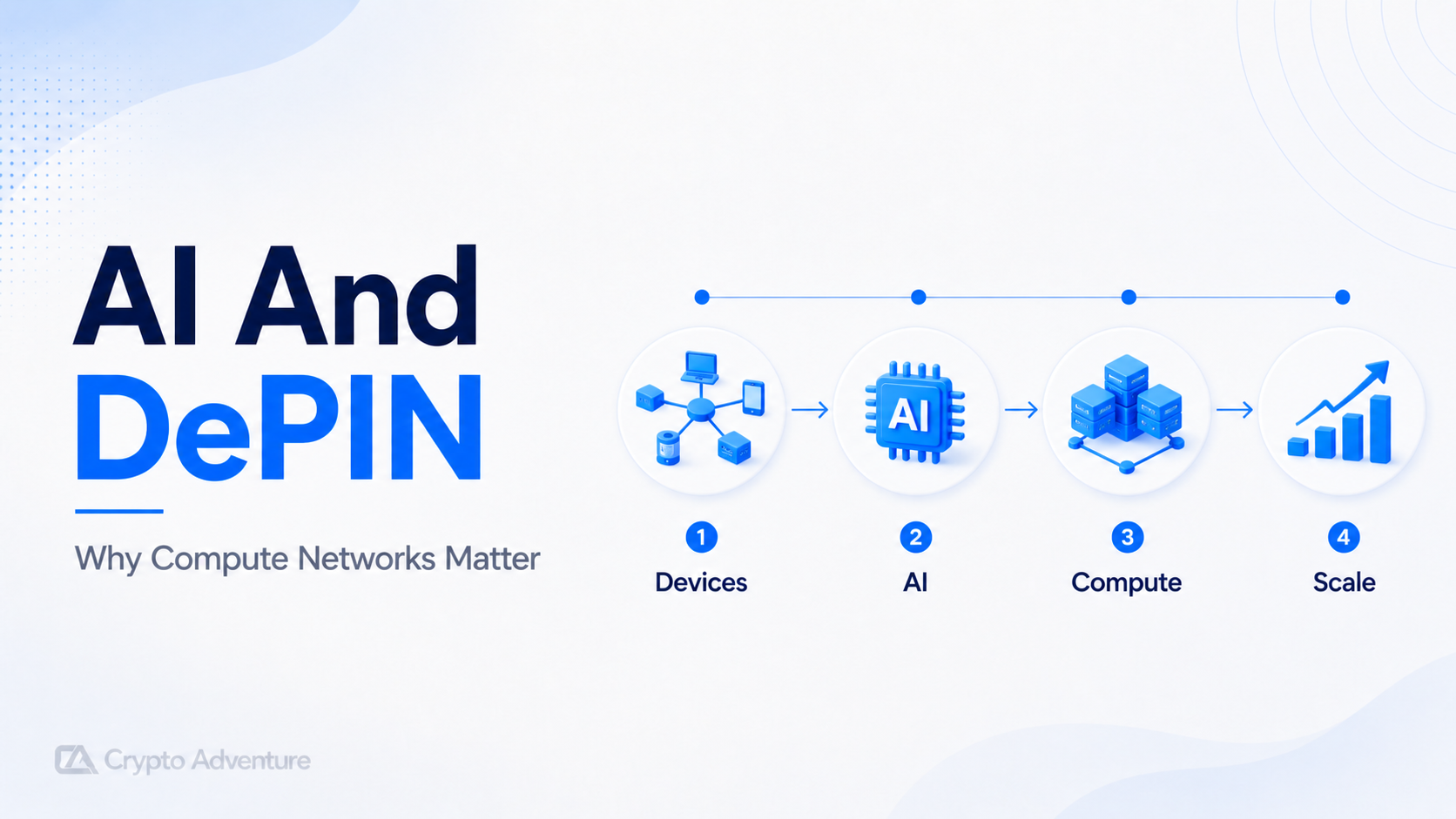
AI and DePIN meet at the compute layer. AI needs GPUs, storage, bandwidth, inference servers, training clusters, and low-latency infrastructure. DePIN, or decentralized physical infrastructure networks, coordinates real-world hardware through crypto incentives and on-chain settlement.
This makes compute one of the most important DePIN categories. AI demand has made GPUs expensive, scarce, and concentrated inside large cloud providers. Decentralized compute networks try to aggregate underused hardware from data centers, miners, independent operators, and specialized providers so users can rent capacity without relying only on Amazon, Google, Microsoft, or other centralized clouds.
The opportunity is not only lower cost. It is market structure. A decentralized compute network can match buyers and sellers globally, create price discovery for hardware, reward providers, and give AI builders another path to training, inference, rendering, or model-serving capacity.
AI workloads are compute-hungry because models require large matrix operations, memory bandwidth, parallel processing, and fast hardware. Training a model can require many GPUs working together for long periods. Inference can also become expensive when millions of users ask models to generate text, images, video, code, audio, or decisions in real time.
Centralized cloud providers are powerful, but supply can be expensive, contract-heavy, and concentrated. Startups may struggle to access the right GPUs quickly. Builders may not want long cloud commitments. Smaller teams may need burst compute rather than permanent infrastructure.
DePIN compute networks try to solve this by turning distributed hardware into a marketplace. The network does not need to own every GPU. It needs to coordinate supply, verify availability, route jobs, settle payments, and maintain enough quality for users to trust the output.
A DePIN compute network usually has providers and users. Providers contribute hardware such as GPUs, CPUs, storage, or bandwidth. Users rent that hardware for workloads. The network handles discovery, pricing, job scheduling, settlement, incentives, and sometimes verification.
Akash Network is a decentralized cloud marketplace where users buy and sell compute resources. Its documentation describes an open network for deploying workloads, with providers competing to supply compute. This model is closer to decentralized cloud hosting than a single AI-only network.
io.net focuses heavily on AI and machine learning workloads by aggregating GPUs from independent data centers, mining operations, and private clusters. Its documentation covers orchestration, scheduling, fault tolerance, scaling, model serving, preprocessing, reinforcement learning, and distributed training.
GPU-specialized networks are important because AI and rendering workloads need a different type of performance than ordinary web hosting. A CPU server can handle websites and APIs. AI workloads often need high-memory GPUs, fast interconnects, reliable drivers, and predictable job execution.
Render Network began with decentralized GPU rendering for creative workflows and now also connects idle GPU capacity with next-generation rendering and AI-related workloads. Its peer-to-peer marketplace helps GPU owners monetize underused hardware while users access rendering capacity.
Aethir focuses on decentralized enterprise-grade GPU cloud infrastructure for AI, gaming, and virtualized compute. Its documentation positions the network around aggregating high-performance GPU chips into a global supply layer for on-demand compute.
These networks are not identical. Akash is broader cloud infrastructure. Render has a strong creative and GPU rendering history. io.net focuses on AI and ML workload orchestration. Aethir leans into enterprise-grade GPU cloud and gaming infrastructure.
Blockchain helps DePIN compute networks coordinate supply and incentives. Providers can be paid for useful hardware. Users can rent capacity through a marketplace. Tokens can reward uptime, capacity, demand fulfillment, or network participation.
On-chain settlement also supports transparency. Payments, staking, slashing, provider reputation, and market activity can be more visible than in closed cloud marketplaces. This does not automatically make compute reliable, but it creates a coordination layer for distributed infrastructure.
The strongest use of blockchain is not putting AI computation directly on-chain. Most AI computation happens off-chain because it is too heavy for blockchains. The chain coordinates payments, incentives, identity, proofs, reputation, and settlement.
The first workload is inference. An app can use distributed GPUs to serve model outputs, such as text generation, image generation, speech, embeddings, or agent responses.
The second workload is fine-tuning. Teams can rent temporary GPU clusters to adapt models to specialized data.
The third workload is rendering. Artists, studios, and 3D teams can use decentralized GPU networks for rendering jobs.
The fourth workload is training and experimentation. Some workloads can use distributed GPU supply for model training, hyperparameter tuning, simulations, or research.
The fifth workload is edge and regional compute. Distributed providers can bring capacity closer to users in some markets, although quality and latency vary.
The first hard problem is reliability. AI jobs need predictable uptime, hardware quality, software compatibility, driver support, and job completion. A cheap GPU is not useful if it fails during a workload.
The second problem is verification. Networks need to know whether providers actually supplied the promised hardware and completed the job correctly. This is harder for complex AI workloads than for simple storage or bandwidth tasks.
The third problem is latency. Some inference workloads need fast response times. A decentralized provider far from the user may be cheaper but slower.
The fourth problem is enterprise trust. Large companies need service-level agreements, compliance, support, procurement processes, data controls, and security guarantees.
The fifth problem is token incentives. Rewards must encourage useful compute, not fake capacity, low-quality nodes, or short-term farming.
Compute networks matter because they give crypto a real infrastructure use case. Instead of only trading tokens, users can buy and sell physical resources that AI markets need.
They also connect two major demand trends. AI needs more compute. Crypto needs more real-world utility. DePIN compute sits between those trends by turning GPUs and cloud resources into programmable markets.
The strongest networks will not win by branding alone. They need real workloads, reliable providers, competitive prices, transparent usage, and enough demand to support the token economy.
Users should start with demand. A compute network needs paying users, not only token incentives. Real workload volume matters more than headline GPU counts.
Next comes supply quality. Enterprise GPUs, uptime, region coverage, drivers, orchestration, and support all affect whether builders can use the network.
Then comes verification. A network should have a credible way to measure capacity, job completion, provider reputation, and fraud.
Finally, users should review token economics. Provider rewards, staking, emissions, fees, burns, and demand capture decide whether the token benefits from real usage.
AI and DePIN connect through compute. AI needs GPUs and cloud resources, while DePIN networks can coordinate distributed hardware through marketplaces, incentives, and on-chain settlement.
The strongest compute networks can make AI infrastructure cheaper, more open, and more competitive. The risks are reliability, verification, latency, enterprise adoption, and token incentive design. AI compute DePIN is one of crypto’s more practical infrastructure narratives, but it only works when real users rent real hardware for real workloads.
The post AI And DePIN Explained: Why Compute Networks Matter appeared first on Crypto Adventure.





