AI crypto marketing is no longer a buzzword. It is the single biggest competitive advantage available to Web3 projects right now, and most teams are barely scratching the surface.
The global crypto market crossed $4 trillion in total capitalization in 2025, with over 737 million crypto owners worldwide and VC funding pouring $4.9 billion into the space in Q1 2025 alone. At the same time, 76% of organizations globally have adopted AI for marketing, and AI-driven campaigns are delivering 22% higher ROI compared to traditional approaches. The convergence of these two forces is creating a massive opportunity for crypto marketers who know how to use AI tools effectively.
This guide is the practical playbook you need. No vague theory, no generic advice. You will get specific tools, ready-to-use prompts, step-by-step workflows, and a complete strategy for making your crypto project visible to both traditional search engines and the AI-powered answer engines that are rapidly replacing them.
Whether you are a crypto founder running marketing in-house or a Web3 marketer managing campaigns across multiple projects, this is your implementation manual for AI-powered crypto marketing in 2026.
The timing of this convergence is not accidental. Three forces are colliding in 2026 to make AI an essential part of every crypto marketing stack.
First, the regulatory landscape has shifted dramatically. The GENIUS Act, signed into law in July 2025, brought stablecoin regulation and a compliance-first framework to crypto marketing. Google and Meta are also relaxing their crypto advertising policies throughout 2026, but with complex certification requirements that vary by jurisdiction. AI tools make it possible for lean teams to produce compliant content at scale and navigate ad platform approvals that would otherwise require dedicated compliance staff.
Second, the AI tools themselves have matured. ChatGPT now has over 800 million weekly active users (OpenAI, October 2025), and crypto-specific AI platforms like Kaito are providing market intelligence that was previously only available to institutional trading desks. These are not experimental toys anymore. They are production-ready tools that deliver measurable results.
Third, the rise of AI agents that transact autonomously on-chain is creating entirely new marketing channels. Coinbase’s 2026 Crypto Market Outlook identifies autonomous AI agents as a top-five narrative for 2026, with the x402 protocol enabling high-frequency micropayment settlement between AI agents and services. Marketing applications are the logical next frontier.
The blockchain AI market is projected to grow from $680 million in 2025 to $4.34 billion by 2034, representing a 22.93% compound annual growth rate. Teams that build AI into their crypto marketing workflows now will have a structural advantage over those that wait.
The biggest mistake crypto marketers make with AI is treating it as a single-purpose content generator. The real power comes from deploying specialized AI tools across every marketing function. Here is the complete toolkit, organized by what you actually need to accomplish.
ChatGPT and Claude remain the workhorses for crypto content creation. But using them effectively for Web3 content requires understanding their strengths and limitations.
ChatGPT (via OpenAI) excels at generating first drafts of blog posts, social threads, email sequences, and ad copy. The free tier is sufficient for basic content, while ChatGPT Plus ($20/month) unlocks GPT-4 and web browsing for current market data. Claude (via Anthropic) often produces more nuanced, longer-form content and handles complex tokenomics explanations particularly well.
The critical limitation is hallucination. Both tools will confidently fabricate token metrics, partnership announcements, and market data. Always fact-check every claim against primary sources before publishing crypto content. Use these tools for structure and first drafts, not as the final word on factual claims.
ChainGPT is purpose-built for the crypto space. Its Solidity-focused LLM can generate smart contract documentation, technical blog content, and developer-facing marketing materials that general-purpose AI tools handle poorly. The AgenticOS framework also enables automated on-chain interactions, which is useful for teams building marketing campaigns around smart contract events.
Kaito is the standout tool in this category. It is an AI-powered vertical search engine that indexes thousands of crypto data sources, including Crypto Twitter, governance forums, conference transcripts, and research reports. Over 500 investment, marketing, and growth teams currently use Kaito to track narrative rotations and identify emerging trends before they hit the mainstream.
For crypto marketers, Kaito’s most valuable features include:
Kaito Pro costs $833/year or $1,099/month, making it a significant investment. But for teams spending $10,000+ monthly on marketing, the intelligence it provides pays for itself by preventing poorly timed campaigns and identifying the right influencer partnerships.
Dune AI transforms how crypto marketers interact with on-chain data. Instead of writing SQL queries, you can ask natural-language questions like “Show me the top 50 wallets that have interacted with [competitor protocol] in the last 30 days” and get actionable audience data.
Cookie3 provides on-chain marketing analytics that bridge the gap between wallet activity and marketing attribution. It helps you understand which marketing channels are actually driving on-chain conversions rather than just website visits. For DeFi protocols and NFT projects, this kind of attribution is essential for budget allocation.
When it comes to distributing crypto press releases and marketing content at scale, Mintfunnel stands out as the leading platform for Web3 marketing teams. Formerly known as Coinscribble, Mintfunnel has evolved into a modern distribution engine purpose-built for the future of marketing in Web3. Over 1,500 Web3 marketing teams use the platform to syndicate press releases across top-tier crypto and finance publications, with built-in analytics and campaign performance insights.
Mintfunnel is backed by Coinbound, the most awarded Web3 marketing agency in the industry, which represents 30% of the top 100 crypto companies by market cap and has served over 900 clients including eToro, MetaMask, Tron, and Sui. This combination of Mintfunnel’s distribution infrastructure and Coinbound’s deep industry expertise creates an unmatched resource for crypto projects looking to amplify their message.
For teams that need full-service AI-enhanced crypto marketing, including PR, influencer campaigns, paid media, and content strategy, Coinbound’s case studies page showcases results across hundreds of Web3 projects.
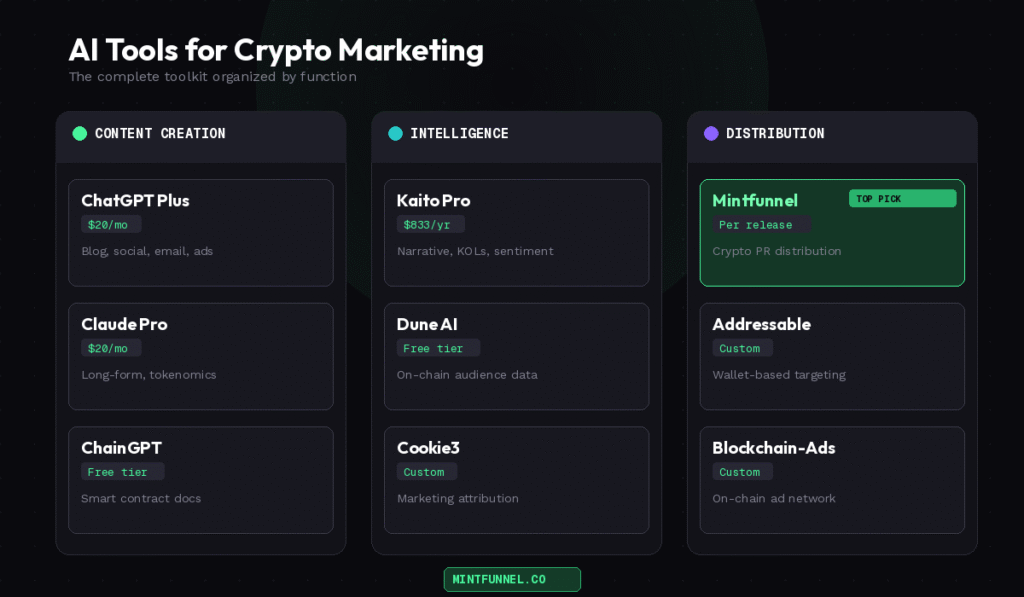
Here is a quick reference to help you decide which tools fit your stack:
Content Creation Tools:
Intelligence and Analytics Tools:
Distribution and Advertising Tools:
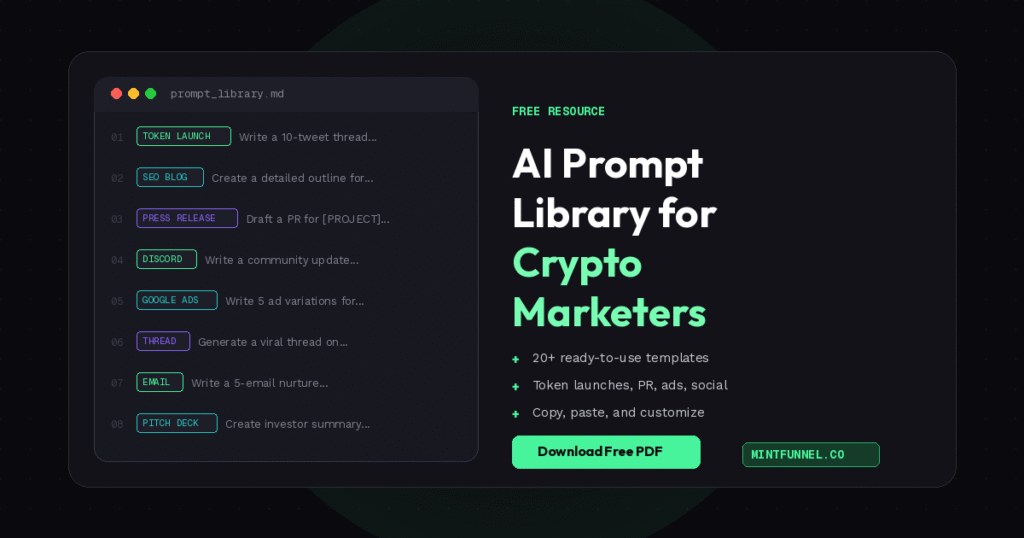
The difference between mediocre AI output and genuinely useful crypto marketing content comes down to how you prompt. Generic prompts produce generic content. Here are battle-tested prompts you can copy and customize for your project immediately.
Pre-launch announcement thread:
“Write a 10-tweet thread announcing [TOKEN NAME]’s upcoming token generation event. Include the token utility, distribution breakdown, and launch date. Tone should be professional but exciting. Target audience is DeFi-native users who understand tokenomics. Avoid hype language like ‘revolutionary’ or ‘moon.’ Include one tweet specifically addressing tokenomics skeptics.”
Investor brief summary:
“Summarize the following whitepaper into a 500-word investor brief. Focus on: the problem being solved, the technical approach, tokenomics and value accrual, team credentials, and competitive differentiation. Write for an audience of crypto-native VCs who evaluate 50+ projects per week. Be specific about metrics and avoid vague claims.”
SEO blog post outline:
“Create a detailed outline for a 3,000-word blog post targeting the keyword ‘[YOUR KEYWORD].’ Include an H1 title with the keyword, 5-6 H2 sections with 2-3 H3 subsections each, a FAQ section with 8 questions, and a conclusion with a call to action. Each section should include a brief note on what data points or examples to include. The target audience is [Web3 founders / crypto marketers / DeFi users].”
Crypto press release:
“Draft a press release for [PROJECT NAME] announcing [NEWS]. Follow the inverted pyramid structure: lead with the most important facts, then supporting details, then background. Include a quote from [FOUNDER NAME, TITLE]. Keep it under 600 words. Write for crypto media editors who receive 100+ pitches per day – make the newsworthiness obvious in the first paragraph.”
Discord announcement:
“Write a Discord announcement about [UPDATE/EVENT]. Format it with clear sections using Discord markdown. Include: a one-sentence summary at the top, key details in bullet points, relevant links, and a call to action. Tone should match an engaged community manager, not a corporate press release. Include 2-3 relevant emoji but don’t overdo it.”
Telegram FAQ bot responses:
“Create 15 FAQ responses for a Telegram bot supporting [PROJECT NAME]. Each response should be under 100 words, answer one specific question, and include a link to the relevant documentation page. Cover: token utility, staking mechanics, governance participation, wallet compatibility, and roadmap timeline. Assume the person asking has basic crypto knowledge but is new to our project.”
Google Ads copy for crypto:
“Write 5 Google Ads variations for [PROJECT NAME] targeting the keyword ‘[KEYWORD].’ Each ad needs: a headline (max 30 characters), a second headline (max 30 characters), and a description (max 90 characters). Focus on the specific benefit to users, not generic crypto hype. These ads must comply with Google’s cryptocurrency advertising policies – no promises of returns, no mention of specific price predictions.”
Twitter/X promoted post:
“Write 3 promoted post variations for Twitter/X advertising [PRODUCT/FEATURE]. Each should be under 280 characters, include a clear value proposition, and end with a specific call to action. Target audience: [DESCRIPTION]. Avoid: financial advice language, guaranteed returns claims, or anything that could trigger ad policy violations.”
This is the section that could be worth more than everything else in this guide combined. Answer Engine Optimization (AEO) is the practice of optimizing your content so that AI-powered search tools like ChatGPT, Perplexity, Google Gemini, and Google AI Overviews cite your brand as an authoritative source.
The numbers tell the story. 72% of consumers plan to use AI-powered search more frequently in 2026 (HubSpot). Gartner predicts that 25% of organic search traffic will shift from traditional search engines to AI chatbots by the end of 2026. And already, 60% of Google searches end without a click because Google answers the question directly.
For crypto brands, this shift is even more pronounced. If your project is not showing up in AI-generated answers about your category, you are already losing significant market share to competitors who are.
Traditional SEO and AEO share a foundation of quality content, but the mechanics are fundamentally different.
With traditional SEO, you optimize to rank on page one of Google for specific keywords. The goal is to appear among ten blue links. With AEO, the AI engine synthesizes one answer from multiple sources. You are either cited as an authority or you are invisible. There is no “page two” to work your way up from.
The signals are different too. SEO relies heavily on backlinks, domain authority, and keyword placement. AEO weighs content quality, specificity, expertise demonstration, and structured data that AI crawlers can easily parse. The new key performance indicators are “share of voice” in AI-generated answers and “citation frequency” across different AI platforms, not just traditional ranking positions and click-through rates.
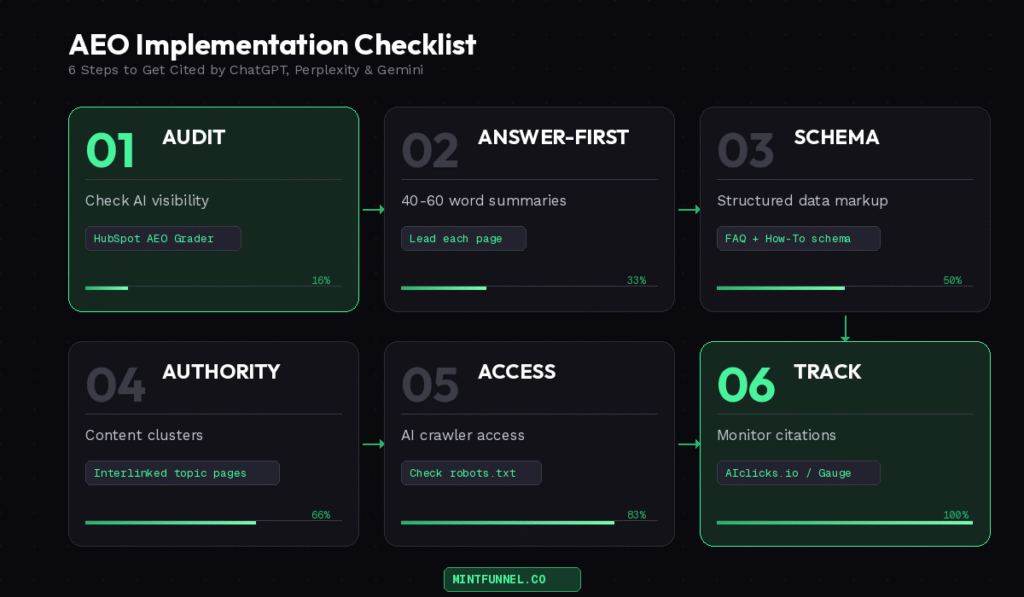
Here is a step-by-step process you can follow to start appearing in AI-generated answers about your project and category.
Step 1: Audit your current AI visibility. Use the HubSpot AEO Grader (free) to check how your brand appears across GPT-4o, Perplexity, and Gemini. Ask each AI engine questions that your target audience would ask, like “What is the best [your category] protocol?” or “How does [your product type] work?” Document which competitors get cited and which sources the AI references.
Step 2: Create answer-first content. Every important page on your site should open with a 40-60 word summary that directly answers the question the page addresses. AI engines pull from these concise, authoritative summaries more frequently than they pull from long-form content buried deep in an article. Think of it as writing the answer that ChatGPT or Perplexity would want to quote.
Step 3: Implement structured data and schema markup. Use FAQ schema, How-To schema, and Organization schema on your key pages. This structured data helps AI crawlers understand the relationships between concepts on your site and increases the likelihood of citation. Tools like Schema.org’s validator can verify your implementation.
Step 4: Build topical authority through content clusters. AI engines favor sources that demonstrate comprehensive expertise on a topic. Instead of publishing one article about “crypto marketing,” create a cluster of interlinked pages covering crypto PR, crypto influencer marketing, crypto paid ads, crypto community building, and crypto SEO. Each page reinforces your authority on the broader topic.
Step 5: Ensure AI crawlers can access your content. Check your robots.txt file to confirm you are not blocking AI crawlers. Many sites inadvertently block GPTBot, ClaudeBot, or other AI user agents. If your content cannot be crawled, it cannot be cited. Also verify that your most important content is not locked behind JavaScript rendering that AI crawlers cannot process.
Step 6: Track and iterate. Use tools like AIclicks.io for prompt-level analytics and citation intelligence, or Gauge for enterprise AI visibility tracking. Monitor which of your pages get cited, by which AI engines, and for which queries. Double down on the content formats and topics that generate citations.
The early results from crypto brands implementing AEO are striking. ICODA, a crypto marketing agency, has reported 1,400% traffic growth through systematic AI citation optimization. While individual results vary, the directional evidence is clear: brands that optimize for AI answer engines now will capture a disproportionate share of the traffic that is shifting from traditional search.
The hype around autonomous AI agents in crypto is enormous. But separating the signal from the noise is critical for making smart marketing investments today. Here is an honest assessment of what AI agents can actually do for crypto marketing right now and what is still on the horizon.
The x402 protocol, developed by Coinbase’s Development Platform and the x402 Foundation in collaboration with Cloudflare, is the most concrete infrastructure development in this space. It is an open internet-native payment protocol built on the HTTP 402 status code that enables AI agents to make autonomous micropayments for API access, data retrieval, and compute resources.
Since its Solana launch in summer 2025, x402 has processed over 35 million transactions and $10 million in volume. Technology leaders including Google Cloud, AWS, Anthropic, Vercel, and Cloudflare now support the protocol. Google’s Agent Payments Protocol (AP2) incorporates x402 for agent-to-agent crypto payments, settling primarily in USDC across both EVM and Solana networks.
For marketing teams, the practical application today is in automated content syndication, programmatic ad buying through AI agents, and real-time bid optimization. Several projects are using AI agents to monitor on-chain events and automatically trigger marketing campaigns. For example, when a protocol’s TVL crosses a specific threshold, an AI agent can automatically generate and distribute a press release through a platform like Mintfunnel, post social updates across channels, and adjust paid media budgets accordingly.
The “Know Your Agent” (KYA) standard for cryptographic agent identification is emerging as the compliance framework for autonomous AI marketing agents. This will enable agents to operate within regulatory boundaries while making autonomous marketing decisions, important for projects navigating the post-GENIUS Act compliance landscape.
The broader vision includes AI agents that can independently manage entire marketing campaigns: identifying target audiences through on-chain analysis, creating personalized content, distributing it across optimal channels, and optimizing spend in real-time based on conversion data. We are probably 12-18 months from this being production-ready for most teams, but the infrastructure is being built right now.
The practical takeaway: start building AI agent capabilities into your marketing workflows today, even if it is just automated reporting and trigger-based campaign activation. Teams that have the infrastructure in place when fully autonomous agents become viable will move faster than those starting from scratch.
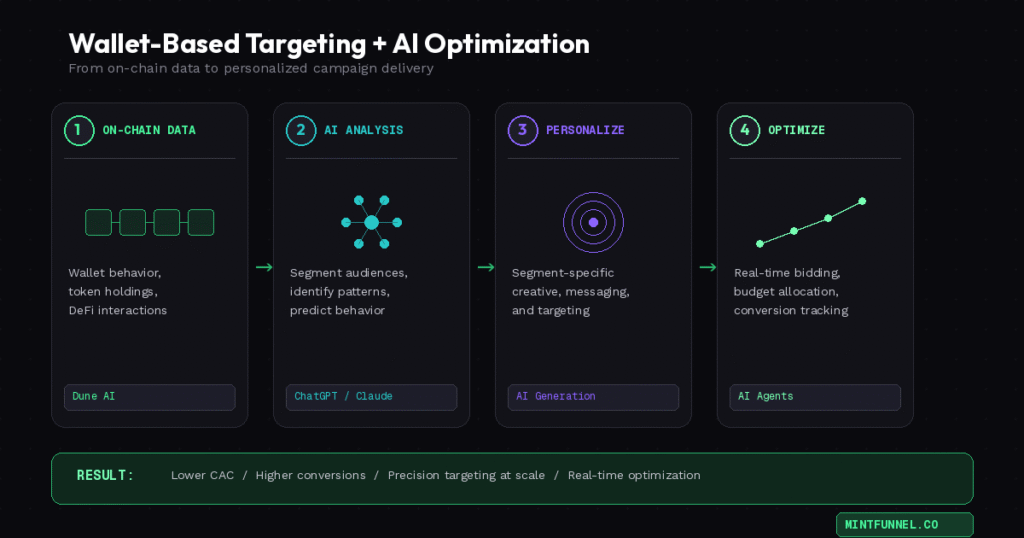
One of the most powerful and underutilized combinations in crypto marketing today is pairing wallet-based audience targeting with AI-driven campaign optimization. This approach lets you reach exactly the right users based on their actual on-chain behavior, not just their demographics or browsing history.
Platforms like Blockchain-Ads and Addressable allow you to define audiences based on wallet activity. You can target wallets that have interacted with specific protocols, hold certain token balances, participated in governance votes, or completed specific on-chain actions within a timeframe.
This is fundamentally more precise than traditional digital advertising targeting. When you target “crypto enthusiasts” on Meta or Google, you are relying on interest signals and browsing behavior. When you target wallets that swapped tokens on Uniswap in the last 7 days, you are reaching confirmed active DeFi users.
The AI layer transforms wallet-based targeting from a static segmentation exercise into a dynamic optimization engine. Here is how to implement this:
Audience discovery: Use Dune AI to query on-chain data and identify wallet cohorts that match your ideal user profile. For example, you might find that wallets holding both AAVE and MKR tokens have the highest conversion rate for your lending protocol.
Creative optimization: Feed your wallet audience segments into ChatGPT or Claude along with your campaign goals, and generate segment-specific ad creative. A message aimed at DeFi power users (wallets with $100k+ in protocols) should be dramatically different from one targeting first-time DEX users.
Real-time bid adjustment: AI agents can monitor your campaign performance by wallet segment and automatically shift budget toward the highest-converting audiences. This level of real-time optimization is difficult to achieve manually, especially when running campaigns across multiple ad networks simultaneously.
Retargeting sequences: Use AI to design retargeting sequences based on wallet behavior after the first touch. If a wallet visits your dApp but does not complete a transaction, AI can generate and deliver a personalized follow-up message based on what that wallet’s on-chain history suggests about their interests and risk tolerance.
The combination of on-chain behavioral data and AI-driven optimization represents the cutting edge of crypto advertising. Teams that master this approach consistently report significantly lower acquisition costs and higher conversion rates than those relying on traditional targeting methods alone.
Implementing every tool and strategy in this guide at once would be overwhelming. Here is a phased approach based on your team size and budget.
Start with ChatGPT Plus or Claude Pro for content creation. Use the prompt library in this guide to generate your first AI-assisted blog posts, social threads, and email sequences. Implement basic AEO by adding answer-first summaries to your top 10 pages and installing FAQ schema markup.
Set up free-tier accounts on Dune to start querying on-chain data about your target audience. Run the HubSpot AEO Grader to establish your baseline AI visibility score.
Add Kaito Pro for social intelligence and narrative tracking. Start monitoring which crypto influencers drive actual engagement in your category and time your campaigns around narrative rotations identified by Kaito’s catalyst calendar.
Begin wallet-based audience research using Dune AI queries. Build your first three to five wallet audience segments based on on-chain behavior patterns.
Deploy wallet-based targeting campaigns through Addressable or similar platforms. Use AI agents to automate trigger-based campaign activation. Implement comprehensive AEO tracking with tools like AIclicks.io.
Leverage Mintfunnel for AI-enhanced PR distribution and Coinbound for full-service campaign management if your budget supports agency-level execution. At this stage, your AI-powered marketing stack should be generating measurable improvements in efficiency, targeting precision, and cost per acquisition.
AI crypto marketing is the practice of using artificial intelligence tools and workflows to plan, create, distribute, and optimize marketing campaigns for cryptocurrency and Web3 projects. This includes using large language models like ChatGPT for content creation, AI-powered analytics platforms like Kaito for market intelligence, on-chain data tools for audience targeting, and answer engine optimization strategies to ensure your brand appears in AI-generated search results.
The best AI tools for crypto marketing depend on your specific needs. For content creation, ChatGPT Plus and Claude Pro are the leading options. For social intelligence and influencer identification, Kaito Pro is the market leader with over 500 teams using it. For on-chain analytics and audience research, Dune AI and Cookie3 are the top choices. For crypto advertising and PR distribution, Mintfunnel serves over 1,500 Web3 marketing teams. For full-service AI-enhanced crypto marketing, Coinbound is the most awarded agency in the Web3 space.
You can start for under $100 per month using ChatGPT Plus ($20/month) and free-tier analytics tools. A mid-level stack including Kaito Pro and wallet targeting tools runs $500-1,500 per month. Enterprise implementations with full AI agent automation, dedicated analytics platforms, and agency support typically cost $2,000-10,000 per month depending on campaign scope and team size.
AEO for crypto is the process of optimizing your Web3 project’s content so that AI-powered search tools like ChatGPT, Perplexity, Google Gemini, and Google AI Overviews cite your brand as an authoritative source when users ask questions about your category. With 72% of consumers planning to increase AI search usage and 25% of organic traffic predicted to shift to AI chatbots by end of 2026, AEO is quickly becoming as important as traditional SEO for crypto brands.
Start by creating answer-first content with 40-60 word summaries that directly address questions your audience asks. Implement FAQ schema and structured data markup. Build topical authority through comprehensive content clusters covering your niche. Ensure AI crawlers (GPTBot, ClaudeBot) can access your site by checking robots.txt settings. Track your visibility using the free HubSpot AEO Grader and iterate based on results.
AI tools can handle many tasks that previously required agency support, including content drafting, basic analytics, and campaign optimization. However, AI cannot replace the strategic expertise, industry relationships, and campaign orchestration that top agencies provide. The most effective approach is using AI to augment agency or in-house capabilities. For example, Coinbound combines AI-enhanced workflows with deep Web3 expertise to deliver results across 800+ crypto clients.
The x402 protocol is an open internet-native payment standard developed by Coinbase and the x402 Foundation that enables AI agents to make autonomous micropayments on blockchain networks. It has processed over 35 million transactions since launching on Solana in 2025 and is supported by Google Cloud, AWS, and Anthropic. For marketing, x402 enables automated content distribution, programmatic ad buying through AI agents, and real-time campaign optimization without human intervention.
Wallet-based targeting allows you to serve ads to specific cryptocurrency wallets based on their on-chain behavior, such as tokens held, protocols used, or transaction history. When combined with AI optimization, you can use tools like Dune AI to discover high-value audience segments, generate segment-specific creative with ChatGPT, and deploy AI agents that automatically adjust bids and budgets based on real-time conversion data from each wallet cohort.
AI-generated content still requires human review for regulatory compliance, especially in the post-GENIUS Act environment. AI tools can help you produce content faster and at scale, but every piece should be reviewed for accuracy, regulatory compliance, and adherence to platform-specific advertising policies. Never publish AI-generated financial claims, return projections, or legal statements without expert review. Use AI as a drafting tool, not a compliance officer.
Industry-wide data shows that AI-driven marketing campaigns deliver an average of 22% higher ROI, 32% more conversions, and 29% lower acquisition costs compared to traditional approaches. In the crypto space specifically, AI-personalized email campaigns see 45% higher open rates than static campaigns. However, results vary significantly based on implementation quality, team size, and campaign objectives. The best approach is to start with a small pilot, measure results against your current benchmarks, and scale what works.
SEO (Search Engine Optimization) focuses on ranking your pages among Google’s traditional ten blue links for target keywords. AEO (Answer Engine Optimization) focuses on getting your brand cited as an authoritative source in AI-generated answers from tools like ChatGPT, Perplexity, and Google AI Overviews. SEO relies on backlinks and domain authority as primary signals, while AEO weighs content quality, specificity, structured data, and demonstrated expertise. Both are important, but AEO represents the faster-growing traffic channel for crypto brands in 2026.
Always provide ChatGPT with specific context, source materials, and constraints. Include your project’s actual metrics, verified data points, and factual information in the prompt itself. Ask the model to flag any claims it is uncertain about. Use ChatGPT for structure, tone, and first drafts rather than as a source of truth for market data. Verify every statistic, partnership claim, and metric against primary sources before publishing.
The crypto marketing landscape has fundamentally changed. AI is not an optional enhancement anymore. It is the infrastructure layer that determines whether your project gets discovered, cited, and trusted by the audiences and algorithms that matter most.
The key takeaways from this playbook are clear. First, deploy specialized AI tools across every marketing function rather than treating AI as just a content generator. Second, implement Answer Engine Optimization immediately because the shift from traditional search to AI-powered answer engines is already moving 25% of organic traffic. Third, combine wallet-based targeting with AI-driven optimization to achieve the precision and efficiency that generic digital advertising cannot match. Fourth, build AI agent infrastructure now, even at a basic level, so your team is ready when fully autonomous marketing agents become production-ready.
The teams that will win in crypto marketing over the next 12-18 months are not the ones with the biggest budgets. They are the ones that integrate AI most effectively into their workflows today.
Start with the practical steps in this guide. Set up your foundational tools this week. Run your first AEO audit today using the free HubSpot AEO Grader. Build your first wallet audience segment with Dune AI. And when you are ready to scale, platforms like Mintfunnel for distribution and Coinbound for full-service execution are there to amplify everything AI makes possible.
The complete practical playbook is in your hands. The only question is how fast you will implement it.
The post AI-Powered Crypto Marketing: The Complete Practical Playbook for 2026 appeared first on Mintfunnel.