
AI models are only as useful as the data they can access. Training data, real-time context, private datasets, blockchain records, geospatial information, user behavior, scientific data, and financial signals all shape model quality.
The problem is that valuable data is fragmented. Some sits inside platforms, some belongs to users, some lives in private companies, some sits on-chain, and some changes in real time. Large AI companies can buy or scrape data at scale. Smaller builders and open AI networks need better ways to discover, pay for, verify, and license data.
Crypto data markets try to solve that coordination problem. They use tokens, smart contracts, data licenses, access controls, payments, provenance, and sometimes privacy-preserving computation so data can become a programmable asset.
A crypto data market lets data providers sell access to datasets, data streams, APIs, model outputs, or computation over data. Buyers may include AI developers, agents, trading systems, research teams, protocols, companies, or other models.
The data does not always move freely to the buyer. In some designs, the buyer receives direct access. In others, the model or algorithm runs against the data while the raw dataset stays protected. This matters because sensitive data, personal data, and proprietary business data cannot always be copied into an open marketplace.
Ocean Protocol is one of the older examples of this idea. It provides Web3 tools for data sharing and monetization, including marketplaces where data or algorithms can be sold without relying on a traditional broker. Ocean’s marketplace template focuses on selling data or algorithms while preserving privacy around the underlying resource.
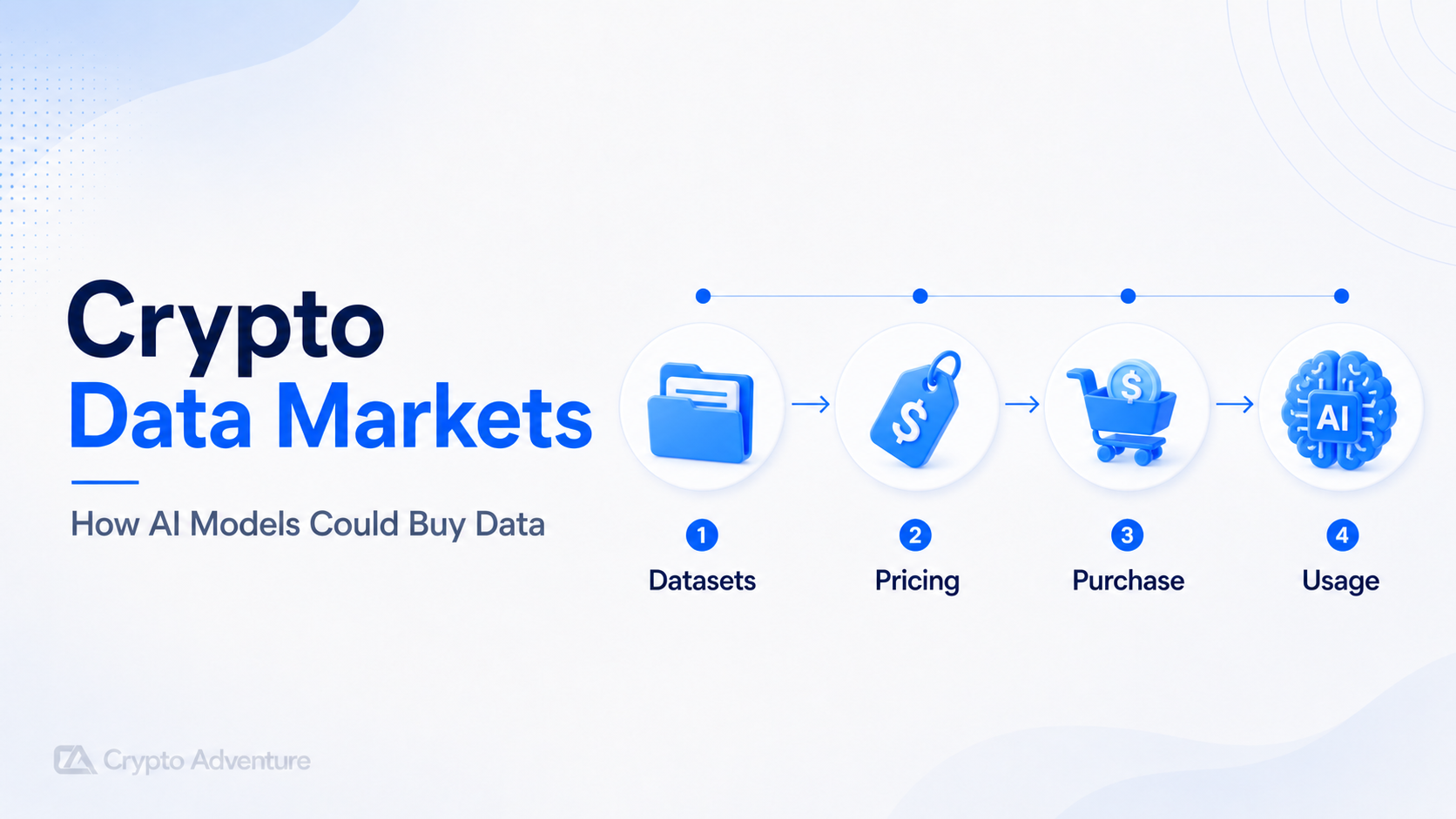
An AI model or agent could buy data in several steps. First, it identifies the data needed for a task. Second, it checks the price, license, source quality, freshness, and access rules. Third, it pays through a stablecoin, token, or protocol-native mechanism. Fourth, it receives access, an API response, a dataset, or a computation result.
This can support pay-per-query data, subscriptions, real-time feeds, training datasets, or one-time model fine-tuning packages. A model could pay for a financial dataset before making a forecast, buy geospatial updates for a logistics task, or access user-approved personal data for a specialized assistant.
The strongest version uses stablecoins or programmatic payments because data purchases can be small, frequent, and global. A model should not need a credit card account for every dataset it touches.
User-owned data is one of the most important categories. Many AI companies train on user behavior, social activity, app usage, or content without users receiving much control or value. Crypto data markets can create a different model where users pool, license, and monetize their own data.
Vana is built around programmable data ownership and data sovereignty. Its protocol model includes personal servers, secure enclaves, and tokenized data rights. That structure is designed for a world where users can control how their data is used and potentially benefit when AI systems train on it.
This is powerful, but it is also sensitive. Personal data markets need strong consent, privacy, deletion rights, usage limits, and security. A bad design can turn user-owned data into another extraction layer.
AI models also need live web context. Static training data becomes stale. Agents need current information, fresh prices, current documentation, local availability, news, and updated product data.
Grass is building a Sovereign Data Rollup that sources and transforms web data through a distributed network of nodes. The goal is to turn public web data collection into structured AI-ready data through decentralized infrastructure.
This category matters because AI agents will need current data, not only old training sets. A model that can buy verified live context can be more useful than one locked to static data.
Blockchain data is another major source. AI agents, trading systems, risk engines, and DeFi tools need wallet activity, contract events, token transfers, protocol state, governance records, liquidity changes, and cross-chain flows.
The Graph indexes and queries blockchain data across more than 80 networks through products such as Subgraphs, Substreams, and Token API. Space and Time connects blockchain and off-chain data through verifiable compute, giving applications and AI systems a way to use provable query results.
These systems are not only for AI, but they become more important as agents need reliable data before acting on-chain. A trading agent, lending monitor, treasury bot, or DeFAI assistant cannot make good decisions with incomplete or unverifiable data.
Some data should never be copied into a buyer’s database. Health records, financial records, enterprise data, location data, and personal behavior data require tighter controls.
Compute-to-data models address this by moving the algorithm to the data instead of moving the raw data to the buyer. The buyer pays for a result, model training step, or computation output, while the dataset stays protected inside controlled infrastructure.
This approach can support AI development without giving every buyer raw access. It can also create better compliance paths because data providers can enforce usage limits, audit access, and reduce leakage risk.
The first risk is data quality. A marketplace can contain stale, fake, duplicated, biased, or low-value data.
The second risk is consent. User data must be collected and sold only under clear permission.
The third risk is privacy leakage. Even computed outputs can reveal sensitive information if safeguards are weak.
The fourth risk is licensing. AI buyers need to know whether data can legally be used for training, inference, resale, or commercial products.
The fifth risk is token incentives. A network that rewards data volume without quality checks can attract spam.
A strong data market needs quality controls. Data should be scored by freshness, source, completeness, accuracy, uniqueness, and demand.
It also needs clear rights. Buyers should know what they can do with the data. Providers should know how their data will be used.
Payment design matters too. Stablecoin payments work well for pay-per-use access. Protocol tokens can coordinate incentives, but they need real demand from data buyers to avoid becoming reward-only systems.
Finally, privacy must be built into the product. Data markets that ignore privacy will struggle with regulation, trust, and long-term adoption.
Crypto data markets could let AI models buy data, live context, blockchain records, user-owned datasets, and computation over private information. The value is not only payment. It is provenance, access control, licensing, auditability, and programmable settlement.
The strongest markets will not reward data volume alone. They will reward useful, legal, fresh, consent-based, and verifiable data. AI models need better data pipelines, and crypto can help create them, but only if data rights, quality, privacy, and real buyer demand are treated as core infrastructure.
The post Crypto Data Markets: How AI Models Could Buy Data appeared first on Crypto Adventure.





