APY in crypto is the percentage return earned on digital assets over a year, taking into account compound interest. It measures how your crypto holdings grow when your rewards are reinvested and start generating more income on their own. Understanding what APY in crypto means is essential for anyone evaluating staking, lending, or yield farming opportunities.
Crypto APY helps investors measure compounding interest earned on investments, compare platforms, and identify genuine earning potential in the market. In this article, we will discuss everything you need to know about what APY in crypto is, how it works, its benefits and risks, and how it differs from APR.
You will also learn how to calculate APY, what qualifies as a good APY rate, the difference between APR and APY, and how APY can help investors build consistent income through staking, lending, and DeFi opportunities.
APY stands for Annual Percentage Yield, a key metric that describes the total amount of interest an investor earns on a deposit or crypto investment over one year, taking into account compound interest. Compound interest means earning interest on both your principal (which could be prior interest earned) and on the accumulated interest over a specific period.
Unlike a standard or simple interest rate, which only shows the nominal rate of return, APY includes the effect of compounding, that is, earning interest on both your initial deposit and the interest already accumulated. This makes APY a more accurate reflection of your true yearly earnings.
APY helps crypto investors understand the real earning power of their digital assets. Below are the key benefits of APY in crypto:
While APY offers clear benefits, it also comes with risks that every investor should understand before committing funds. Below are some of the main risks associated with APY in crypto:
High APY crypto staking refers to earning above-average returns by locking crypto assets on a blockchain network to support its operations while receiving rewards that grow through compounding. A high APY usually falls between 5% and 10% on assets such as Ethereum (ETH) or Solana (SOL), depending on the platform and reward frequency.
Some smaller projects may offer higher rates, but such yields often carry greater risk. The best APY crypto opportunities combine fair rewards, transparent systems, and reliable networks, allowing investors to earn passive income without exposing their assets to unnecessary risk.
Some examples of projects offering staking opportunities with high APY include, but are not limited to Binance, Bitget, and Coinbase. However, before you start investing via these platforms, check out our comprehensive Binance review and Bitget review to learn more about these exchanges and what they offer.
If you are not satisfied with the staking rewards available on these platforms, you can explore other options from this compilation of the best crypto staking platforms that offer high-yield products.

APY refers to the total return on an investment that includes the effect of compounding, while APR (annual percentage rate) shows the yearly interest rate charged or earned without compounding. Here’s a comparison between APY and APR:
| Features | APY | APR |
| Interest Type | Compound | Simple |
| What it Measures | Total annual return, including compound interest | Annual rate without compounding |
| Best For | Savings accounts, investments, and loans where you are earning money | Loans, credit cards, and mortgages where you are borrowing money. |
| Formula | APY = (1 + r/n)^n – 1. | APR = r × 100 |
| Accurate Short-Term Metric | No | Yes |
| Accurate Long-Term Metric | Yes | No |
In summary, APY measures total earning potential, while APR (annual percentage rate) represents cost or simple interest without compounding. Knowing both helps investors make informed investment decisions across DeFi, crypto staking, and lending platforms.
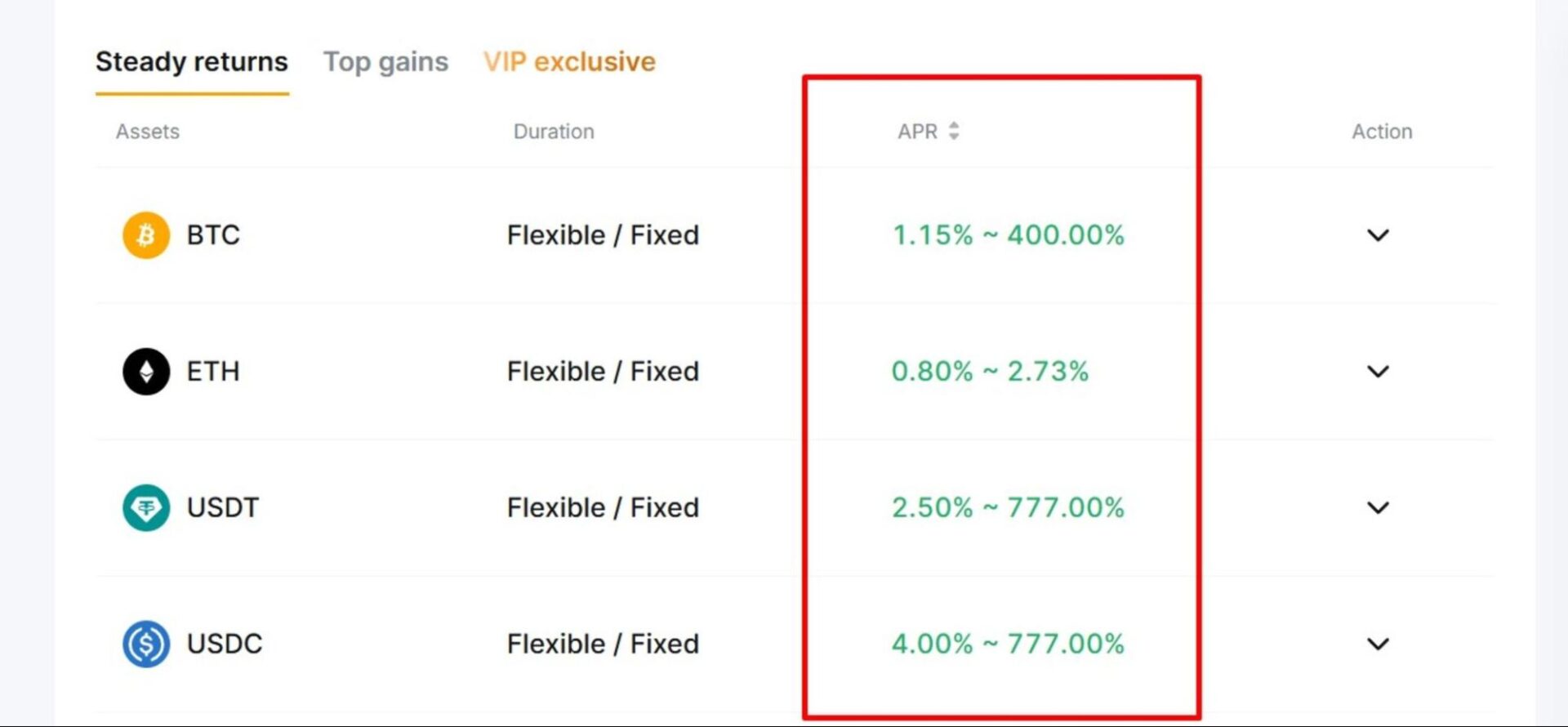
APY in crypto works on the principle of compounding, where earned rewards are continuously added to your initial investment/balance, generating more returns over time. When crypto assets are staked or lent out, the platform distributes rewards based on the locked amount and duration.
The longer the staking or lending period, the higher the potential annual percentage yield (APY). Factors such as asset type, network demand, and the frequency of reward distribution also influence how much an investor earns. Platforms that offer flexible or auto-compounding features usually deliver higher growth than fixed-rate options.
The basic formula for calculating APY in crypto is: APY = (1 + r/n)^n – 1
Where:
For example, if a crypto staking platform offers an annual rate of 12% (r = 0.12) with monthly compounding (n = 12):
APY = (1 + 0.12/12)^12 – 1 = 0.1268
Therefore, the crypto APY for this hypothetical staking platform is 12.68%, showing how compounding slightly increases the total annual return compared to the flat 12% rate. Calculating APY manually can be cumbersome; use reliable online APY calculators to determine your potential returns easily.

A good APY rate in crypto depends on the asset type and the level of risk involved. For stablecoins, an APY of 4% to 10% is generally considered reasonable, as these assets have lower volatility and provide steady returns.
For more volatile cryptocurrencies like Ethereum or Solana, higher APYs above 10% may be offered, but such rates often come with increased risk. Key factors that determine what qualifies as a good APY rate include:
A 4% APY can be considered a solid and stable return in the crypto market, especially for low-risk assets such as stablecoins. For instance, staking $1,000 at a 4% APY would yield about $40 in profit over a year, assuming rewards are compounded. While higher APYs may look attractive, they often come with added risks, such as token price volatility or unreliable platforms.
APY helps investors grow their wealth through compounding and passive income. When rewards from staking or lending are added back to the balance, those earnings begin to generate additional returns, creating exponential growth over time. This compounding effect allows investors to maximize profit without constant trading or monitoring.
For example, staking Ethereum or lending stablecoins on DeFi platforms can yield consistent returns through interest payouts. The main benefits of APY crypto include measurable growth, steady passive income, and transparency in evaluating earning potential. Understanding annual percentage yield (APY) makes it easier for investors to compare investment opportunities and select those that align with long-term goals and acceptable risk levels.
APY in crypto is a crucial metric that measures the true annual return on your crypto investment, taking into account compounding interest, including interest earned on your holdings and cryptocurrency savings account. It shows how much an asset can grow when rewards are reinvested over time. Understanding how APY works, how it differs from APR, and how to calculate it helps investors make informed decisions.
While high APYs can offer bigger rewards, they often come with higher risks, such as token volatility or unreliable platforms. The best approach is to balance returns with safety by focusing on reputable projects and realistic yields. Before making investment decisions, compare APY rates, evaluate platform credibility, and align each decision with your goals before committing to any APY opportunity in crypto.
The post What Is APY (Annual Percentage Yield) in Crypto? (2025) appeared first on CryptoNinjas.





