Blockchain security firm PeckShield dropped a serious alert on June 1, 2026. As per their data, hackers have drained a cumulative $340.7 million from cross-chain bridge protocols through 14 major exploits so far this year. This is not a one-off incident. It is a clear pattern, and every DeFi investor needs to understand what is happening.
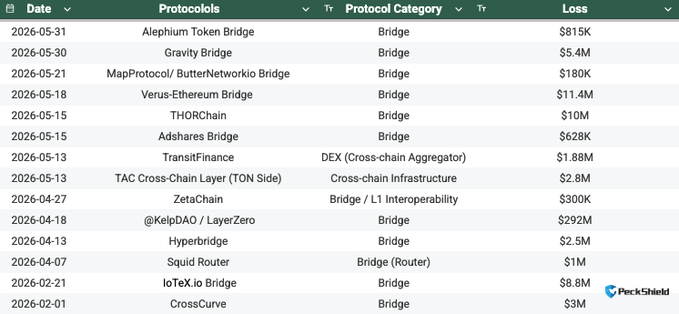
Source: PeckShield X post
The image published in the PeckShield post tells the full story. Bridges dominate the list. From small drains of $180K to a single $292 million attack, the data confirms one hard truth: they have become the most targeted infrastructure in all of crypto.
Before breaking down the incidents, it helps to understand why bridges are the top target in crypto hacks 2026.
It locks your tokens on one blockchain and mints equivalent assets on another. To do this, it holds pooled liquidity, sometimes worth hundreds of millions of dollars, in smart contracts. If a hacker can compromise just the bridge's verification layer, the signing keys, or the messaging protocol, they can drain that entire pool in minutes.
That single design risk makes bridges the highest-value, highest-vulnerability target in DeFi. And the 2026 crypto crime report from PeckShield confirms attackers have figured this out completely.
Here is a breakdown of all 14 incidents from the PeckShield data, grouped by scale and method, so you understand the full picture as a trader or investor.
The @KelpDAO / LayerZero exploit on April 18 was the single largest incident, draining $292 million. Chainalysis found that LayerZero had set a dangerously low 1-of-1 RPC quorum by default, meaning a single compromised node could authorize fraudulent cross-chain messages. Hackers spoofed the verification and drained pooled rsETH collateral across ecosystems. The damage did not stay in one place. It spread across interconnected DeFi protocols that used KelpDAO as backing.
On April 13, Hyperbridge lost $2.5M in a separate incident, adding to what became April 2026's record as the worst-hacked month in crypto history, 30 total incidents in a single month.
THORChain was hit for $10M on May 15, the same day Adshares Bridge lost $628K. The Verus-Ethereum Bridge was drained of $11.4 million on May 18, with Blockaid and CertiK both flagging suspicious outflows before the full damage was confirmed. Squid Router, a bridge-router protocol, lost $1 million on April 7.
The Infrastructure Layer Hits: TransitFinance
TransitFinance, a DEX cross-chain aggregator, lost $1.88M on May 13. The same day, TAC Cross-Chain Layer on TON's side lost $2.8 million through cross-chain infrastructure weaknesses. ZetaChain, a bridge and Layer 1 interoperability protocol, was exploited for $300K on April 27.
CrossCurve was the first major name on the list, drained of $3 million on February 1. The IoTeX.io Bridge followed on February 21 with $8.8M in losses, which at the time seemed large. Looking back now, it was just the beginning of the 2026 crypto crime report's most alarming chapter.
Gravity Bridge lost $5.4 million on May 30 after signing keys were suspected to be compromised, not a code flaw but an operational failure. The attacker routed stolen funds through Binance and ChangeNow. MapProtocol / ButterNetwork Bridge lost $180K on May 21. And on May 31, Alephium TokenBridge rounded off the list with an $815K drain.
This crypto hack news is not just headlines. It has direct portfolio implications.
63% of May losses came from infrastructure-layer attacks, not smart contract bugs
Bridges accounted for 41% of all May losses despite being just one category
$340.7M stolen from bridge protocols alone in 2026, before the year is even halfway done
Total crypto hacks 2026 losses across all categories crossed $750 million by mid-April
The shift is important. Earlier hacks targeted smart contract bugs, which audits could catch. Now attackers are going after signing keys, RPC nodes, and cross-chain messaging layers. These are harder to audit and easier to miss.
Based on the pattern in this crypto hacking news, here is what informed investors are doing:
Reduce bridge exposure. If you are holding it or wrapped assets, assess whether that bridge has a security audit and multi-sig verification
Check protocol dependencies. Some DeFi protocols use it as collateral infrastructure. If the bridge fails, your position can unwind
Hold native assets on regulated exchanges when you are not actively using DeFi
Watch PeckShield and CertiK alerts as part of your daily crypto news today routine; they flag suspicious activity before losses are confirmed
Avoid protocols using single-node RPC quorums; the KelpDAO attack exposed this as a critical design flaw
No single step eliminates risk, but reducing Cross-Chain Network exposure reduces the chance of waking up to a drained wallet.
The data from PeckShield is clear. Crypto hacks 2026 are not random. Hackers have identified bridges as the weakest, most rewarding target in the entire DeFi ecosystem, and they are executing with increasing precision. From a $180K router drain to a $292 million protocol collapse, the range of incidents shows that no bridge is too small or too large to be targeted.
For traders and investors, awareness is the first line of defence. The image in the PeckShield post tells you everything, 14 incidents, one category, $340.7 million gone.
Stay informed. Stay careful.
Disclaimer: This article is for informational and educational purposes only and does not constitute financial or investment advice. Cryptocurrency markets involve significant risk. All data referenced is sourced from PeckShield's official alert published June 1, 2026. Always conduct your own research before making any financial decision.





