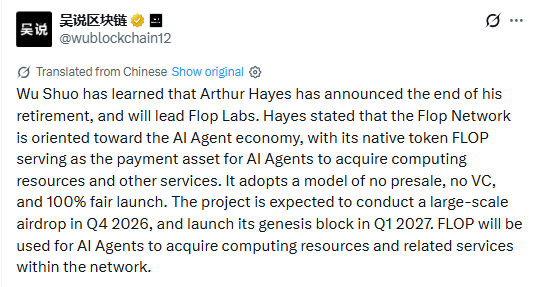
BitMEX co-founder Arthur Hayes announced on August 18 that he is ending his retirement to lead Flop Labs, a new venture building Flop Network and its native token. Per Wu Blockchain, which first reported the announcement, Hayes described the project's purpose in one line: FLOP is designed to serve as the payment asset AI agents use to acquire computing resources and other services within the network.
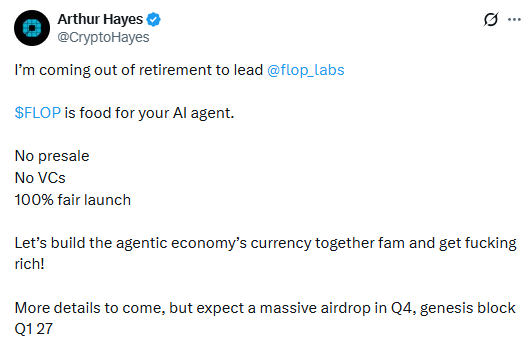
Hayes confirmed the move directly on his own X account, summarizing FLOP as "food for your AI agent" and stating the project will follow three specific principles:
No presale
No VC allocation
100% fair launch
He also gave a preliminary timeline: a large-scale airdrop planned for Q4 2026, followed by the network's genesis block targeted for Q1 2027. One detail worth flagging directly — the airdrop is scheduled roughly a full quarter before the blockchain it's meant to run on actually exists, meaning early recipients would hold a token ahead of any live network. As of this writing, the only publicly disclosed requirement to qualify for the airdrop is following the flop labs account on X.
 Source: X (formerly Twitter)
Per the project's own materials, It is not a new AI model — it's a proposed network for AI agent compute, verification, and payment settlement. The core idea: most AI agents today rely on infrastructure paid for by human developers, using someone else's API keys and cloud storage rather than handling their own resource trading and billing.
The Network aims to close that gap. According to the project's published concept:
An AI agent pays the token to purchase inference (model computation) services
An agent also pays FLOP to store and retrieve long-term memory
GPU providers handle the actual computation
Independent verifiers confirm the service was actually delivered
The name FLOP borrows from "floating-point operations," the standard unit for measuring computational performance. That said, one token does not equal one floating-point operation — the project has not disclosed any fixed exchange rate between the token and a specific amount of compute. "Food for your AI agent" is a metaphor for the token's purpose, not a technical unit of measurement.
As per the project' published overview, the network is structured around four participant types:
Participant | Role | How They Earn Token |
Miners | Provide compute power to process AI agent inference requests | Block rewards + inference service fees |
Verifiers | Confirm miners actually delivered the requested service; help secure network and store agent memory | Block rewards + inference fees + storage fees |
AI Agents | Primary consumers — pay for compute, memory, and transactions with other agents | N/A (spenders, not earners) |
KOLs / Community Partners | Promote the network and recruit miners, verifiers, and agents | Rewards based on community activity generated |
The project calls its underlying consensus approach a "Proof-of-Useful-Inference" protocol — the idea being that network rewards are tied to computation that genuinely serves a real AI agent request, rather than arbitrary work. That's a design goal, not a working mechanism yet: the project hasn't published how verifiers would actually confirm inference correctness, how randomness in model outputs would be cross-verified, or how incorrect or malicious results would be penalized.
Separating what's independently confirmed from what remains a stated intention:
Confirmed:
Hayes's announcement itself, posted directly to his personal X account and reflected in his updated bio (now listing him as CEO of Flop Labs)
A public landing page at flop.finance
Three live application forms for prospective GPU providers, validators, and promoters
One public GitHub repository, called "technocore-chat" — described by the project itself as agent communication and coordination infrastructure, explicitly not responsible for settlement, key custody, or protocol logic
The project's X account was created in June 2026 and has grown from roughly 570 followers to over 1,200 since the announcement, a fraction of the nearly 806,000 followers Hayes brings to the project personally
Not yet published, as of this writing:
A whitepaper or technical documentation
A token supply schedule or total allocation breakdown
A named underlying blockchain or smart contract
An independent security audit
Detailed verification mechanics for the "Proof-of-Useful-Inference" system
Hayes brings a significant public profile to the announcement — he co-founded BitMEX and helped popularize the perpetual swap contract that now underpins much of crypto derivatives trading. He also pleaded guilty to a US Bank Secrecy Act violation in 2022 and received a presidential pardon in 2025, background context relevant to evaluating his return to an operating role.
Arthur Hayes's return with the project pairs a well-known name and a real, identifiable problem — AI agents increasingly need their own way to pay for compute and storage — with a project that is still almost entirely conceptual. The fair-launch pitch, the Q4 2026 airdrop, and the Q1 2027 genesis block are the concrete milestones to watch. Until Flop Labs publishes a whitepaper, core protocol code, testnet data, and clear token allocation rules, the "Proof-of-Useful-Inference" model should be understood as a stated design goal rather than a deployed, working system.
This article is for informational purposes only and does not constitute financial or investment advice. Details are based on Arthur Hayes's own public statements, The project's ' official materials, and reporting from Wu Blockchain, current as of August 19, 2026. Project timelines, token mechanics, and airdrop eligibility criteria remain preliminary and subject to change. Cryptocurrency projects at this early a stage carry significant risk, including the possibility that stated plans are delayed or never materialize. Always conduct independent research before making any decision.





