Traditional international banking often involves multiple accounts, complex reconciliation, higher costs, and slower settlement times. These challenges can create operational bottlenecks for companies managing customers in different countries.
Virtual IBANs are changing that.
Rather than opening and maintaining separate bank accounts in every market, businesses can use Virtual IBANs to simplify global payment collection while improving visibility, automation, and customer experience.
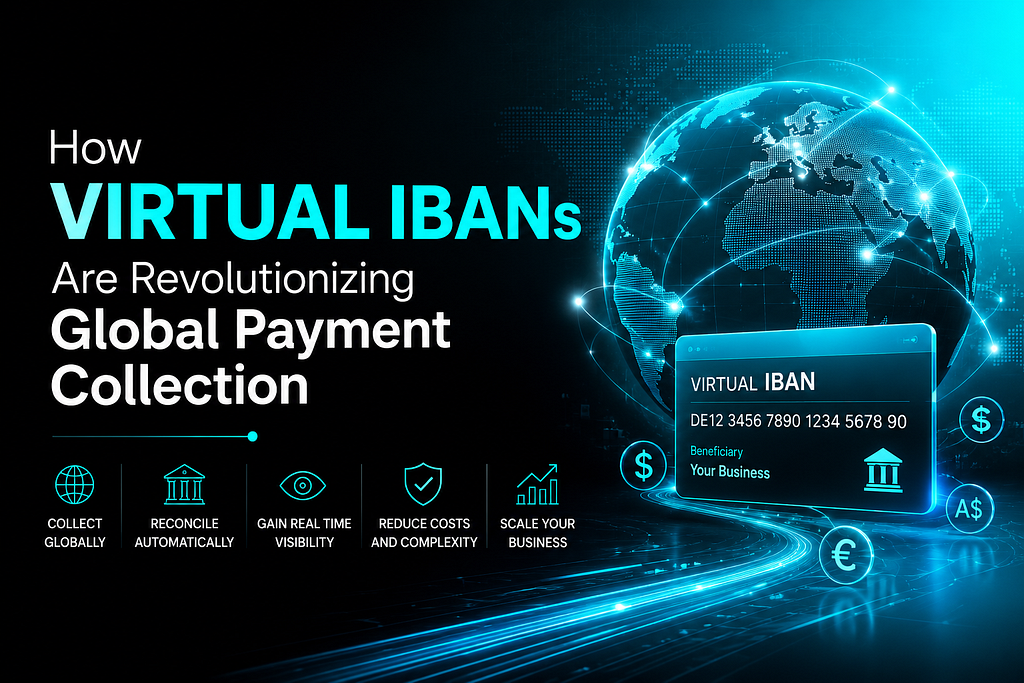
A Virtual IBAN is a unique International Bank Account Number assigned to a customer, business unit, marketplace seller, or transaction. Unlike a traditional bank account, multiple Virtual IBANs can be linked to a single underlying account.
Each Virtual IBAN acts as a dedicated payment identifier, allowing incoming funds to be automatically recognized and routed without requiring multiple physical accounts.
This approach simplifies payment operations while maintaining the familiarity of standard bank transfers.
Businesses operating internationally often encounter several challenges:
As payment volumes increase, these issues become more difficult to manage and can slow business growth.
Instead of establishing local banking infrastructure in every country, businesses can assign Virtual IBANs to customers across different markets while managing funds through a centralized account.
This reduces complexity and accelerates market entry.
One of the biggest advantages of Virtual IBANs is automatic reconciliation.
Because every customer or transaction can receive a unique Virtual IBAN, incoming payments are instantly identifiable. Finance teams spend less time matching payments manually, reducing errors and improving operational efficiency.
Customers prefer making payments to local looking bank accounts using familiar banking rails.
Virtual IBANs create a seamless payment experience while businesses continue managing funds through centralized infrastructure behind the scenes.
Every incoming payment can be tracked in real time.
Finance teams gain better visibility into receivables, allowing faster reporting, forecasting, and financial decision making.
Maintaining numerous international bank accounts requires ongoing administration, compliance, and banking fees.
Virtual IBANs significantly reduce these overheads while providing scalable payment infrastructure.
Virtual IBANs have become valuable across many industries, including:
Any organization handling large volumes of international payments can benefit from the efficiency Virtual IBANs provide.
Virtual IBANs are no longer just a payment collection tool.
They have become a core component of modern Banking as a Service platforms, embedded finance solutions, and payment orchestration systems.
Combined with APIs, automated compliance checks, and real time payment networks, Virtual IBANs enable businesses to build scalable financial infrastructure without the complexity of traditional banking models.
As global commerce becomes increasingly digital, flexible payment infrastructure is becoming a competitive advantage rather than a luxury.
The demand for faster, more transparent, and more efficient international payments continues to grow.
Virtual IBANs provide businesses with a practical way to simplify cross border collections, automate reconciliation, improve customer experience, and scale internationally without maintaining dozens of bank accounts.
For fintech companies, payment providers, and enterprises operating across multiple markets, Virtual IBANs are helping redefine how global payment collection works.
In a world where speed, automation, and visibility matter more than ever, Virtual IBANs are becoming one of the most important building blocks of modern financial infrastructure.
How Virtual IBANs Are Revolutionizing Global Payment Collection was originally published in Coinmonks on Medium, where people are continuing the conversation by highlighting and responding to this story.





