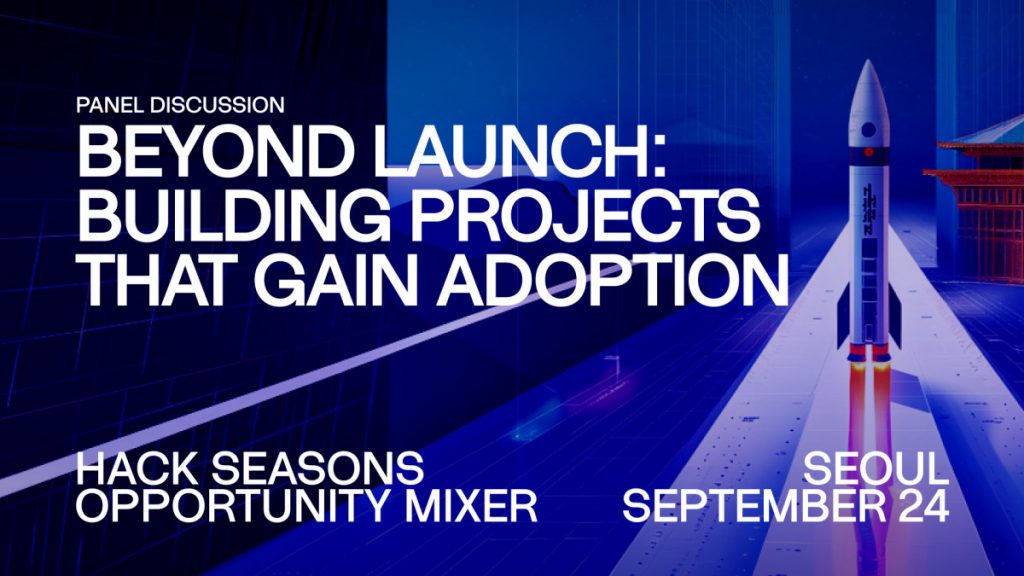
At the end of September, the Hack Seasons Opportunity Mixer in Seoul served as a global gathering for technologists, investors, and innovators to discuss the opportunities and challenges involved in advancing Web3 adoption.
One of the event’s most anticipated sessions was the panel titled “Beyond Launch: Building Projects That Gain Adoption,” featuring Gleb Gora, Co-Founder and CEO of Vortex; Dillon Chen, Founder and CEO of Common; Miumiu Qin, Ecosystem Relations at Sonic Labs; Lily Park, CEO of Exilist; YQ, Founder of AltLayer; and Rania Rahardja, Director of Sales for APAC at Ondo Finance.
The panel discussion opened with an exploration of the key early decisions that are critical for a successful project launch. Speakers emphasized that every project functions as a product, and initial token distributions or airdrops need careful planning. Poorly designed airdrops can attract participants who are only temporarily interested, making it difficult for projects to build a sustainable and engaged community. Pre-planning these processes is essential to establish trust and long-term participation.
Panelists also highlighted the role of tokens as embodiments of ownership, providing stakeholders with opportunities to participate in governance. Governance structures need to be clearly defined to ensure that stakeholders understand the rules and their responsibilities, which is essential for long-term project stability.
The conversation then turned to the evolution of blockchain infrastructure. While early chains were primarily general-purpose, there is now a trend toward application-specific projects. Institutions and new companies are increasingly seeking solutions that go beyond token launches, focusing on revenue-generating services that support the deployment of new chains. As blockchain infrastructure matures, the demand for these application-focused solutions is expected to grow, providing opportunities for projects that offer customized infrastructure services.
Looking ahead to 2025, the panel identified several emerging trends relevant to early-stage protocols. Perpetual markets, including prediction markets, are gaining attention, especially as regulatory clarity improves in the U.S., enabling product and financial innovation. These markets present opportunities to address inefficiencies in traditional financial systems and unlock value that has historically been inaccessible.
AI is another area of fast development. AI agents and LLMs are increasingly being applied beyond basic communication tools. One promising application is automated auditing of smart contracts, which can enhance project security. The combination of AI and on-chain data also allows for more efficient analysis of market sentiment and token performance, supporting faster and more informed decision-making.
Additional trends identified by the panel include the integration of crypto with real-world assets (RWAs), the expansion of institutional participation in crypto, and the development of stablecoin infrastructure for institutional use. The convergence of AI and RWAs is also emerging as a notable area of interest, highlighting opportunities for innovation at the intersection of digital finance and artificial intelligence.
Overall, the discussion highlighted the importance of combining robust community design, governance, and innovative technology to create sustainable projects that can adapt to evolving market demands and regulatory environments.
Another topic of discussion focused on finding the balance between bootstrapping a project and attracting major venture capital support.
Panelists noted that this balance is highly dependent on the specific project and available resources. From a founder’s perspective, the approach varies based on the type of project and the resources at hand. Successful bootstrapping requires a clear understanding of the problem being solved, a well-defined plan for leveraging available resources, and awareness of the competitive landscape. Founders must also assess how external funding could complement their efforts and what kind of support would be most beneficial.
Several panelists emphasized the ongoing importance of bootstrapping, highlighting how it builds resilience and deep knowledge of the market.
The discussion also explored the impact of AI on fundraising, noting that AI is changing how venture capital firms evaluate and support projects.
The post Hack Seasons Opporrunity Mixer Panel Explores Strategies For Web3 Adoption, Governance, And Emerging Trends In Crypto appeared first on Metaverse Post.





