August was the month crypto remembered how to rally. $Bitcoin closed it up roughly 26 percent, briefly punched through $81,000, and printed its strongest weekly candle in more than three years. Then it stopped.
September opened with a shrug. Bitcoin is changing hands around $77,951 after a daily candle that opened at $78,571, tapped $79,184, and closed the session down 0.91 percent. Nothing dramatic. But after a vertical move like August, "nothing dramatic" is exactly what bulls did not want to see.
Underneath the surface, though, this market is anything but boring. Michael Saylor is buying again, privacy coins are printing eight-year highs, and September is stacked with catalysts that could decide whether the rally has legs or whether traders spend the autumn explaining what went wrong.
The short answer is Kevin Warsh.
The Fed Chair used his first Jackson Hole appearance in late August to make clear that inflation is not beaten, and markets promptly repriced the odds of a September rate hike rather than a cut. Bitcoin dropped roughly 3.3 percent to $77,678 on August 29 after Warsh's speech pushed rate hike expectations higher, cutting short a strong rally.
That is the awkward part of the 2026 setup. Bitcoin spent August climbing on institutional demand and a stabilising ETF bid, and then ran straight into a central bank that is still talking about tightening. Bitcoin had gained roughly 26 percent in August before the pullback, giving traders every reason to lock in profits when yields moved higher, and the failure to hold $80,000 reflected macro conditions overriding otherwise supportive spot demand.
The flow picture improved sharply, which is what makes the stall interesting rather than alarming. US spot Bitcoin and Ether ETFs pulled in a combined $2.6 billion in a single week, their best result since October 2025, trimming the products' 2026 deficit from $5.7 billion to $3.1 billion while BTC consolidated near $77,000. Demand is back. The macro permission slip is not.
Michael Saylor went quiet for two months. On August 30 he posted two words on X, "We're ₿ack", and the market did the rest.
The filing landed Monday. Strategy acquired 4,603 BTC for $369.7 million at an average price of $80,318 per coin, lifting total holdings to 845,050 BTC, more than 4 percent of Bitcoin's maximum supply. The company also added $29 million to its USD cash position and repurchased $152 million of STRC preferred stock while keeping net leverage at 0.0 percent.
The number matters less than the context. Between June 29 and August 23, Strategy paused Bitcoin buying entirely to clean up its balance sheet, selling 6,916 BTC for around $429 million, raising $4.56 billion through MSTR share issuance, and repurchasing over $500 million of STRC preferred shares. In other words, the largest corporate holder in the market spent the summer de-risking, not accumulating. With net leverage now at zero and dollar assets fully covering outstanding debt, Monday's purchase signals that Strategy considers the balance sheet strong enough to go back on offense.
For a market that spent June and July watching its loudest buyer sell, that is a meaningful psychological reset. Whether it converts into a breakout is another question. Analysts note Bitcoin could retest $80,000 if it holds above $77,000, but favourable Federal Reserve signals are still needed to confirm a breakout.
Look at the year-to-date column in any market screener right now and one sector jumps out. Zcash is up more than 65 percent this year. Monero is up 21 percent. Almost every other large cap is deep in the red for 2026.
Zcash has been the trade of the year for anyone who caught it. ZEC hit an eight-year high of $888 on August 25 and gained over 60 percent in seven days against Bitcoin's 20 percent, a "de-Bitcoinization" move that reflected capital rotating into privacy assets and dragged Dash, Tezos and Monero higher with it.
The catalysts are real rather than purely narrative. The bullish case has been reinforced by ZEC crossing $800 in August, Grayscale's ZCSH ETF listing on NYSE Arca, and 4.81 million ZEC, roughly 28.4 percent of supply, sitting in shielded pools as of August 27. A new commercial entity, Zcash Labs, launched in August 2026 to fund and drive business and institutional adoption, and an SEC probe into Zcash was dropped in January 2026 with no enforcement action.
Now the honest part. This rally has been leveraged and violent in both directions. Zcash dropped as much as 50 percent within 24 hours in June following disclosure of a severe Orchard vulnerability, and CoinDesk reported billions in futures volume against far lower spot volume as ZEC broke $800, with prices reversing quickly. Monero, meanwhile, is quietly doing its own thing, up 17 percent over the past week while most of the top 15 bled.
Privacy is the strongest sector narrative of 2026. It is also the one most likely to hand out 40 percent drawdowns without warning.
Here is the top of the market as of this morning's snapshot, with 24 hour, 7 day and year-to-date moves side by side. The YTD column is the one worth studying, because it tells you where capital actually went in 2026.
| # | Asset | Price | 24h | 7d | YTD | Market cap |
|---|---|---|---|---|---|---|
| 1 | Bitcoin ($BTC) | $77,951 | 🔴 -0.49% | 🔴 -2.52% | 🔴 -10.93% | $1.56T |
| 2 | Ethereum ($ETH) | $2,451.14 | 🟢 +0.33% | 🔴 -1.37% | 🔴 -17.39% | $295.8B |
| 3 | Tether ($USDT) | $0.9997 | 🔴 -0.01% | 🟢 +0.01% | 🟢 +0.13% | $183.33B |
| 4 | $BNB | $686.38 | 🟢 +0.08% | 🔴 -2.99% | 🔴 -20.47% | $91.4B |
| 5 | $XRP | $1.36 | 🔴 -0.50% | 🔴 -8.48% | 🔴 -25.73% | $85.73B |
| 6 | $USDC | $0.9999 | 🔴 -0.00% | 🔴 -0.00% | 🟢 +0.03% | $73.4B |
| 7 | Solana ($SOL) | $102.22 | 🔴 -0.93% | 🟢 +1.56% | 🔴 -17.88% | $59.82B |
| 8 | TRON ($TRX) | $0.3304 | 🔴 -1.82% | 🔴 -3.76% | 🟢 +16.24% | $31.36B |
| 9 | Hyperliquid ($HYPE) | $83.14 | 🟢 +2.23% | 🟢 +1.91% | 🟢 +226.95% | $20.92B |
| 10 | Zcash ($ZEC) | $845.82 | 🟢 +1.73% | 🔴 -0.07% | 🟢 +65.04% | $14.25B |
| 11 | Dogecoin ($DOGE) | $0.08264 | 🔴 -0.10% | 🔴 -9.40% | 🔴 -29.54% | $12.87B |
| 12 | Monero ($XMR) | $524.44 | 🟢 +1.23% | 🟢 +17.07% | 🟢 +21.06% | $9.85B |
| 13 | UNUS SED $LEO | $9.29 | 🔴 -3.54% | 🔴 -0.90% | 🔴 -3.29% | $8.54B |
| 14 | Chainlink ($LINK) | $11.34 | 🟢 +0.69% | 🔴 -2.43% | 🔴 -10.11% | $8.48B |
| 15 | Cardano ($ADA) | $0.1975 | 🟢 +0.64% | 🔴 -10.93% | 🔴 -40.65% | $7.25B |
Three things stand out.
Ethereum sits in its own awkward spot. ETH is trading near $2,455 with repeated rejections around $2,545, and despite record 2026 weekly inflows of $824.42 million into US spot Ethereum funds, it has struggled to hold above $2,500 after gaining more than 30 percent in August. Wallets holding 100 to 1,000 ETH sold 207,000 coins over the past week while larger holders accumulated 182,000. Retail is distributing into whale bids.
The daily chart makes the situation unusually legible.
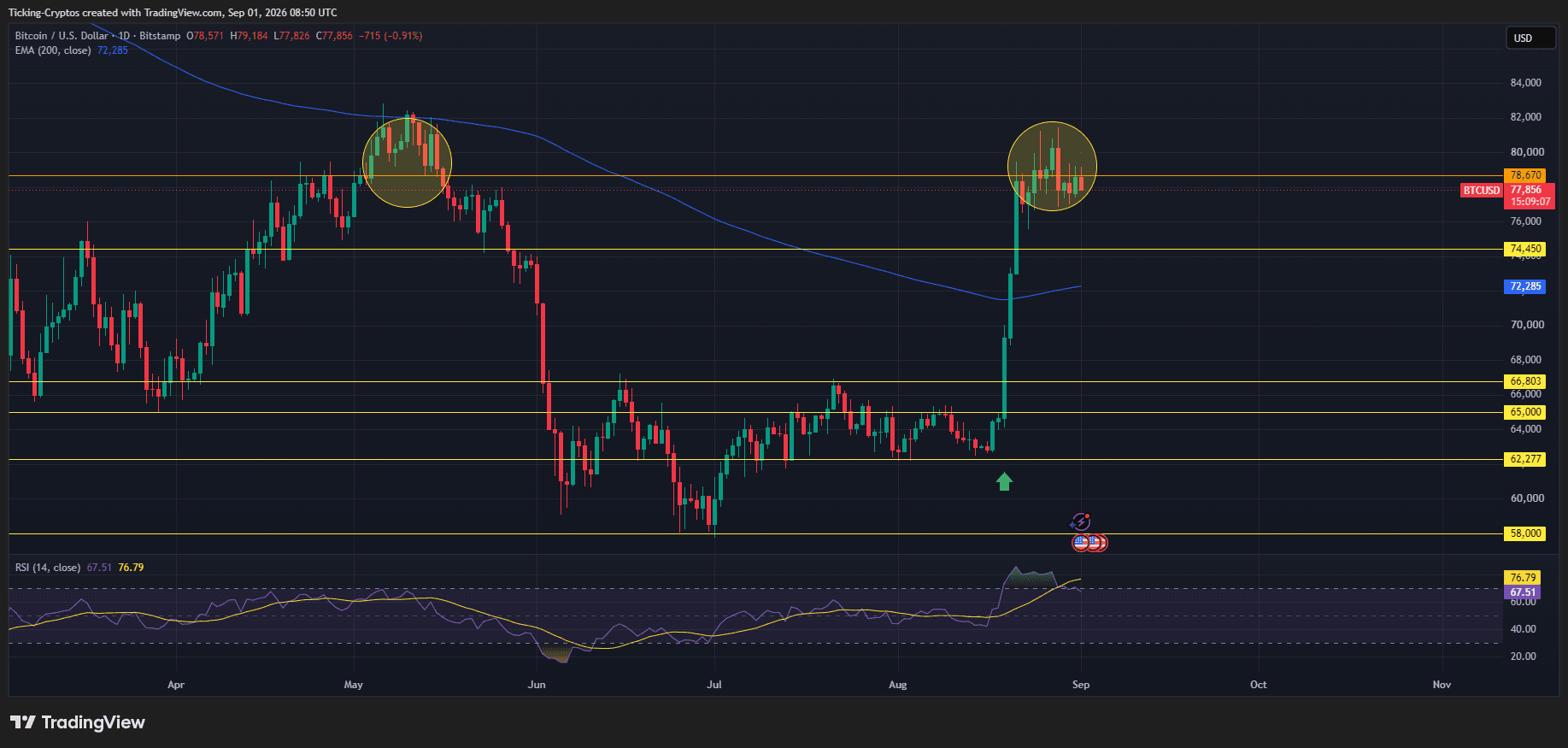
Bitcoin is pressing against the same horizontal band near $78,670 that capped price back in May, marked on the chart by the highlighted zone where the previous rally rolled over. The move that got us here was near vertical, a gap-like surge from the mid $60,000s to $79,000 in a matter of days, which means there is very little traded volume beneath the current price to catch a fall.
Deeper down the chart, $66,803, $65,000, $62,277 and $58,000 remain the structural levels from the summer range. Nobody wants to revisit them. They are worth knowing anyway.
September is not a quiet month this year. Three separate catalysts land inside the same window.
One analyst has flagged that mid September is the key risk window precisely because a Senate vote, a Fed decision and quadruple witching converge within days, and while spot Bitcoin ETFs took in nearly $2 billion in a single week, their best of the year, the funds remain more than $2.5 billion down for 2026. A strong week is not yet a trend.





