Australia’s July 1 AML/CTF deadline has turned regulated crypto transfers into a data workflow for exchanges and other virtual asset service providers.
Users can still hold and move crypto in self-custody. The friction begins when funds pass through a reporting entity, where a transfer instruction can trigger identity, wallet, counterparty, secure-messaging, and record-keeping checks before assets move or become available.
AUSTRAC’s transitional rules deferred some AML/CTF obligations for new registrable virtual asset services until July 1, 2026, including the rules covering transfers of value involving virtual assets.
The agency’s guidance says those deferred services were not required to comply with Travel Rule obligations for virtual asset transfers until that date.
That runway has now closed. For Australian exchanges and other virtual asset service providers, transfer instructions now carry more than an operational request.
They may require identity collection and verification, wallet classification, counterparty checks, secure message handling, and records linking the payer, payee, wallet, and transfer path.

The sharpest user-facing detail is the absence of a small-transfer carve-out.
AUSTRAC’s guidance on when the Travel Rule does not apply states that there is no minimum amount for a value transfer.
The rule applies to international or domestic value transfers of any amount, unless a specific exception applies.
That turns compliance friction into a question of both transfer type and transaction size. Crypto users often associate additional checks with large withdrawals, suspicious flows, or bank-style thresholds.
Australia’s framework points to a different operating rule. The key question is whether a reporting entity is providing a covered value-transfer service.
For users, that can translate into more prompts, more required recipient or wallet information, and more delays when an exchange needs to classify a destination, resolve missing information, or decide whether the next institution in a transfer chain can receive data securely.
For exchanges, even routine transfers may require systems that consistently collect and route information, rather than relying on manual reviews only for higher-value activity.
The result is as much a privacy-and-friction story as a compliance story. A blockchain withdrawal may still settle on-chain as usual, but the regulated transfer process around it now includes a data layer that must be handled before or alongside the movement of assets.
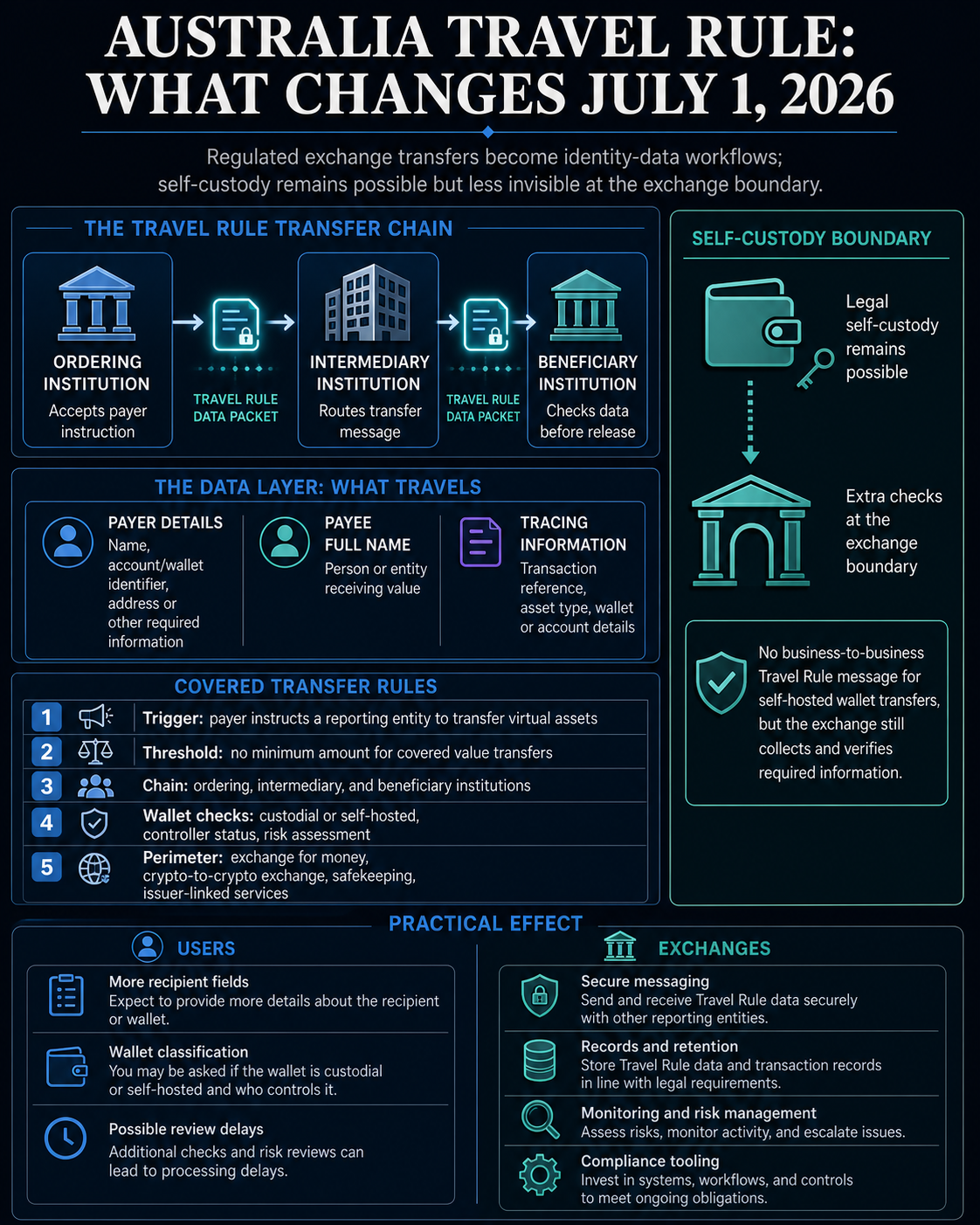
AUSTRAC’s Travel Rule overview describes a value transfer chain that begins whenever an institution accepts a payer's instruction to transfer value.
That chain can include an ordering institution, intermediary institutions, and a beneficiary institution.
In plain terms, the exchange that accepts a customer’s instruction may have to collect and verify payer information, collect the payee’s full name, and pass relevant transfer-message information to other businesses involved in the transfer.
A receiving institution may have to check whether information is missing or inaccurate before making the transferred value available.
This is why the July 1 date changes the experience of exchange-linked transfers. The crypto transaction itself is only one piece of the regulated workflow.
The business handling the transfer also needs to understand who is sending, who is receiving, what wallet or account is involved, and whether the information can move safely through the transfer chain.
The framework also makes repeat movements relevant. AUSTRAC says a new value transfer chain begins every time a payer instruction is accepted.
If a customer receives value into an account or custodial wallet and then instructs a separate transfer, that second movement can carry its own Travel Rule obligations.
That structure is likely to push exchanges toward more standardized withdrawal and deposit flows. Platforms need workflows that gather transfer data at the point of instruction and maintain enough information to satisfy both sending and receiving obligations.
The most important boundary is self-custody.
AUSTRAC’s virtual-asset guidance includes a specific rule for transfers involving self-hosted wallets. A transfer to a self-hosted wallet is exempt from sending Travel Rule information to another business in the transfer chain.
But that still leaves compliance work for the regulated entity handling the transfer.
For an ordering institution sending virtual assets to a self-hosted wallet, AUSTRAC says the business must collect and verify payer information, collect payee information, and collect tracing information.
For a beneficiary institution receiving virtual assets from a self-hosted wallet, the business must obtain payer information and tracing information, and if it does not already hold it, the payee’s full name before making the assets available.
The same guidance also says businesses need policies for determining whether a transfer is to or from a custodial or self-hosted wallet, assessing whether a custodial wallet controller is licensed or registered under laws that give effect to FATF recommendations, and managing risk where a wallet is controlled by a person not required to be licensed or registered.
That is the distinction users will feel. Holding assets in a private wallet remains possible.
Moving assets between private wallets differs from sending through a reporting entity. But when funds enter or leave an exchange, the platform may need to ask more questions about the wallet and the person controlling it.
In practice, self-custody becomes less invisible at the exchange boundary. The wallet may sit outside another regulated institution, but the exchange still has to decide what kind of wallet it is dealing with, what information it needs, and whether the transfer can proceed under its AML/CTF program.
The July 1 date also falls within a regulatory perimeter broader than Australia’s older digital-currency exchange model.
AUSTRAC’s virtual asset designated services guidance covers exchanging virtual assets for money, exchanging one virtual asset for another, virtual-asset safekeeping services, and some financial services connected with the offer or sale of a virtual asset.
Its VASP overview also outlines the ordering and beneficiary institution roles for businesses that accept instructions to transfer virtual assets or make transferred virtual assets available to customers.
That framing is important because the user experience now extends beyond fiat-to-crypto onboarding. Custody, crypto-to-crypto exchange, transfer services, and issuer-linked financial services can bring businesses into the AML/CTF framework where the service has the required connection to Australia.
CryptoSlate’s Australia AML/CTF virtual-asset profile already tracks the broader reform timeline, including the March 31 commencement, the July 1 deferred-obligation date, and the July 29 registration deadline for providers beginning new registrable virtual asset services before July 1.
The live news now is the operational effect of that timeline: the obligation has moved from future compliance to being built into the transfer flow.
The market consequence is straightforward: Travel Rule compliance is now product infrastructure.
AUSTRAC’s virtual-asset guidance requires businesses to determine wallet type, assess counterparty licensing or registration status, manage risks associated with self-hosted wallets, and consider whether transfer-message information can be transmitted securely and confidentially.
These legal obligations have product consequences. They require data collection, wallet intelligence, transaction monitoring, message routing, and record-keeping systems that fit inside a live exchange workflow.
Compliance firms have been positioning around that shift. Chainalysis described July 1 as a major milestone in Australia’s compressed compliance calendar, while 21 Analytics summarized the Australian threshold as applying to all transactions unless an exemption applies.
Those are vendor perspectives, but they point to the same operational reality created by the primary AUSTRAC rules.
Exchange-facing guidance is already translating the rule into user language. CoinSpot’s public support page on the Travel Rule says Australian exchanges and VASPs need to update how cryptocurrency is sent and received from July 1.
That is where the story meets users. A rule designed around information flows between institutions becomes a product-design problem: what does the platform ask for, when does it ask, how does it explain the request, and what happens when the other side of the transfer is a private wallet or a service that cannot securely receive Travel Rule data?
For users who value privacy, the change makes the trade-off more explicit. Self-custody remains available, but the regulated bridge between self-custody and exchanges is more likely to ask for information.
For exchanges, the competitive question becomes whether compliance can be handled without turning every transfer into a confusing support ticket.
The immediate answer for Australian crypto users is that regulated transfers can now carry more data obligations regardless of size. The immediate answer for exchanges is that July 1 turns Travel Rule readiness from a project plan into a live operating requirement.
The next signals are practical rather than philosophical. Watch whether Australian platforms add wallet-ownership checks, recipient-detail fields, longer review times, or clearer explanations around self-hosted wallet transfers.
Watch whether compliance vendors become more embedded in exchange withdrawal flows. Watch whether users respond by keeping more assets in self-custody, or by accepting more data sharing as the price of using regulated venues.
The rule preserves private crypto use in Australia while reshaping the regulated edge around it. From July 1, the simple question of where a user wants to send crypto can require an exchange to first answer a second set of questions: who is involved, what kind of wallet it is, what information must travel, and whether the transfer can proceed under AUSTRAC’s AML/CTF framework.
The post Australia’s new crypto transfer rules to make exchange withdrawals pass through identity checks appeared first on CryptoSlate.