Banks decide whats true by writing it down. A blockchain gets thousands of strangers who distrust each other to agree on one ledger with no one in charge.
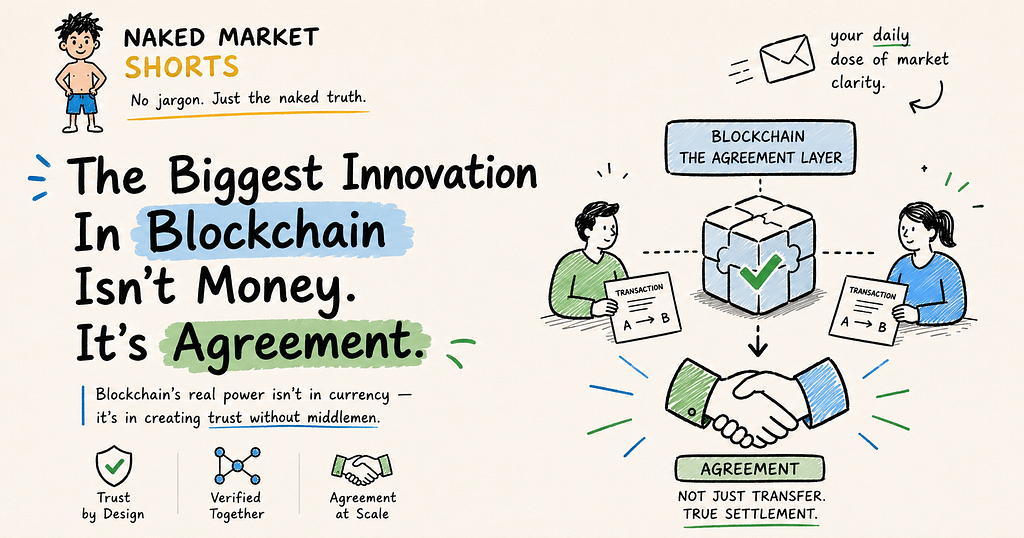
Naked Market breaks down macro finance, blockchain infrastructure, AI systems, and automated trading to help readers understand the future of global finance before the mainstream catches up.
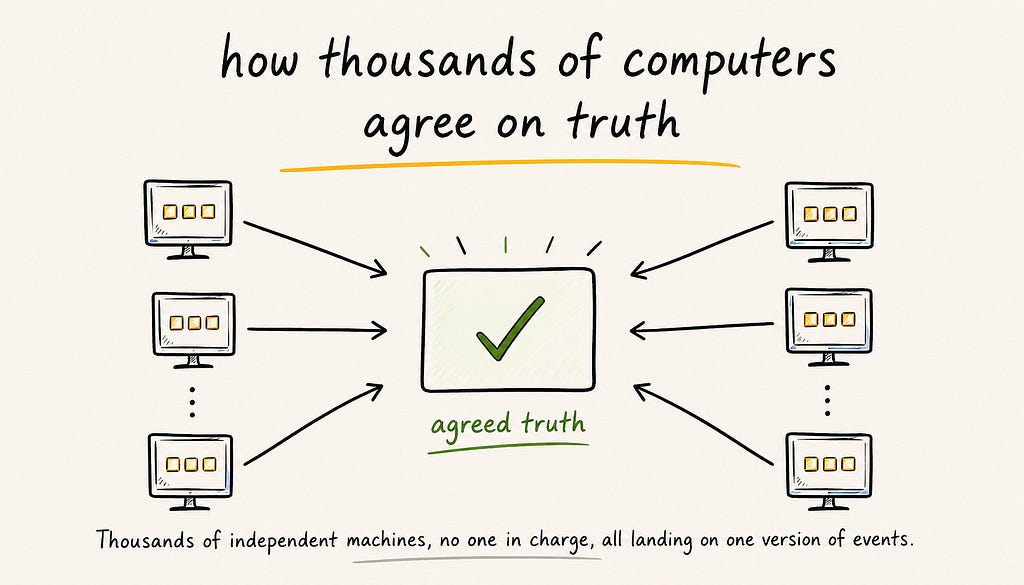
Imagine a thousand strangers scattered across the planet who have never met and have no reason to trust each other. Now ask them to agree to the exact penny, in the exact order on who paid who today. No boss in the room. No referee with the final word. No one anybody is required to believe.
Sounds impossible. For most of history it was. Every system we ever built for tracking money quietly solved it the same lazy way: put someone in charge.
Your bank balance is true because your bank says so. The land record is true because the registry says so. The score is true because the league says so. In every case, truth is whatever the authority at the centre writes down. We dont actually agree on it. We outsource it.
That works right up until you stop trusting the authority or it makes a mistake, or it gets leaned on, or it just decides to change the number. Then theres no appeal. The referee owns the truth, and you own whatever the referee says you own.
A blockchain pulls off something that sounds like a magic trick. It gets thousands of machines that dont trust each other to agree on one version of events, with no referee at all. Most people assume that means either chaos or some clever cryptography that magically forces everyone to be honest. Both are wrong.
Theres no honesty machine. What there is, is a way of making the truth the cheapest thing in the room to agree on. And the whole idea of money moving onto shared global rails — 8 billion people and 180-odd countries eventually settling on the same ledger rests entirely on whether strangers can agree without a boss.
So lets watch them do it.
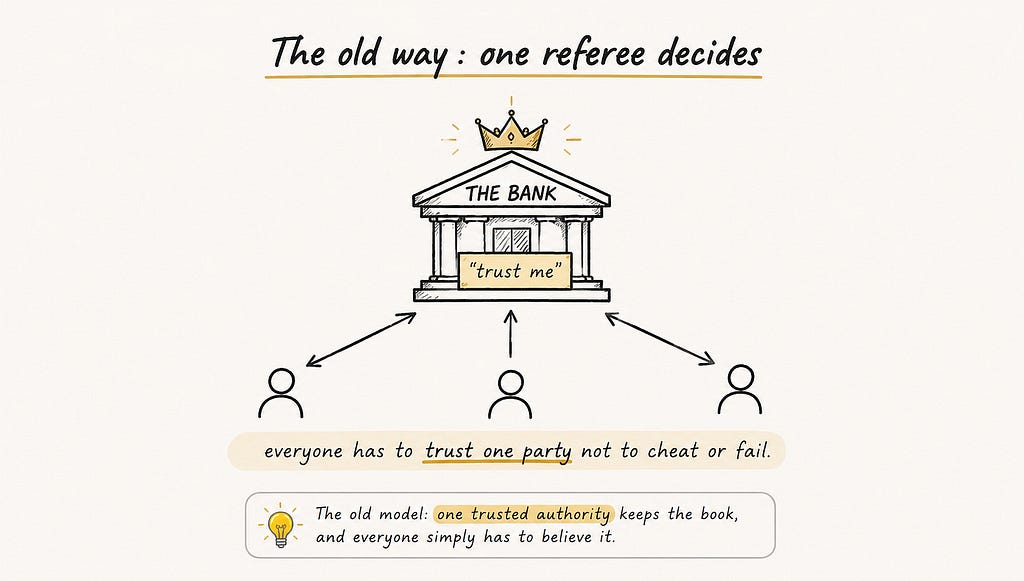
For thousands of years there was exactly one way to make a crowd agree on a number — appoint someone to keep the book, and agree to trust them. A king. A bank. A clearing house. A platform. One throne, one version of events.
Its clean and its fast and it works, with a single catch: youve handed one party the power to cheat, to fail, or to be forced. The whole system inherits the honesty of its weakest referee. When that referee wobbles, everything built on top of it wobbles too.
So the real question was never “how do we track money.” We cracked that ages ago. The hard question was this: can a group agree on truth WITHOUT trusting any single one of them? For decades, computer scientists had a name for that problem and mostly a reason it couldnt be done out in the open.
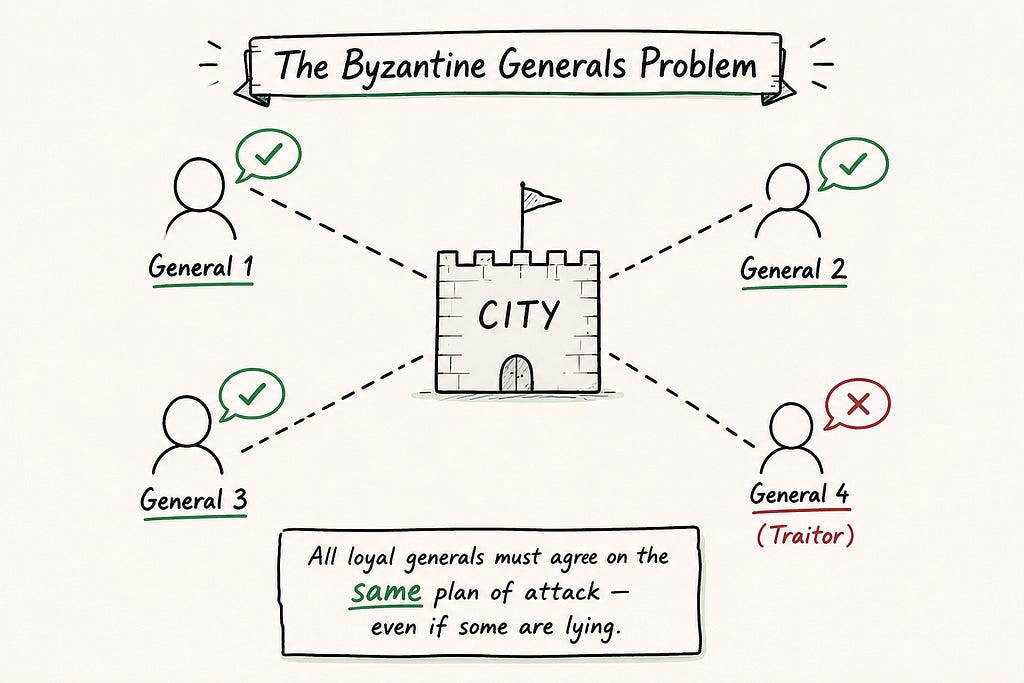
In 1982, three computer scientists — Leslie Lamport, Robert Shostak and Marshall Pease wrote the problem up as a little story. (The “Byzantine” bit is just a nod to an old empire famous for plotting and intrigue.)
Picture several generals camped around a city, each commanding part of the army. They only win if they all attack at the same moment. They can only talk by sending messengers back and forth across enemy ground. And heres the poison: some of the generals or some of the messengers are traitors. Theyll whisper “attack” to half and “retreat” to the other half, purely to split the group and get everyone killed.
The puzzle: can the loyal generals still end up on the same plan, even while liars are actively feeding them garbage? No central command. No reliable way to know who to believe.
That is, almost exactly, the problem a global ledger faces. Swap generals for computers. Swap “attack at dawn” for “this payment is real and happened in this order.” Swap traitors for anyone who wants to quietly spend the same money twice. Solve the generals, and you can run money with no one in charge. Fail, and you cant.
For years the honest answer was: inside a closed group where you already know everyone, its solvable. Out in the open, where anyone can join anonymously, it looked hopeless. Heres the exact reason why.
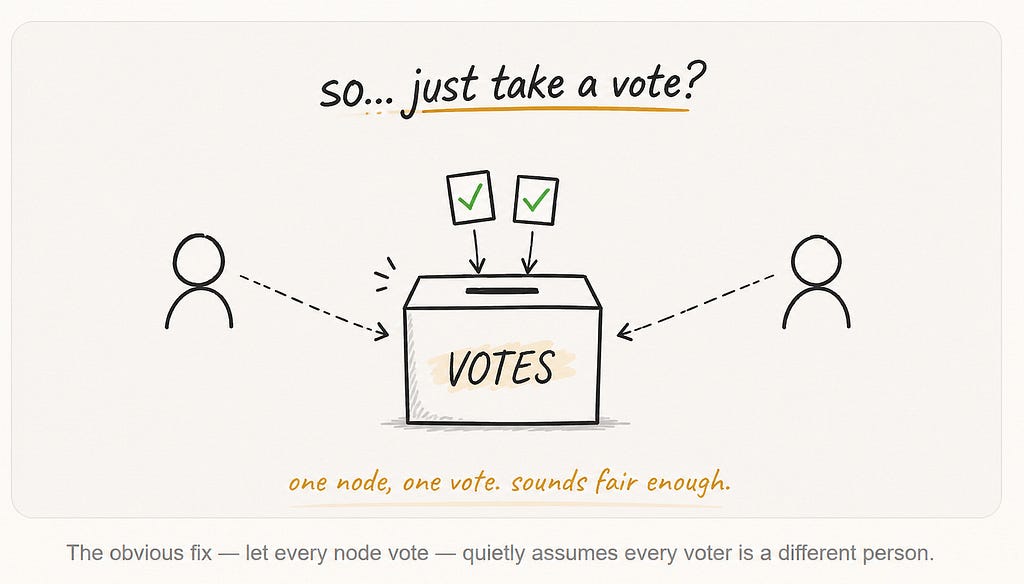
The obvious fix is a vote. Let every computer on the network get a say, go with the majority, done. One node, one vote. Feels fair, feels democratic.
It falls apart the instant you remember the internet doesnt check IDs.
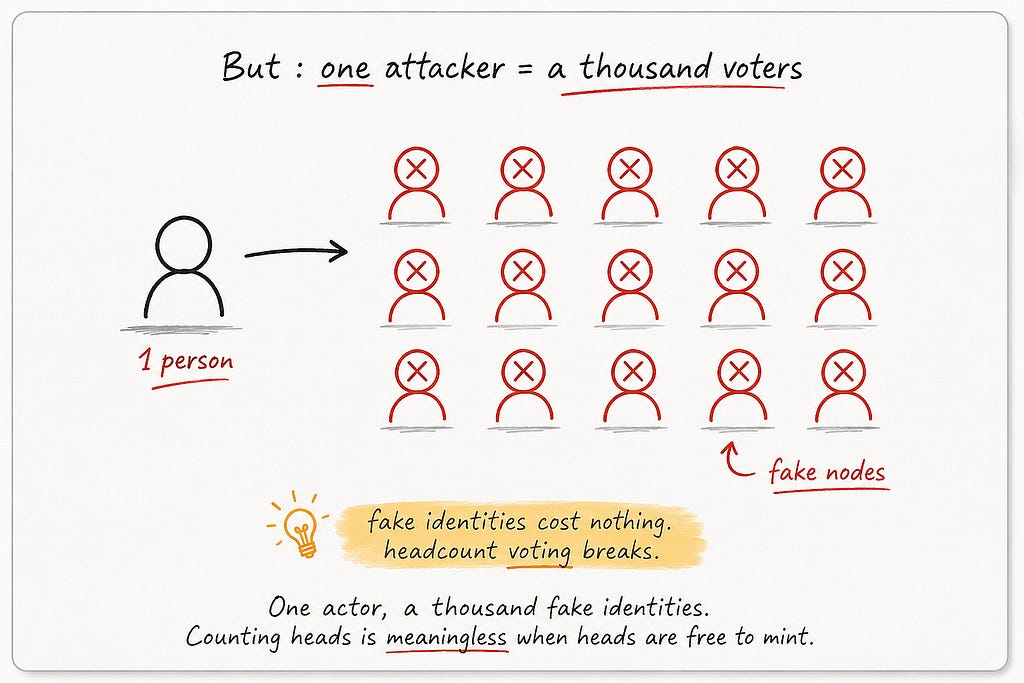
On an open network, an identity costs nothing. No passport, no phone number, no nothing. One person can spin up a thousand “computers” in an afternoon, each one looking like a separate, independent voter. So your nice democratic vote gets quietly drowned — one attacker turns up wearing ten thousand masks and wins every single poll.
This has a name. Its a Sybil attack, named after a 1973 book about a woman with many personalities, and its the wall every open system runs straight into. If identities are free to fake, counting them is meaningless. You can vote with WHO you are only when being someone is expensive. On the open internet, it just isnt.
Which is the trapdoor Bitcoins anonymous creator quietly stepped through. If you cant vote with identities, then vote with something nobody can fake for free.
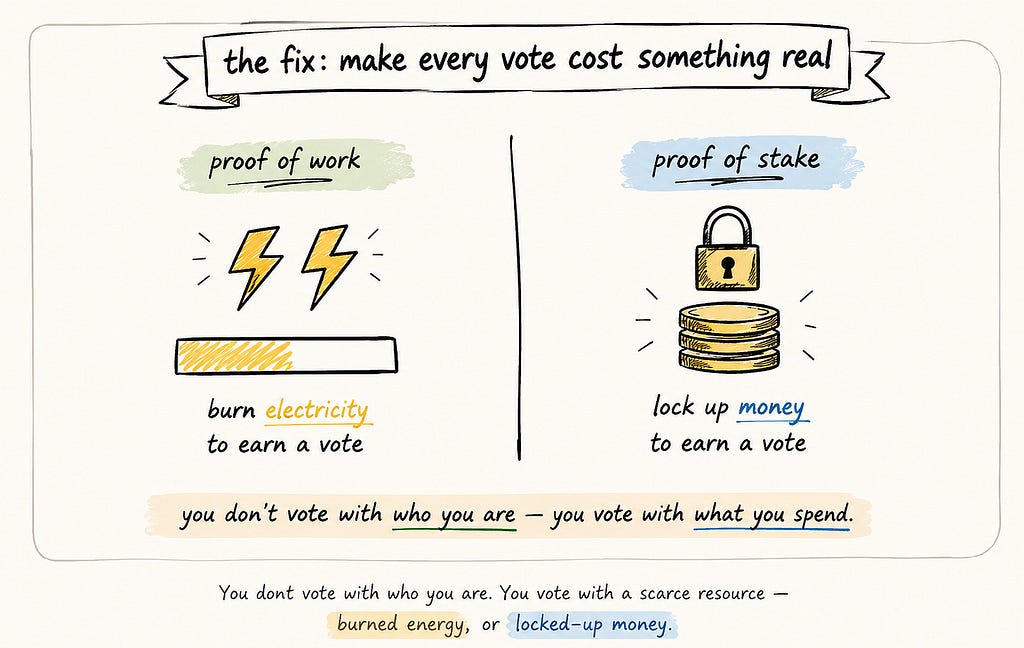
Heres the whole idea, and once it clicks the rest is just detail. You dont get a vote because you exist. You earn a vote by spending something scarce that nobody can counterfeit. Burn real-world energy, or lock up real-world money. Now minting ten thousand fake identities buys you nothing because every last one of them still has to pay the toll.
Two flavours of toll run almost the entire industry.
The first is proof of work. To get a say in the next block, your computer has to win a kind of lottery you can only enter by doing staggering amounts of pointless arithmetic which burns electricity, real money, right now. Thats what “mining” actually is. Youre not voting with your identity. Youre voting with your power bill.
The second is proof of stake — the model Ethereum has run on since 2022. Instead of burning energy out in the world, you lock up a pile of the networks own money as a security deposit. Step out of line and you lose it. Here you vote with money youve put directly at risk.
Different tolls, identical logic: attacking the vote now costs a fortune, and faking identities is pointless. So lets see how each one actually arrives at an answer.
In a proof-of-work system, the rule for “what really happened” is almost insultingly simple, the true history is whichever chain has the most work stacked behind it. Usually thats just the longest one. (If you want the nuts and bolts of how blocks get chained together in the first place, we built one from scratch in an earlier issue.)
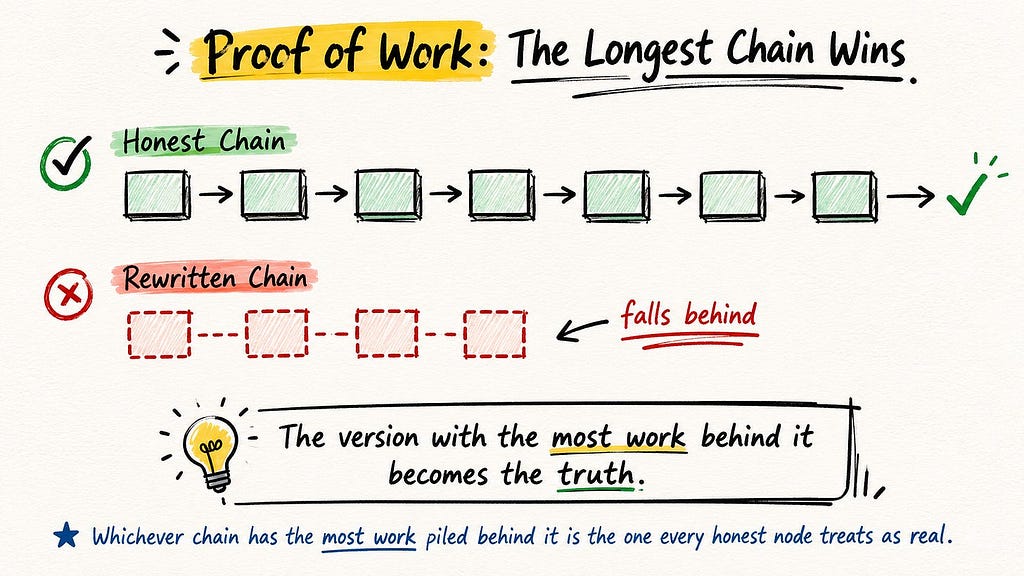
Miners everywhere race to add the next block. Sometimes two of them find one at nearly the same instant and the chain briefly splits two candidate versions of the truth sitting side by side. No committee meets. No vote is called. Everyone just keeps building on whichever branch they happened to see first, and within a block or two one side pulls ahead. The shorter branch gets abandoned, its transactions tipped back into the queue, and the whole network quietly re-converges on a single thread.
Thats the genius of it. Agreement is never announced. It emerges, on its own, from everyone chasing the heaviest chain. To force YOUR version of history to win, youd have to out-build every honest miner on earth combined not for a moment, but forever. Thats the famous 51% attack, and for a serious chain it runs into the billions. Which is precisely the point: the truth is simply the version too expensive for anyone to overturn.
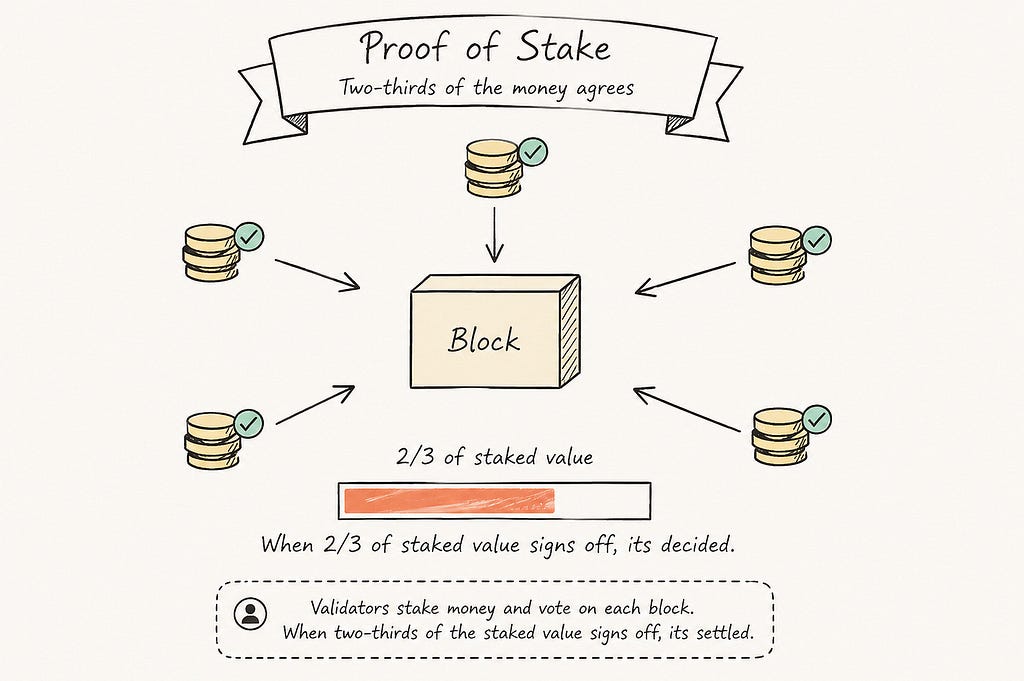
Proof of stake reaches the same place by a different road. Instead of the heaviest chain quietly winning a silent race, validators vote out loud but their votes are weighted by money staked, not by headcount (which, remember, is fakeable).
On Ethereum there are now over a million validators, each one having locked up a deposit. Time gets sliced into twelve-second slots. In each slot, one validator proposes a block and a crowd of others attest vote on whether it looks right. The number that matters is two-thirds: once validators holding two-thirds of all the staked money have signed off, the network treats that block as decided.
Notice what just replaced the referee. Not a person. A threshold. “True” becomes nothing more than “two-thirds of the money at stake vouched for it.” And because that money is real and forfeitable, vouching for a lie is very much not a free action which is the next piece of the machine.
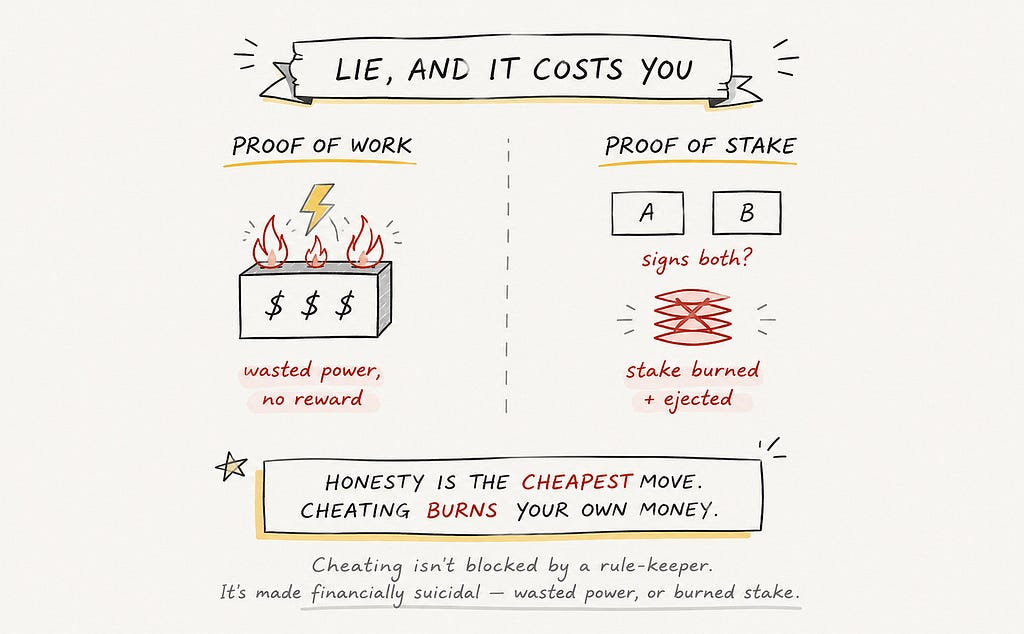
No system actually stops you from lying. They just make lying cost more than telling the truth automatically, with no judge in the loop.
Under proof of work, if you mine on a fake version of history, you spend all that electricity and the rest of the network simply ignores your blocks. You torched real money chasing a reward that never arrives. Honesty wins because honesty is the only move that pays.
Under proof of stake its sharper still. Try to vote for two conflicting versions of history at once the digital version of swearing two contradictory oaths and the protocol catches it, burns a chunk of your deposit, and ejects you. They literally call it slashing. Coordinate the attack with other validators and the penalty scales up, until a big enough conspiracy wipes out the entire stake.
Nobody on the network has to be honest. They just have to be unwilling to set their own money on fire.
As Ethereums own documentation puts it, the incentives pay for honesty and punish bad actors. Youre not trusting people to be good. Youre trusting them to be greedy in the right direction which is a far safer thing to bet on.
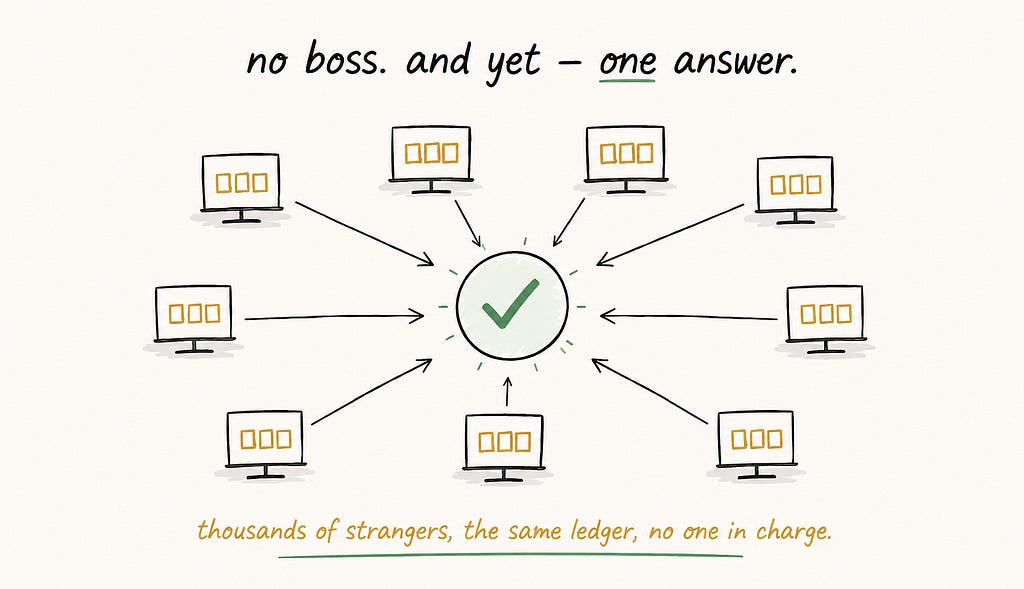
Step back and notice what actually happened. Nobody decreed the truth. Thousands of machines that dont know or trust each other each followed the same plain rules chase the heaviest chain, or back the two-thirds majority and out the far end popped a single shared history they all accept.
Truth on a blockchain isnt a fact handed down from above. Its an equilibrium. Its the version it would cost too much for anyone to overturn, so everybody just builds on it instead. Agreement stops being a decision somebody makes and becomes a side effect of everyone acting in their own self-interest.
Which raises the one question that actually matters once money is on the line: after theyve “agreed,” how sure can you be it wont quietly un-happen?
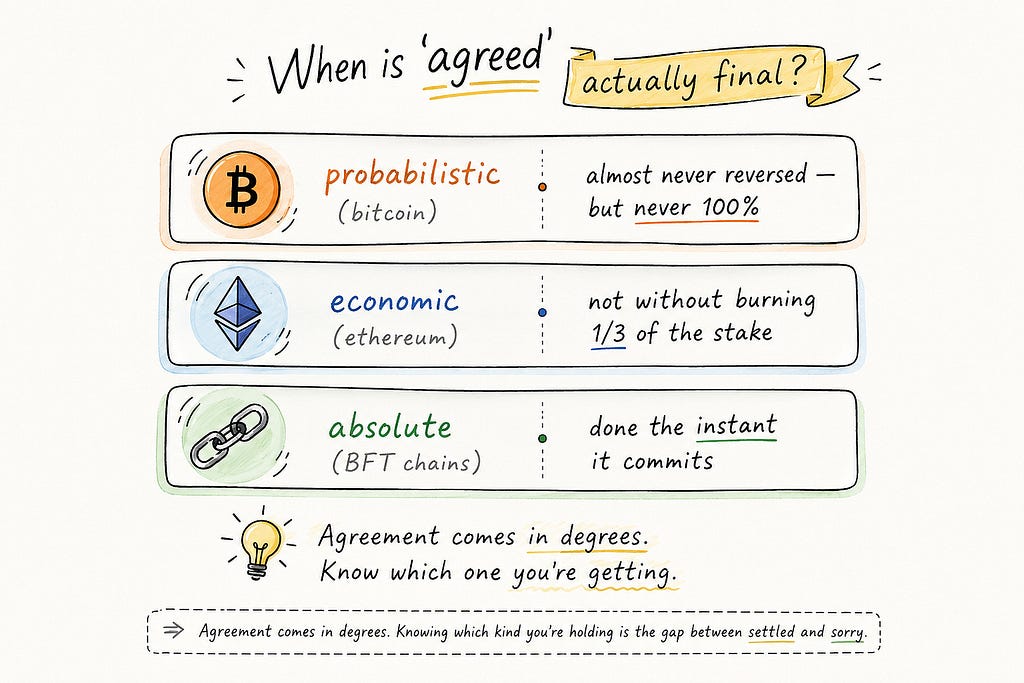
This is the part beginners skip right past, and it costs real people real money. “Confirmed” is not the same as “final.” Agreement arrives in degrees.
On Bitcoin, finality is probabilistic. A block is never 100% permanent — it just gets exponentially harder to reverse as more blocks pile on top of it. The rough convention is to wait for six blocks, about an hour, before treating a large payment as done. Not certainty. Just odds so steep that reversing it stops being worth anyones while.
On Ethereum, finality is economic. After roughly thirteen minutes a block gets explicitly “finalised,” and undoing it would force an attacker to destroy at least a third of all staked ether — millions of coins, billions of dollars, deliberately set on fire. Not impossible on paper. Financially insane in practice.
On a third family of chains — the ones banks tend to prefer finality is absolute: the instant a block commits, its done, full stop, no take-backs.
This is not a technicality. The classic way people lose money is acting on a payment that looked confirmed but wasnt final yet, then watching the network quietly reorganise and erase it. Exchanges have been drained in exactly this way. Settlement isnt the moment a transaction appears. Its the moment it can no longer be reversed.
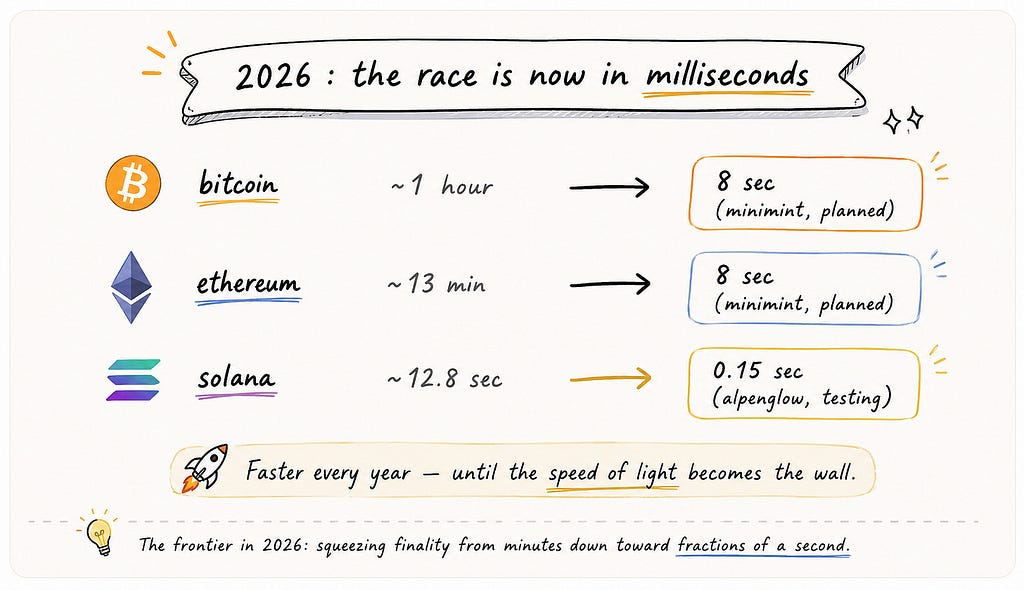
For years the knock on this whole approach was speed. Waiting an hour or even thirteen minutes to be sure a payment has truly settled feels absurd next to a card swipe. In 2026, that gap is closing fast.
In February, Ethereums researchers published a long-range plan that Vitalik Buterin called “very important,” built around a new consensus design nicknamed Minimmit. The goal is to crush finality from around sixteen minutes toward as little as eight seconds, with block times stepping down from twelve seconds toward two.
Solana is pushing even harder. Its largest-ever consensus overhaul, Alpenglow, went live for testing in May and targets final settlement in roughly 150 milliseconds, faster than you can blink by swapping out its old machinery wholesale. As a bonus, it stops treating validator votes as on-chain transactions, which had been eating something like three-quarters of the networks space.
Theres a real ceiling here, and its physics, not engineering. As one veteran put it, you cannot push a confirmation through a fibre-optic cable across an ocean and back faster than light will carry it. But inside that hard limit, “agreement among strangers” is collapsing from an hour toward a heartbeat which is exactly what money rails have always needed it to do.
So heres the tool to walk away with. Next time something waves the word “decentralised” at you — a coin, a chain, a tokenised-asset pitch, a government pilot dont argue about the technology. Run it through three questions.
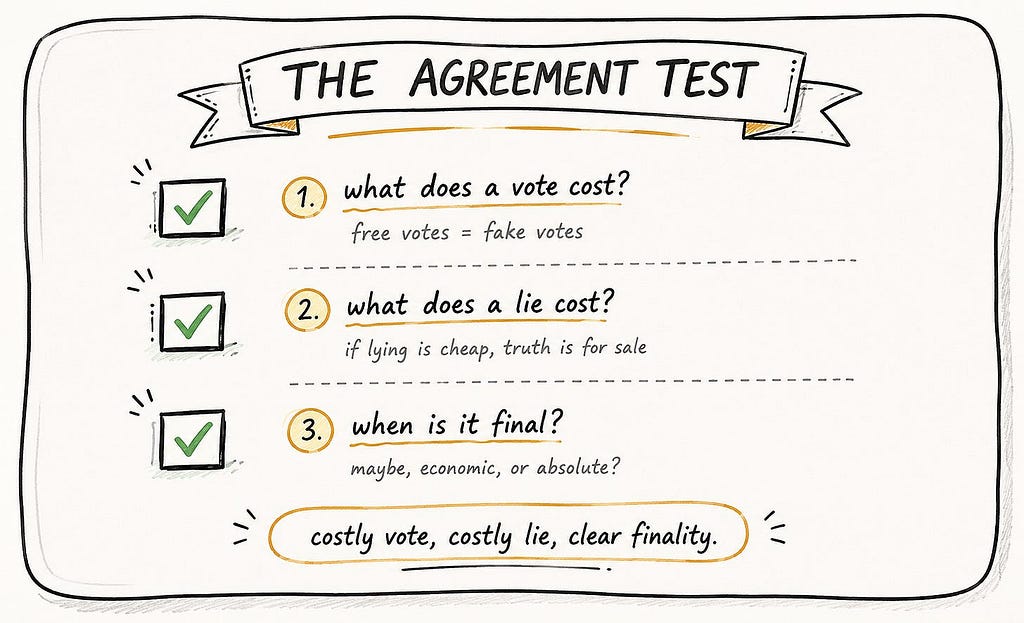
Costly vote, costly lie, clear finality. Pass all three and youre looking at genuine trustless agreement. Fail one and youre almost always looking at an old-fashioned referee wearing a blockchain costume.
Zoom all the way out and the point of the whole exercise snaps into focus.
A single financial system for the planet has always smashed into the same wall: who keeps the book? No country trusts another to control the ledger the entire world settles on. No bank should hold that power either. The honest broker everyone accepts has simply never existed which is why we still live with 180-odd currencies, a maze of correspondent banks, and money that crawls across borders over days.
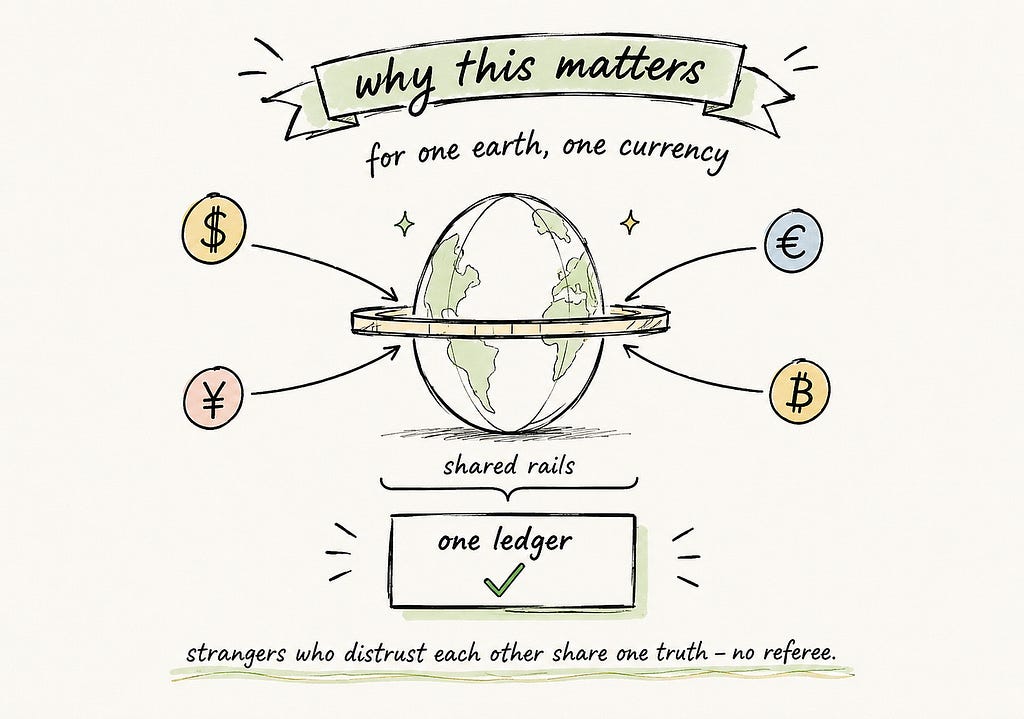
Consensus is the way around that wall. It lets parties who flatly distrust each other share one set of books anyway because the thing keeping everyone honest isnt a trusted authority. Its math and cost. No nation in charge. No bank in charge. No off-switch. Just rules that make agreement the cheapest move and cheating the most expensive one.
Thats the quiet machine humming underneath the One Earth, One Currency idea this newsletter keeps circling back to. Stablecoins, tokenised treasuries, digital currencies, AI agents that pay each other directly — every one of them is built on top of this single trick: thousands of strangers, no referee, agreeing on what is true.
Solve agreement without a boss, and a shared financial world stops being a fantasy. It starts being an engineering problem with a date on it.
If you want to understand the architecture of where global money is heading before it becomes obvious — subscribe. One clear breakdown at a time.
The Biggest Innovation In Blockchain Isn’t Money. It’s Agreement. was originally published in Coinmonks on Medium, where people are continuing the conversation by highlighting and responding to this story.





