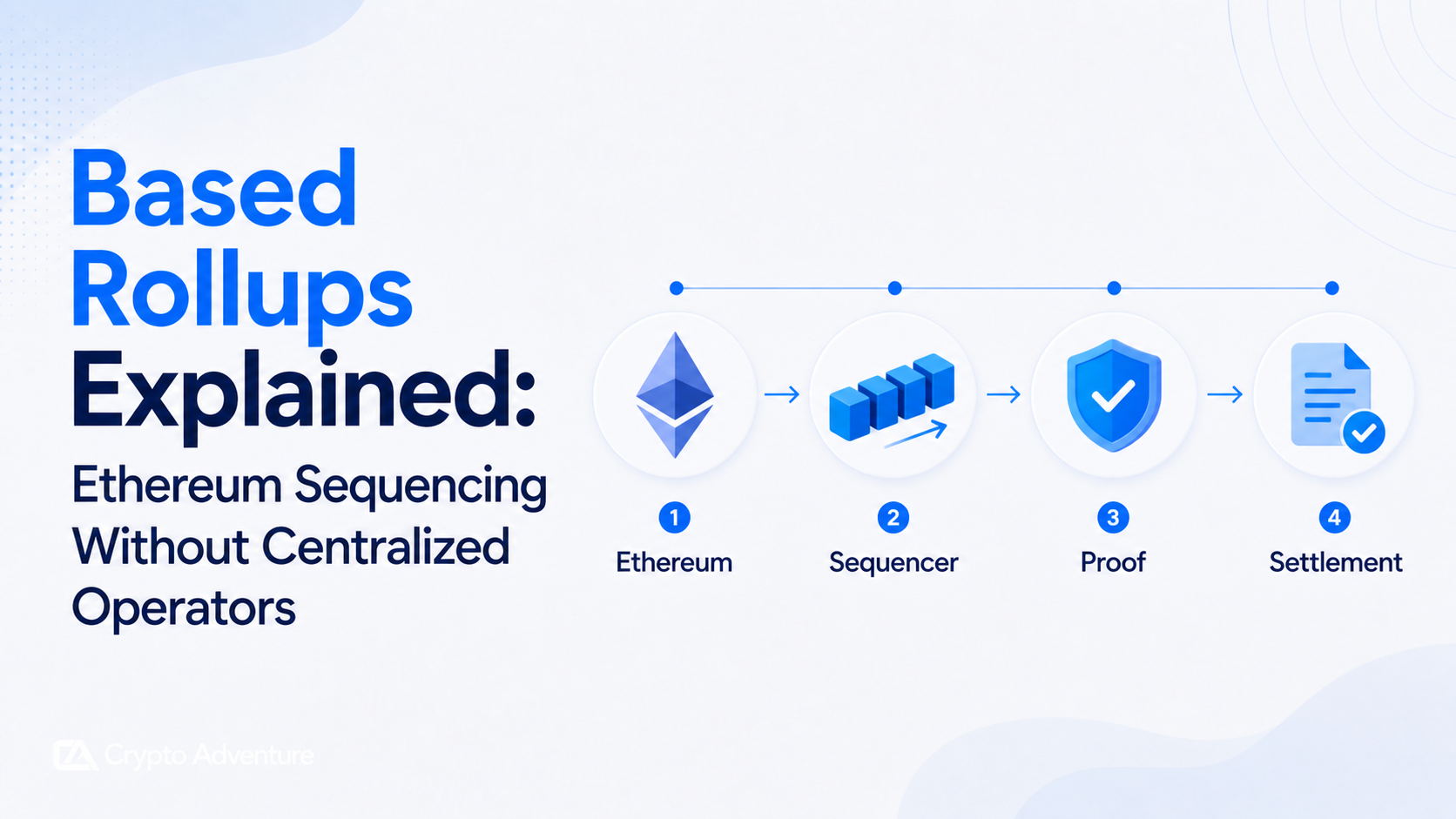
Based rollups are Ethereum Layer 2 networks that use Ethereum itself for transaction sequencing. In a normal rollup, a separate sequencer orders L2 transactions before the rollup posts data and state commitments to Ethereum. In a based rollup, sequencing moves closer to Ethereum’s own block-building pipeline.
A rollup is based when the next Ethereum L1 proposer can permissionlessly include the next rollup block as part of the next Ethereum block, usually with help from searchers and builders. The rollup still executes offchain, but ordering power is no longer controlled by a single L2 operator.
This changes the trust model. A centralized sequencer can offer fast confirmations, smooth user experience, and strong product control, but it can also censor transactions, capture MEV, pause ordering, or become a single point of failure. Ethereum’s own roadmap recognizes that rollups reduce fees but still rely on centralized components that mature systems should remove over time.
Sequencing decides which transactions enter a block and in what order. That sounds technical, but it affects real user outcomes. Transaction order can influence MEV, liquidation priority, sandwich attacks, bridge timing, arbitrage, and whether a user’s transaction gets delayed or excluded.
A centralized sequencer can make an L2 feel fast because it can issue quick soft confirmations before final settlement. The trade-off is trust. Users depend on that sequencer to keep operating, treat transactions fairly, and eventually publish data to Ethereum. Centralized operators can influence transaction ordering in both optimistic rollups and zk-rollups.
Based rollups try to reduce that operator trust. They outsource ordering to Ethereum’s validator and proposer system. That gives the rollup stronger alignment with Ethereum’s decentralization, liveness, and neutrality.
A based rollup still has the main rollup structure: users submit transactions, the rollup executes them, and Ethereum provides settlement and data availability. The difference is who gets to order the rollup’s blocks.
Instead of one sequencer creating the canonical L2 order, Ethereum validators can include rollup blocks through the L1 block process. For example, Taiko does not use a centralized L2 sequencer; anyone can become a proposer permissionlessly, and the Ethereum validator for the current block ultimately sequences the rollup.
That design is powerful because it makes the rollup inherit Ethereum’s liveness more directly. If Ethereum keeps producing blocks, the based rollup can keep making progress through the same proposer pipeline. The rollup does not need a separate sequencer company to stay online.
Based rollups matter because they attack one of Ethereum L2’s biggest contradictions. Rollups settle on Ethereum for security, but many still depend on centralized ordering for user experience. That creates a trust gap between Ethereum-level settlement and L2-level transaction flow.
Based sequencing narrows that gap. It can reduce censorship risk, remove a separate sequencer monopoly, and push sequencing revenue back toward Ethereum validators rather than a closed L2 operator. This makes based rollups more Ethereum-aligned than rollups that control ordering through a private sequencer.
The design can also reduce governance risk. If a rollup operator controls sequencing, future changes to that operator, its governance, or its legal exposure can affect users. A based rollup keeps the ordering layer closer to Ethereum’s existing validator set.
The hard part is speed. A centralized sequencer can give users fast confirmations because it controls ordering immediately. A basic based rollup waits for Ethereum block production, which can feel slower for users who expect instant L2 feedback.
That is why preconfirmations are becoming central to based rollup design. Based preconfirmations allow an Ethereum validator or preconfirmer to issue a cryptographic commitment that a transaction will be included or executed before the final Ethereum block lands. Taiko’s based preconfirmation design uses commitments, collateral, forced inclusion, and slashing penalties to improve speed while keeping the system tied to Ethereum.
This is the key product challenge. Based rollups need decentralized sequencing without making users feel like every transaction waits for slow finality. Preconfirmations are the bridge between Ethereum-grade neutrality and app-grade speed.
The first benefit is stronger decentralization. Based rollups remove the separate centralized sequencer as the main ordering authority.
The second benefit is Ethereum alignment. Sequencing happens through Ethereum’s own validator and proposer system, so value and liveness move closer to the base layer.
The third benefit is better censorship resistance. A single operator has less power to exclude transactions, delay withdrawals, or control MEV flow.
The fourth benefit is simpler trust messaging. Users do not need to trust a separate sequencer company in the same way. They mainly rely on Ethereum and the rollup’s proof, settlement, and data systems.
The first risk is user experience. Without strong preconfirmations, based rollups can feel slower than centralized-sequencer L2s.
The second risk is implementation complexity. Preconfirmation systems, proposer commitments, collateral, forced inclusion, and slashing logic need careful engineering.
The third risk is MEV design. Based sequencing can redirect MEV toward Ethereum’s block-building pipeline, but it does not magically remove MEV. It changes where MEV is captured and how it is managed.
The fourth risk is ecosystem readiness. Many dapps, wallets, RPC providers, bridges, and users are already tuned around today’s L2 confirmation assumptions. Based rollups need tooling that makes the transition feel invisible.
Based rollups are strongest for users and developers who care about Ethereum neutrality, censorship resistance, and long-term decentralization. They are especially relevant for DeFi, bridges, settlement-heavy applications, and protocols that cannot afford a single sequencer failure.
They may be less attractive for applications that need ultra-fast confirmations before preconfirmation systems mature. Games, consumer apps, and high-frequency trading systems may prefer centralized-sequencer speed unless based rollups can deliver comparable soft confirmation performance.
Based rollups move Ethereum L2 sequencing away from centralized operators and closer to Ethereum itself. The model uses Ethereum validators and proposers as the sequencing layer, which can improve neutrality, reduce operator trust, and align rollups more closely with Ethereum’s security model.
The trade-off is execution. Based rollups need strong preconfirmations, careful MEV design, reliable proposer incentives, and wallet-friendly UX before they can fully compete with fast centralized sequencers. The idea is one of Ethereum’s most important L2 design paths because it targets the real bottleneck behind many rollups: not only scaling transactions, but decentralizing who gets to order them.
The post Based Rollups Explained: Ethereum Sequencing Without Centralized Operators appeared first on Crypto Adventure.





