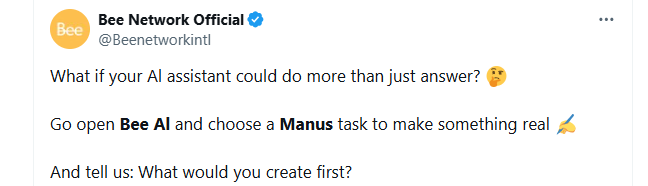
The platform just pushed a fresh feature inside its mining app – an AI assistant called Manus. The tool lets users generate real outputs: websites, apps, designs, even functional code, all through a chat-style interface inside the AI. The team posted about it on June 3, 2026, asking the community what they would build first.
Manus is a task-execution AI, meaning it takes instructions and actually completes them, producing something usable at the end. Inside the app, users can open AI, pick a Manus task, and walk away with a built output rather than just a text response.
The timing of this Bee Network update makes sense from a product roadmap angle. Phase 2 of the project focuses on building community infrastructure – KYC verification, node systems, and Dapp ecosystems.
Layering in an AI tool expands what the platform offers beyond basic mining. The project has always positioned itself as a full Web3 interactive platform, not just a coin tap app.
However, this new AI feature reads more like distraction than progress to anyone who’s waiting for the Bee-Network listing.
The app runs on a simple loop. Open it once every 24 hours, tap the bee-button, and earn coins at the current base rate. No device needs to stay on.
New users who join through an invitation start with 88 BEE-coins already in their balance. Referral bonuses decay over time – full 25% in year one, dropping to 20%, 15%, 10%, and 5% across subsequent years.
The coin supply formula is tied directly to user activity. Total supply equals all tokens earned by Pioneers, Ambassadors, and Verifiers, plus 25% on top allocated to the core development team.
No fixed cap exists, the final number depends entirely on how many people mine before the project hits 1 billion users.
The project started building its user base in 2020, and as of mid-2026 the Bee Network launch date has never been announced. The token still cannot be withdrawn, sold, or traded on any exchange.
All coins mined so far remain indirectly locked. While many users have completed KYC, there has been no progress towards TGE, fueling community frustration.
The official FAQ states plainly that no withdrawal is possible in Stage 1 or Stage 2. The Bee-Network listing only unlocks when the project reaches the exchange phase, and the roadmap ties that to community maturity, not a calendar.
Listing Date: What the Project Says and What the Timeline Suggests
The project whitepaper frames the exchange listing as a Phase 3 milestone, conditional on the ecosystem becoming mature and sustainable. Phase 3 covers 10 million to 100 million users and includes launching the value exchange marketplace.
Reading the roadmap structure:
Phase 1 reached 1 million users,
Phase 2 focuses on KYC and node systems, and
Phase 3 triggers the Bee Network launch onto exchanges.
If the project is currently in Phase 2 and Phase 3 requires a user base between 10 million and 100 million before listing conditions are met, the Bee Network listing date probably in late 2026 at the earliest.
The whitepaper describes the foundation announcements – core team, advisors, and sponsors, as part of the pre-listing phase. Until it drops, the launch update most users are waiting for has no firm ground to stand on.
$BEE's path closely mirrors Pi Network. Pi launched its mining app in March 2019, ran the same daily-tap model, built tens of millions of users over years with no tradeable token, and finally opened its mainnet and exchange listing in February 2025 – roughly six years after launch.
Pi never gave firm listing dates either. It ran on roadmap phases, KYC requirements, and community growth milestones, the same language Bee-Network uses today.
If Bee Network follows that same arc, the token listing is possible, but the community waiting for it should expect a timeline measured in phases completed, not months promised.
Note: This article is for information purposes only. All the information and facts are based on market present data. The article itself does not claim anything.





