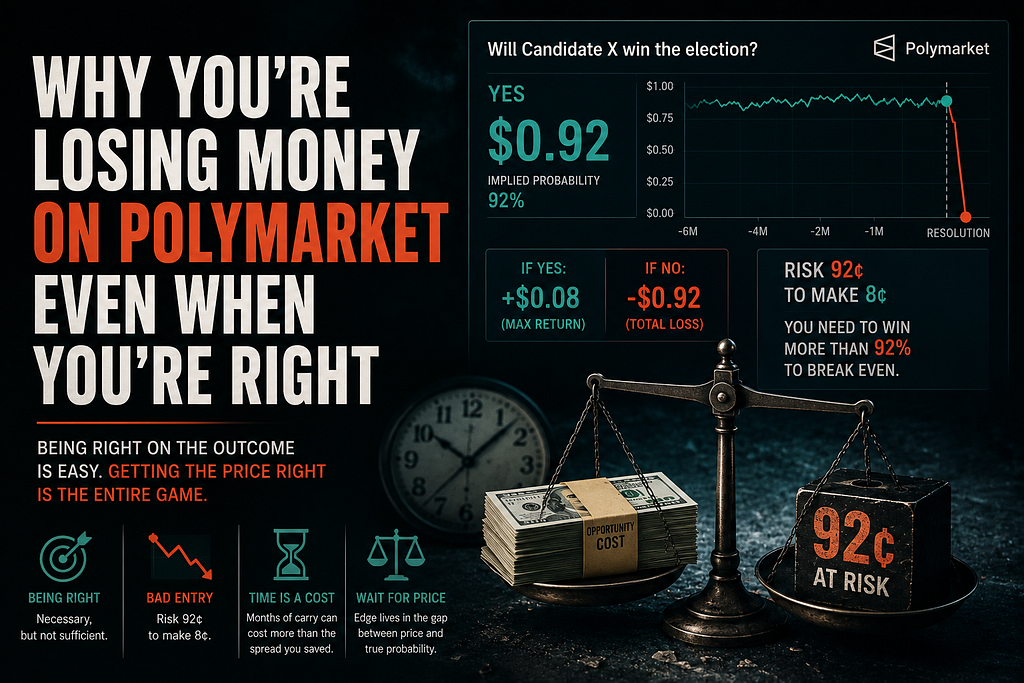
Being right on Polymarket is the easy part. Being right at the price that pays you for being right is the entire game.
A trader can call the outcome of an election, a court ruling, a sports result, or a regulatory decision correctly and still finish the position with a loss. Not because the analysis was wrong. Because the entry was wrong. The contract that resolves YES at one dollar does not pay if the entry was at ninety-two cents and the position sat for six months tying up capital that could have compounded elsewhere. The math of prediction markets is brutal in a way that is invisible to most people who walk in believing the hard part is the forecast.
The hard part is never the forecast. The hard part is the price.
Anyone who follows a topic closely can develop a reasonable view on its outcome. Following politics produces opinions about elections. Following a court case produces opinions about rulings. Following a sport produces opinions about results. These opinions, when they happen to be correct, feel like edge.
They are not. Correctness is necessary but not sufficient. In any liquid market, the consensus has already priced in the obvious. If a candidate is widely expected to win, the YES contract is already trading near the price that reflects that expectation. The trader who shows up with the same view as the market is offered the same price the market gives everyone else. There is no edge in agreeing with the consensus at consensus prices.
The edge, when it exists, is in the gap between what the market is pricing and what the trader believes the true probability to be. That gap is small, usually. Sometimes it does not exist at all. The trader who cannot articulate the gap is not trading probability. They are buying lottery tickets at retail prices and hoping for resolution.
Take a contract trading at ninety-two cents that resolves YES six months later. The maximum return is roughly nine percent, before fees, before any opportunity cost. If the trader is wrong, the loss is the entire ninety-two cents.
The asymmetry matters. The trader is risking ninety-two cents to make eight cents. To break even on expected value, the position needs to resolve YES more than ninety-two percent of the time. If the trader’s actual edge is two percent above the market price, meaning the true probability is ninety-four percent rather than ninety-two, the expected value is positive but thin. A few losses in a sample of similar trades wipe out years of those thin wins.
This is the math that destroys most prediction market traders. They take the trades where they are correct and the entries where the spread to fair value is negligible. The variance from the small percentage of times they are wrong eats more capital than the wins accumulate. The portfolio drifts down even though the individual calls were mostly right.
Capital that is committed to a Polymarket position cannot be deployed elsewhere. A position held for six months at a thin margin is competing with every other use of that capital over six months. If the same dollars could have earned a few percent in a treasury, that opportunity cost is not theoretical. It is real, and it eats directly into the spread the trader thought they were capturing on entry.
There is a piece on how time compounds without decision that traders in long-duration contracts should read before they take their next position. The argument applies directly. Months of carry frequently cost more than the spread saved on entry. A position with a thin edge held for a long time is structurally worse than a position with a wider edge held briefly, even if both resolve the same way.
Most traders never calculate the carry. They look at the entry price, the resolution price, and call the difference the return. The math does not work that way. The clock is part of the trade, and the clock is always running against the holder.
The dynamic is observable on every prediction market, but it is particularly clean on Polymarket, where contracts span everything from elections to sports to crypto-native events. The liquidity is real. The pricing is responsive. The spreads tighten on contracts that attract attention, which means the traders who arrive after the topic is in the news are paying the worst prices.
This is a structural feature of any market where attention drives flow. The contracts that get talked about are the contracts that get crowded. The crowding tightens the spread between current price and resolution, leaving less room for edge. The trader who shows up after the topic is trending is not finding edge. They are buying coverage.
The traders who consistently extract returns from prediction markets are not the ones with the loudest opinions. They are the ones who can identify pricing inefficiencies in contracts the rest of the market has not yet noticed, or who can hold contrarian views with conviction when the consensus is mispricing the tails.
The single most important habit on prediction markets is the discipline to wait for price. The trader who decides on the outcome but refuses to enter unless the price offers a meaningful spread to fair value is operating with edge. The trader who enters because the position is correct, regardless of price, is operating on conviction without math.
Conviction without math is expensive. The market does not pay for being right. It pays for being right at a price that compensates for the risk of being wrong, the time the capital is tied up, and the variance across the portfolio of similar trades. Any one of those three considerations dominates the importance of the forecast itself.
A trader who waits for a contract to move against the consensus before entering, on the basis of analysis that the consensus is wrong, is in a different game than a trader who buys the consensus at consensus prices. The first trader is harvesting mispricing. The second trader is paying retail and praying for resolution.
The seductive trap on prediction markets is the appearance of high win rates. A trader who picks the favorite in eight out of ten contracts and resolves correctly on seven feels skilled. The seventy percent hit rate is intuitively impressive. But if the average entry on those favorites was ninety cents, the seven wins paid roughly seventy cents combined while the three losses cost two dollars and seventy cents. The portfolio is down two dollars on a series of trades that felt mostly correct.
This is the part that breaks people emotionally. The wins feel like skill. The losses feel like bad luck. In aggregate, the math says the strategy is bleeding capital, but the individual experience suggests competence. The disconnect between feeling and result is what keeps traders in losing strategies for years.
The fix is not to stop picking favorites. The fix is to refuse the entries where the price does not compensate for the asymmetric loss. That refusal feels passive. It looks like missing opportunities. It is, in fact, the difference between a profitable book and a slowly draining one.
Prediction markets reward patience in a way that screen-based trading does not. There is no charting tool that will reveal a mispriced contract. There is no indicator that flashes when fair value diverges from market price. The work is qualitative. It requires sitting with a topic long enough to form a genuinely differentiated view, then waiting for the market to offer a price that reflects an opportunity rather than a consensus.
That waiting is the entire skill. Most traders cannot do it. They want to be in the market because being in the market feels like trading. Being out feels like missing out. The discipline of holding cash, watching contracts move, and refusing to enter until the price is right is the same discipline that separates structural traders from narrative traders in any market. It is not a different skill. It is the same skill, applied to a market where the rules of resolution are unusually clean.
The traders who do well on prediction markets are not the ones with the strongest opinions. They are the ones who can identify when an opinion is worth more than the price suggests, and who can resist the urge to act when it is not. Their portfolios are smaller than they could be. Their activity is lower than the platform encourages. Their returns are quieter than the success stories suggest.
But their accounts are not slowly bleeding down. That, in a market designed to reward attention rather than discipline, is the actual edge. Being right is interesting. Being right at the right price is profitable. The first feels like the game. The second is the game.
Most traders never make that transition. They keep being right and keep losing money and keep blaming variance. The variance is real. But the variance is only fatal because the entries are wrong. Fix the entries and the variance becomes survivable. Skip that work and no amount of accurate forecasting will save the account.
More from SwapHunt:
Trade prediction markets: Polymarket — Probability-driven markets on real-world events.
Follow @SwapHunt for daily observations.
This content is for educational purposes only. Not financial advice.
Why You’re Losing Money on Polymarket Even When You’re Right was originally published in Coinmonks on Medium, where people are continuing the conversation by highlighting and responding to this story.





