Bhutan moved $22.4 million in Bitcoin out of sovereign wallets this week, including a direct transaction to institutional market maker QCP Capital. The Himalayan nation’s crypto portfolio has dropped from a $1.4 billion peak to about $412 million.
The outflows continue a pattern of periodic liquidations by the Royal Government of Bhutan, which began mining and holding Bitcoin in 2019. These recent transactions highlight questions facing sovereign crypto strategies amid ongoing market pressures.
Blockchain analytics platform Arkham confirmed the Bitcoin sales. Two major outflows came from Druk Holding Investments (DHI), Bhutan’s sovereign investment arm. The transactions included 184.03 BTC, worth $14.09 million, and 100.82 BTC, valued at $8.31 million, five days earlier. The latter went directly to labeled addresses tied to QCP Capital, a Singapore-based institutional market maker active in derivatives and spot markets.
According to Arkham’s analysis, Bhutan usually sells Bitcoin in roughly $50 million tranches. Historical data shows especially heavy sales between mid and late September 2025, with multiple transactions surpassing $50 million each. The current $22.4 million in weekly outflows is smaller than past sales, suggesting either more measured liquidation or reduced holdings.
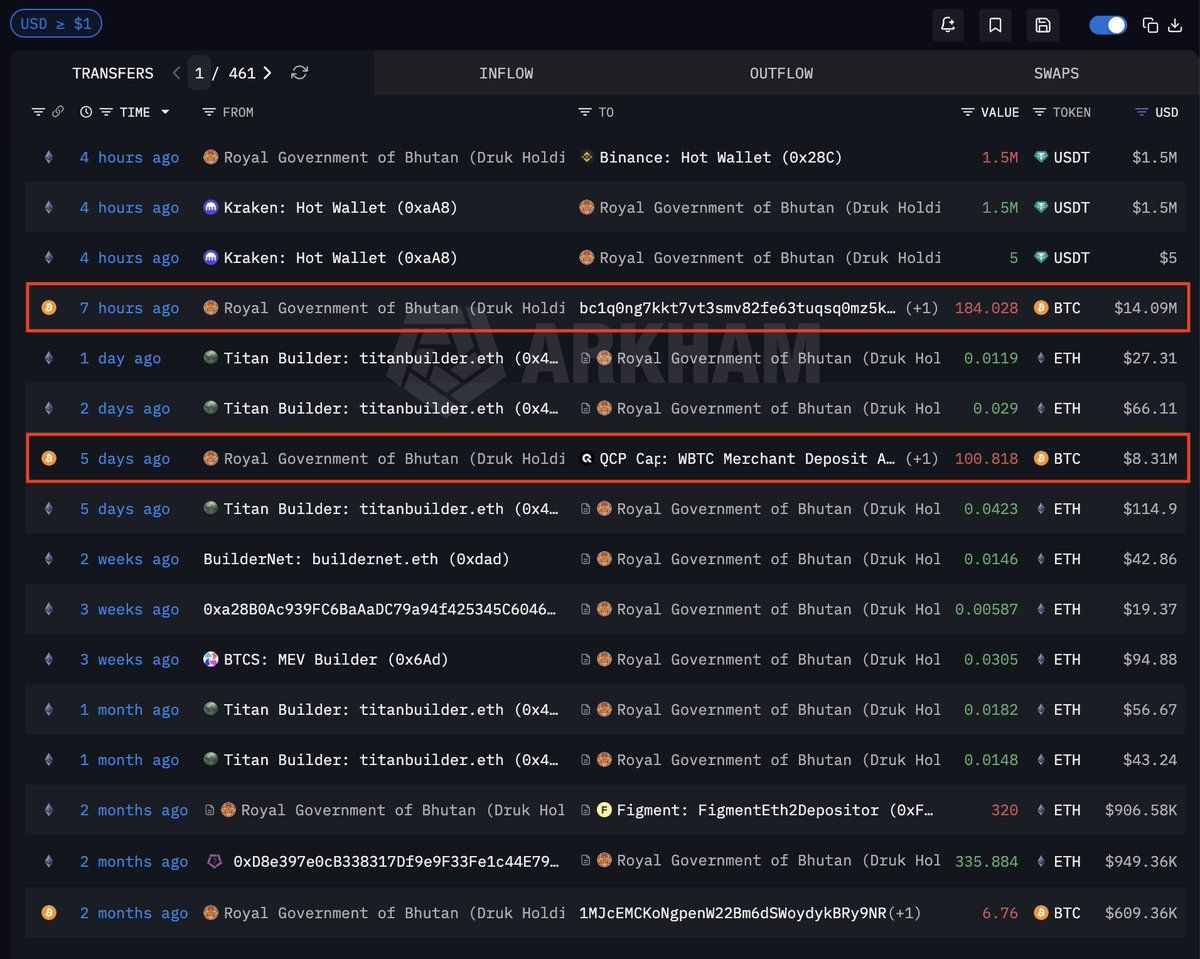
The QCP Capital transaction signals a strategic liquidation rather than distressed selling. Market makers such as QCP enable large block trades without major market disruption. This allows sovereigns to exit positions while minimizing price impact, unlike direct exchange deposits that may trigger sharper reactions.
Bhutan’s Bitcoin strategy began in 2019, with DHI launching a mining operation powered by the country’s abundant hydroelectric resources. Arkham estimates that Bhutan has generated over $765 million in Bitcoin profits since its inception, while total energy costs were about $120 million. Hydropower has kept costs low compared with competitors that rely on fossil fuels.
The 2024 Bitcoin halving fundamentally changed mining economics. This event, which occurs about every four years, halves block rewards. The halving essentially doubled the cost to mine one Bitcoin, making operations less efficient. Data indicate that Bhutan mined most of its holdings before April 2024 and then sharply cut back production.
Pre-halving profit margins enabled Bhutan to amass substantial holdings at favorable costs. However, reduced efficiency after halving likely pushed the nation to monetize its reserves rather than continue energy-intensive mining at lower returns. This strategic shift from accumulation to selective selling mirrors a wider industry trend as sector profitability compresses.
Bhutan’s cryptocurrency portfolio has experienced a dramatic contraction. Arkham Intelligence data show DHI’s on-chain assets currently total about $412 million, down over 70% from the $1.4 billion peak. The portfolio consists mostly of 5,700 BTC, with negligible holdings in Ethereum and other tokens.
The portfolio decline is due to ongoing sales and depreciation in the Bitcoin price. Some value erosion came from strategic liquidations for profit or fiscal needs, but broader market conditions during 2025 and early 2026 also contributed. Bhutan’s peak holdings aligned with Bitcoin’s price highs, amplifying the percentage drop as prices corrected.
Transaction history shows DHI’s main exchange partners are Binance—which has $261 million in transferred value, or 68% of activity—and Celsius Network, with $118 million (31%). Smaller amounts moved through Kraken. These exchange interactions, combined with direct transactions with market makers, show a sophisticated approach to treasury management by Bhutan.
The Druk Holding and Investments entity manages these digital assets along with traditional investments as part of Bhutan’s broader diversification strategy. The integration of cryptocurrency into the sovereign treasury positions Bhutan among a select group of nations involved directly in digital asset markets. Whether Bhutan’s continued liquidations indicate a full exit or just portfolio rebalancing remains an open question as observers track sovereign crypto adoption trends.
The post Bhutan Sold $22.4M in Bitcoin Amid Portfolio Decline of Over 70% appeared first on BeInCrypto.





