The platfrom has confirmed a fresh piece of Binance delisting news, revealing that seven spot trading-pairs will be pulled from the exchange on August 21.
The announcement was published on August 18 as part of the exchange's regular review of listed markets. Trading on the affectet coin will end at 03:00 UTC on the removal date.
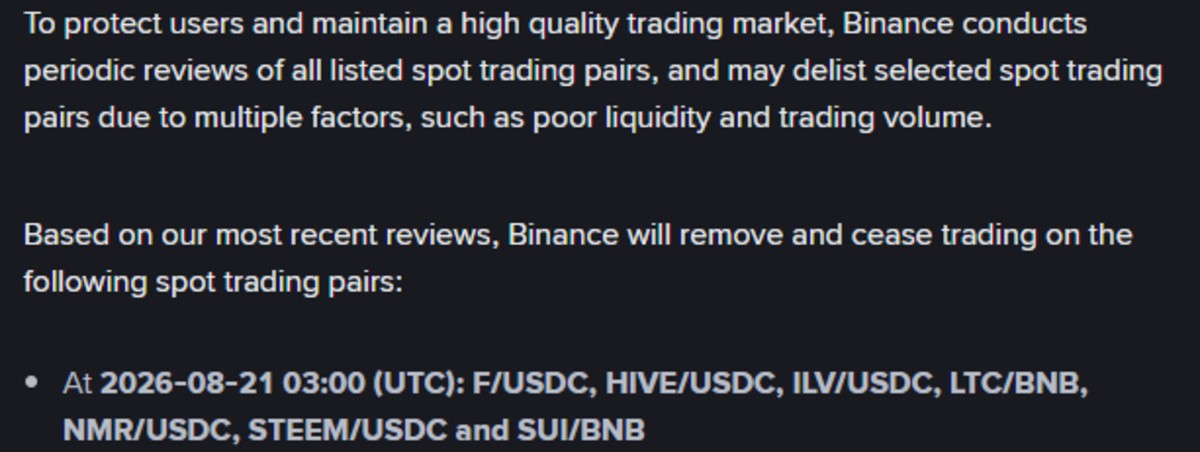
According to the official notice, The Platform periodically reviews all spot trading pairs to protect users and maintain a high-quality trading market.
Pairs can be removed for reasons such as poor liquidity and weak trading volume. The latest review resulted in seven-pairs falling short of the exchange's listing standards.
Source: Official Announcement
The latest Binance delisting news confirms the following will stop trading at 2026-08-21 03:00 (UTC):
Pair | Base Asset | Quote Asset |
F/USDC | F | USDC |
HIVE/USDC | HIVE | USDC |
ILV/USDC | ILV | USDC |
LTC/BNB | LTC | BNB |
NMR/USDC | NMR | USDC |
STEEM/USDC | STEEM | USDC |
SUI/BNB | SUI | BNB |
This Binance delisting news does not affect whether the underlying tokens can be traded on the platform. Removing a spot pair is a market-level change, not a token-level ban, so F, HIVE, ILV, LTC, NMR, STEEM, and SUI all stay listed and accessible through other active pairs on Binance Spot.
Wallet balances and holdings tied to these tokens are untouched; only the order books for the seven named pairs stop matching once the cutoff hits.
The platform also confirmed that spot trading bots configured on any of the seven affected pairs will be shut down automatically once the removal takes effect at 2026-08-21 03:00 UTC.
This covers grid bots, rebalancing bots, and any other automated strategy tied directly to these markets. Users are advised to manually close or cancel affected bots ahead of time, since open bot positions may not settle cleanly once trading on a pair ends.
Anyone following this Binance delisting news should treat the cutoff as a hard deadline rather than a soft warning. Once matching stops, no new orders will be accepted, and existing open orders will not carry over, so positions need to be closed or moved to an equivalent pair beforehand.
The platform has not announced a timeline for relisting any of the seven pairs and has said its review process runs continuously, meaning similar removals could surface again in future cycles.
Market analysts generally treat delistings tied to low liquidity as routine exchange maintenance rather than a judgment on a token's long-term prospects. Thin order books make harder to trade cleanly, and removing them is a standard way for exchanges to keep their markets efficient.
Even so, sudden changes to available-pairs can briefly disrupt order execution and bot performance, which is why traders are encouraged to treat exchange notices as operational alerts worth acting on quickly.
This round of delistings looks like routine liquidity cleanup rather than a warning sign for the tokens involved, but the timing still matters for anyone with open positions or active bots on the seven affected-pairs.
Closing orders, switching to an alternate pair, or pausing a bot strategy before August 21 is the simplest way to avoid disruption once trading on these markets stops.
YMYL Disclaimer: This article is for informational purposes only and does not constitute financial or investment advice. Always verify exchange announcements directly on the official Binance website before making trading decisions.





