Binance users woke up to $1.37 billion in net outflows over seven days — and no new sign-ups to replace them. If your funds sit on an exchange serving European users, its regulatory status just became the single most important thing about your account.
Some platforms made the approved list. Others didn't. Here's what separates them — and it isn't what most people assume.
The EU's Markets in Crypto-Assets framework moved from transition to full enforcement on July 1, 2026. Every platform serving European residents now needs a spot on the European Securities and Markets Authority's official register.
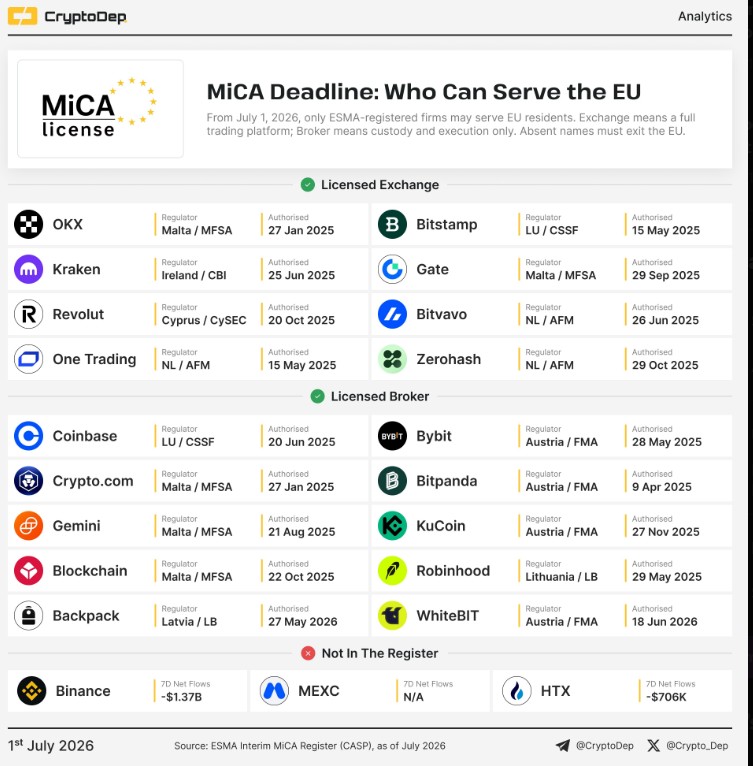
Binance responded by halting new EU MiCA sign-ups, deposits, and Earn products. MEXC and HTX remain unlisted too. Coinbase, OKX, Kraken, Gate, Bybit, and Gemini all appear as authorized, though under different licensing tracks and approval timelines stretching back to early 2025.

Source: CryptoMarketCap X
A missing registration isn't a technicality — it decides whether an exchange can legally onboard or service European accounts at all. That's why displaced users are suddenly a contested market.
Coinbase, OKX, and Gate are running deposit bonuses of up to 10% aimed squarely at users leaving unregistered platforms. For anyone holding a Binance balance, the calculus now blends compliance risk with a real financial incentive to move.
The ESMA register splits approved platforms into two tiers. Full trading venues include OKX, Kraken, and Gate. Custody and execution brokers include Coinbase, Bybit, and Gemini.
Approval paths vary by member state and date. OKX secured Malta/MFSA authorization back in January 2025, while WhiteBIT only cleared Austria's FMA in June 2026 — a 17-month gap between the earliest and latest approvals. Binance, MEXC, and HTX don't appear under any jurisdiction in this rollout.
Source: CryptoDep X
Binance exchange $1.37 billion seven-day outflow figure isn't just a compliance statistic — it's a live signal of where EU capital is rotating. Combined with a freeze on new deposits, that outflow trend has nowhere to reverse from until Binance secures registration somewhere in the bloc.
Hours after enforcement began, reports confirmed that Europe had already opened a review of EU MiCA itself, flagging stablecoin rules and cross-border equivalence as priority revision areas.
That means today's rules aren't necessarily tomorrow's rules. Watch for amended stablecoin issuance standards and whether cross-border equivalence loosens enough to let currently locked-out platforms back in.
MiCA's full-enforcement day reshuffled the EU crypto exchange landscape overnight, splitting the market into registered winners and locked-out incumbents like Binance. With regulators already reviewing the framework's own gaps, this list is likely to keep shifting through the rest of 2026.
Disclaimer: This article is for informational purposes only and does not constitute financial, investment, or legal advice. Cryptocurrency markets are volatile and regulatory frameworks can change rapidly. Readers should conduct their own research and consult a licensed professional before making investment decisions.





