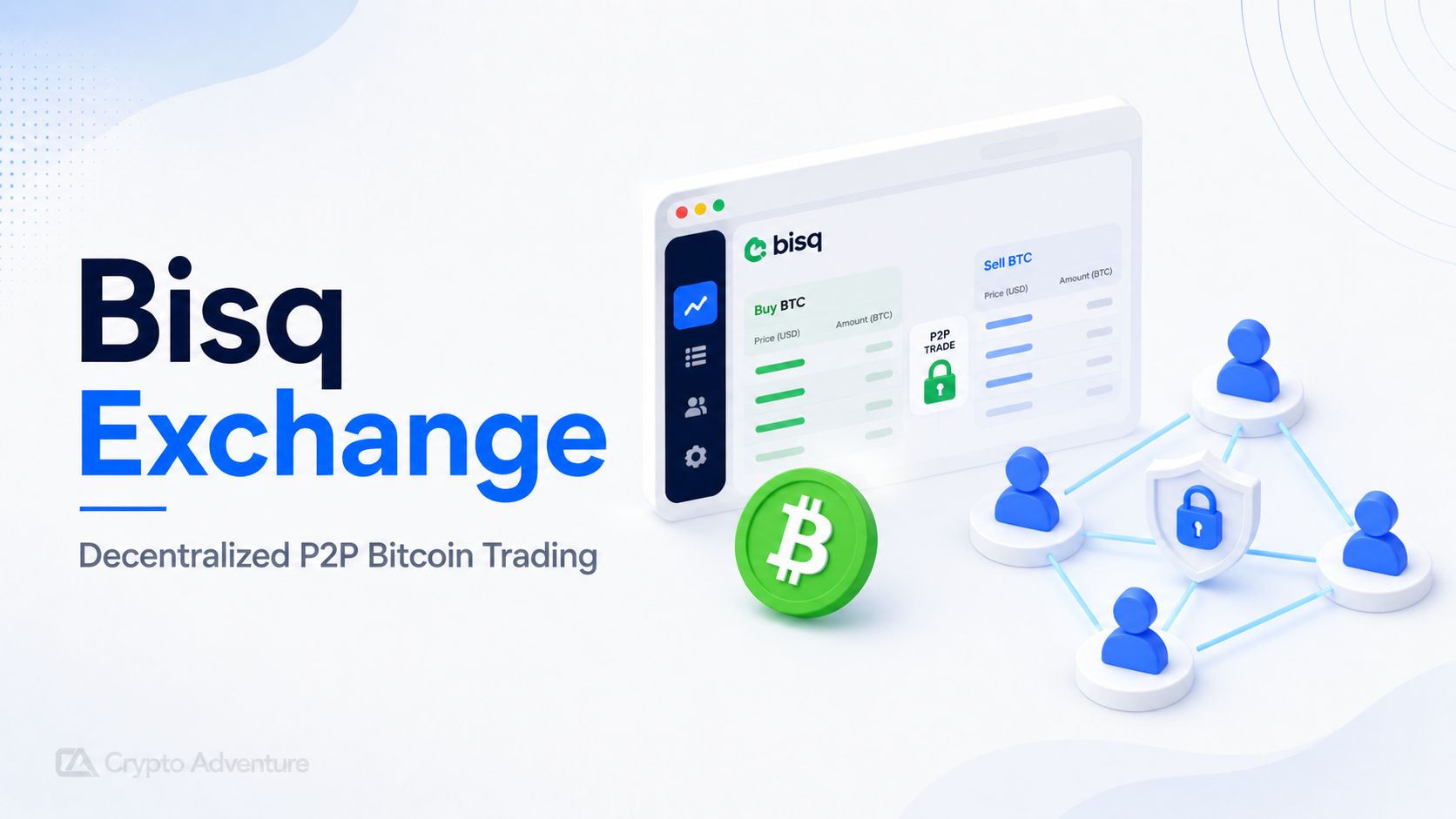
Bisq is one of the few exchanges that still feels built around a principle instead of a growth strategy. That principle is simple: users should be able to buy and sell bitcoin without handing control of their funds, identity, or market access to a centralized company. In a market where most exchanges optimize for convenience first and custody second, Bisq takes the opposite route. It optimizes for self-custody, privacy, and censorship resistance, even when that makes the product slower, rougher, and more demanding to use.
That trade-off defines the entire review. Bisq is not trying to compete with Coinbase, Binance, Kraken, or any of the large custody-first trading platforms on speed, polish, or instant onboarding. It is trying to solve a different problem. It gives users a way to trade bitcoin peer to peer through desktop software, over Tor by default, without registration, without an exchange holding their balance, and without a central operator matching and settling trades in the usual way.
That is a real strength, but it also creates real friction. Bisq can feel slow, intimidating, and thinly liquid if it is judged by mainstream exchange standards. A serious review has to say both parts clearly. It is one of the best products in crypto for users who care deeply about privacy and self-custody. It is also one of the least beginner-friendly ways to buy bitcoin if the goal is speed, simplicity, and high day-one liquidity.
This review looks at Bisq as a real exchange product rather than as an ideology project. It explains how the platform works, what makes its model different, how the fees and payment methods fit together, what Bisq 2 changes, where the product is strongest, where it is weaker, and which type of user is most likely to get lasting value from it.
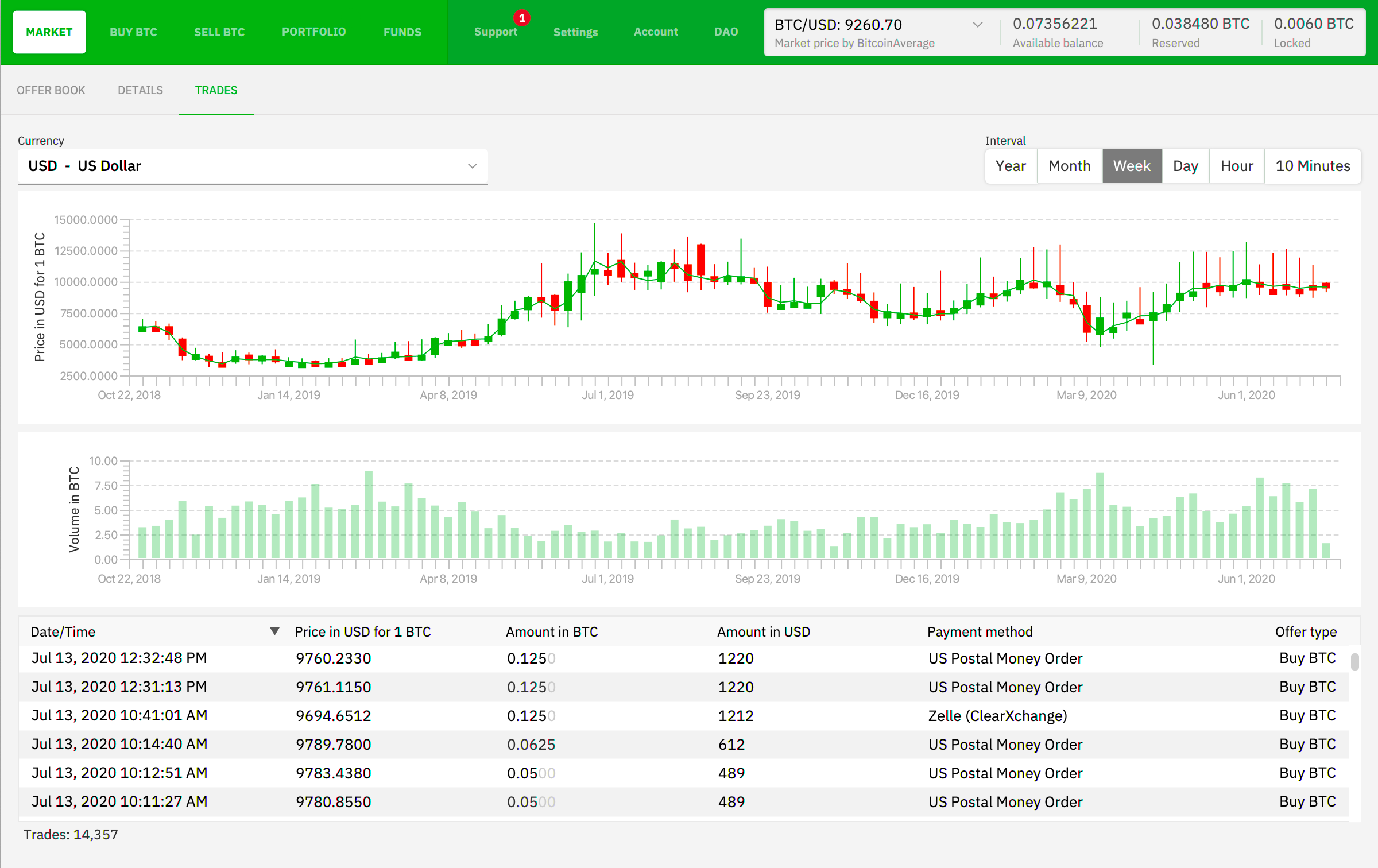
Bisq is an open-source peer-to-peer bitcoin exchange network accessed through desktop software. It is designed to let users buy and sell bitcoin for fiat currencies or other cryptocurrencies without creating an account, without depositing funds onto a centralized exchange, and without relying on a normal corporate matching engine.
That sounds simple enough, but the way Bisq gets there is what matters. The platform is not just a non-custodial trading interface. It is a complete peer-to-peer trading protocol with its own security deposits, dispute-handling structure, payment-account rules, Tor-based networking, and DAO-funded governance model through BSQ.
This matters because Bisq should not be judged as a generic DEX. It is much closer to a peer-to-peer bitcoin marketplace with strong protocol rules than to an onchain swap interface like Uniswap. It does not let users swap tokens inside a liquidity pool. It helps two people complete a real trade directly, with the bitcoin side handled by Bisq’s protocol and the fiat side handled through external payment methods such as bank transfer, cash deposit, money order, or other supported rails.
That gives Bisq a very specific role in the market. It is not the easiest place to speculate on dozens of tokens. It is a serious tool for private bitcoin acquisition and disposal.
The easiest way to understand Bisq is to separate the bitcoin side from the fiat side. On the bitcoin side, Bisq handles offer creation, security deposits, fees, and escrow logic through its own protocol and local wallet setup. On the fiat side, users settle through external payment methods.
In classic Bisq trading, both sides commit bitcoin security deposits to keep the trade honest. When a trade is taken, Bisq creates a dedicated trade wallet. The taker pays the taker fee, both sides lock up their security deposits, and the bitcoin side of the trade moves through a multisig escrow arrangement. Once the fiat payment is completed and confirmed, the bitcoin is released and the security deposits are returned.
That system is elegant in principle because it avoids the usual centralized exchange model where all users’ balances sit inside one custodian. Bisq never takes custody of pooled user funds. That alone makes the platform structurally safer than many centralized exchanges in one very important sense: there is no giant hot-wallet honeypot waiting to be hacked.
The trade-off is complexity. Users need bitcoin on hand to start many trades in the classic model because they must pay fees and post security deposits. That immediately makes Bisq less accessible than a beginner-friendly fiat on-ramp.
Bisq 2 is trying to improve that. The project announced Bisq 2 beta in March 2024, and the first trade protocol in that new app is Bisq Easy. Bisq Easy removes the multisig-and-deposit requirement for beginners and relies instead on seller reputation and a lower-risk trade structure. That makes Bisq more accessible for new users, but it also means the exchange currently spans two experiences at once: the more mature Bisq 1 model and the newer Bisq 2 path that is still in beta.
Privacy is the strongest reason to use Bisq. The software runs over Tor by default, stores user data locally, and does not require registration. There is no exchange account to freeze, no routine identity collection in the normal onboarding flow, and no central operator with a full customer database in the usual exchange sense.
This is where Bisq stands far above most mainstream platforms. It is not just “more private than average.” It is built around the idea that trading should remain possible even when centralized exchanges become hostile, restrictive, surveilled, or unavailable.
The self-custody side matters just as much. Bisq does not hold user balances as an exchange operator. Users fund trades from their own wallets, and the software coordinates the transaction flow instead of taking over the entire trading relationship. That architecture lowers a certain kind of platform risk significantly.
This is also why Bisq still has a devoted user base despite the friction. It solves a problem that most exchanges do not even try to solve.
Bisq’s fee model is different from mainstream exchanges because it is tied to the project’s DAO and governance token, BSQ. Users can pay trading fees in BTC or in BSQ, and BSQ fees are lower. That discount is intentional. It is part of how Bisq funds development and governance without turning into a conventional company.
The more practical point for users is that Bisq is not a cheap-feeling exchange if judged only by the interface headline. There are protocol fees, mining fees, and the economic cost of locking security deposits during trades. Those costs are often worth it for the right user because the platform is delivering privacy and self-custody rather than convenience. Still, users who arrive expecting centralized-exchange simplicity may find the economics awkward at first.
That is especially true for small trades. Bisq makes more sense when the user values the model enough to accept some friction and cost in exchange for the benefits.
One of Bisq’s more underrated strengths is payment-method breadth. The platform supports a wide range of fiat payment methods across different regions, including SEPA, SEPA Instant, Faster Payments, Revolut, Interac e-Transfer, Zelle, cash deposit, MoneyGram, Western Union, face-to-face trading, and more.
That flexibility matters because Bisq is not trying to replace one bank rail with another. It is trying to make direct bitcoin-for-fiat trading possible across many jurisdictions without forcing everyone into the same account structure.
This is also where market quality varies. A payment method can be supported on paper while still having thin offer depth in practice. Bisq’s payment diversity is real, but liquidity is uneven. Users in major fiat corridors may find workable offers more easily. Users in narrower markets may find the network quieter, slower, or more expensive.
That makes liquidity one of the platform’s biggest practical weaknesses. Bisq can be extremely powerful when the right offers exist. It can feel painfully slow when they do not.
Bisq’s architecture deserves credit for reducing custodial risk, but that should not be confused with saying the platform has never had protocol risk. It has. In April 2020, Bisq disclosed a critical security vulnerability that allowed an attacker to exploit a flaw in the trade protocol. According to the project’s own statement, about 3 BTC and 4,000 XMR were stolen from seven victims in the XMR/BTC market. The team halted trading through the alert key and released Bisq v1.3.0 with the flaw corrected.
In May 2026, Bisq v1 was exploited and trading was halted as attacker drained active offers. An attacker exploited its trade protocol and drained a portion of available offers. Bisq disclosed that the impact was limited to offers that were actively taken by the attacker, while funds held inside users’ Bisq Bitcoin wallets are not affected.
These incidents matter in a serious review because it shows the difference between custody safety and protocol safety. Bisq’s design reduced the risk of centralized exchange-style mass loss, but it did not make protocol mistakes impossible.
The positive side is that the project handled the issue publicly, explained the flaw in detail, and fixed it and for the v1 exploit a refunding plan is in place. The more durable conclusion is that Bisq should be respected as a serious open-source exchange, not romanticized as risk-free. Private and decentralized systems still need careful engineering.
This is where Bisq loses most ordinary users. The platform is not hard in an abstract sense, but it asks more from the user than mainstream exchanges do. The desktop-first design, wallet funding process, security deposits, payment-method setup, dispute rules, and trade timing all create friction.
For an experienced bitcoin user, that friction is manageable and often worth it. For a newcomer who just wants to buy some bitcoin in five minutes, it can feel like too much work.
Bisq 2 and Bisq Easy are clear attempts to improve this. They lower the entry burden and give the project a more realistic beginner path. Even so, Bisq as a whole remains a product for deliberate users rather than casual ones.
That is not a criticism. It is simply the truth of the design.
Bisq is best for users who care deeply about privacy, self-custody, and censorship resistance, and who are willing to accept a slower and more involved trading process to get them. It is especially strong for bitcoin buyers and sellers who do not want to rely on a centralized exchange account and who are comfortable working with external payment methods.
It is much less suitable for traders who want deep instant liquidity, polished mobile-first UX, dozens of token markets, or fast speculative execution. It is also not the cleanest first stop for a beginner unless that beginner is specifically committed to privacy from day one.
Bisq is one of the most important bitcoin exchanges in the market, but not because it is the smoothest or the biggest. It matters because it proves that private, non-custodial, peer-to-peer bitcoin trading can exist without asking users to trust a normal exchange company with their identity and balances.
That makes it unusually valuable in a crypto market that still leans heavily on centralized custody. It also makes it unusually demanding. Bisq is not a convenience-first product. It is a sovereignty-first product. Users who understand that are much more likely to appreciate it.
As a pure review verdict, Bisq is excellent for privacy-focused bitcoin users and only average for ordinary exchange shoppers. It is not trying to win everyone, and that is probably the right choice. For the right user, it remains one of the best products in crypto. For the wrong user, it will feel slow, illiquid, and unnecessarily complicated. That is the trade-off, and it is the whole point.
The post Bisq Exchange Review 2026: Privacy, Custody, Fees and Whether It Is Worth Using appeared first on Crypto Adventure.





