The United States faces the prospect of another partial government shutdown only weeks after federal agencies resumed full operations following a funding lapse that lasted from 1 October to 12 November 2025.
That episode, which forced departments to operate with reduced staffing and delayed discretionary spending, has made investors more wary of fiscal standoffs in Washington.
Renewed uncertainty has emerged after Senate Democratic leader Chuck Schumer indicated his party could block a spending package unless contentious provisions relating to the Department of Homeland Security are removed.
Such standoffs are familiar, yet their timing matters. Markets are already contending with stretched positioning across risk assets and a fragile macroeconomic backdrop. On decentralised prediction platform Polymarket, traders now place a 78% probability on a shutdown by the end of the month.
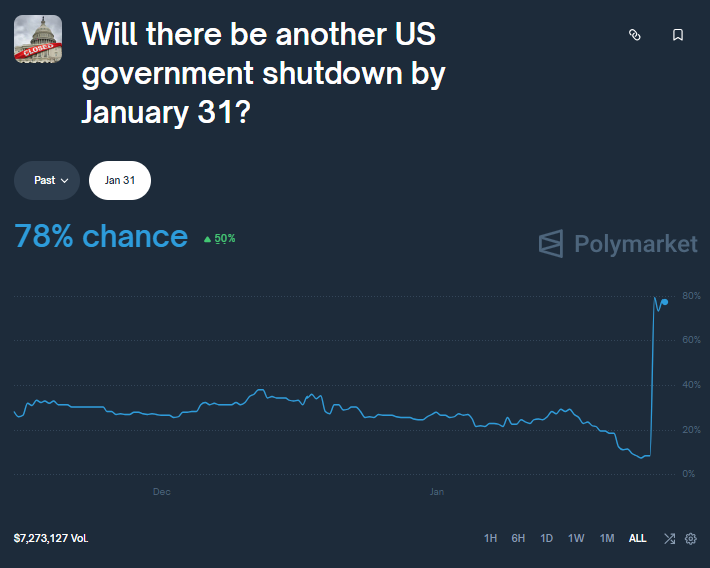
Historically, similar episodes have coincided with near-term selling pressure in Bitcoin, followed by sharp recoveries once political outcomes crystallise and liquidity conditions stabilise.
Related: Ripple CEO: Crypto Set to Smash Records in 2026
That pattern appears to be repeating. Bitcoin slipped below US$88,000 (AU$127,050) in thin weekend trading, extending a week-long correction that has weighed on the broader crypto market.
The decline triggered roughly US$224 million (AU$323.4 million) in liquidations of leveraged long positions, underscoring the degree to which price action remains amplified by derivatives markets and automated margin calls rather than spot flows. Ether and other large-cap tokens recorded steeper percentage losses, reflecting a generalised de-risking rather than asset-specific news.
The pullback has occurred alongside turbulence in traditional markets. The Japanese yen gained 0.7% against the dollar amid renewed speculation about official intervention following abrupt moves late last week.
Elsewhere, U.S. President Donald Trump threatened punitive tariffs on Canada should it advance a trade agreement with China, adding another layer of geopolitical uncertainty, even as tensions over Greenland eased after conciliatory rhetoric.
Related: No Turning Back for Crypto in Wall Street’s Engine Room, Says PwC
Notably, Bitcoin’s recent behaviour has more closely resembled that of a high-beta risk asset than a defensive hedge. While digital assets struggled, traditional commodities rallied strongly. Silver reached a fresh record near US$109 (AU$157.19) an ounce, and gold breached the US$5,000 (AU$7,218) threshold, buoyed by demand for inflation protection and geopolitical insurance.
The divergence suggests that, despite its decentralised architecture and fixed supply, Bitcoin remains tightly integrated into global liquidity cycles and investor risk appetite, rather than functioning as a substitute for conventional safe havens.
The post Bitcoin Dips Below $88K as Weekend Weakness Meets Rising U.S. Shutdown Risk appeared first on Crypto News Australia.





