
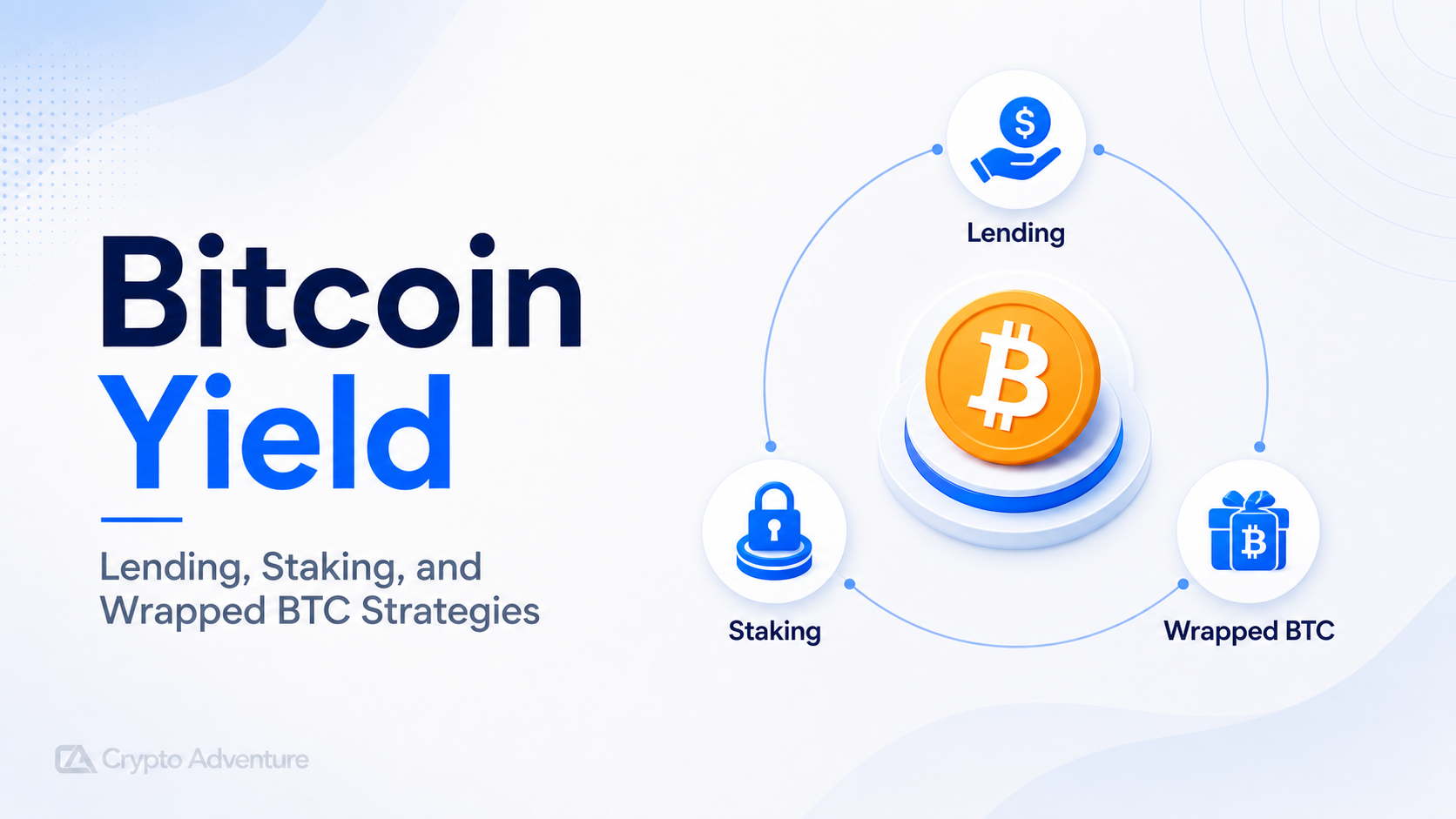
Bitcoin does not pay native yield. Holding BTC in a wallet or cold storage does not create interest, staking rewards, or cash flow. Bitcoin yield appears only when BTC is put into a strategy that takes on extra risk.
That risk can come from lending BTC, using wrapped BTC in DeFi, staking BTC through Babylon-style systems, minting liquid BTC tokens, or entering structured products that use hedging, collateral, or borrower demand. The yield is compensation for doing something beyond passive holding.
This is the core point. Bitcoin yield is not a free upgrade to BTC. It changes the asset’s risk profile. A user may keep BTC price exposure, but the strategy can add custody, bridge, contract, borrower, slashing, liquidity, or redemption risk.
Bitcoin lending yield comes from borrowers who pay to use BTC or BTC-backed liquidity. A user supplies BTC, WBTC, cbBTC, tBTC, LBTC, or another Bitcoin representation into a lending market. Borrowers use it for leverage, collateral management, market making, arbitrage, or liquidity needs. Suppliers earn a portion of the interest.
For instance, on Aave suppliers provide liquidity, borrowers access liquidity by providing overcollateralized positions, and interest rates adjust with supply and demand. When wrapped Bitcoin is supplied to a lending market, the user earns only if borrowers are willing to pay for that asset.
The risk is not only borrower demand. A lending position can face smart contract risk, oracle risk, liquidation design risk, utilization spikes, withdrawal constraints, and wrapped-asset risk. If the supplied BTC is WBTC, cbBTC, or another representation, the user also depends on the wrapper or bridge.
Bitcoin staking yield is different from lending yield. The user is not lending BTC to borrowers. The BTC is used as economic security for other networks.
Babylon Bitcoin staking lets BTC holders lock assets in a time-bound contract as security collateral for decentralized networks. Rewards can come from networks that use Bitcoin-backed finality, while slashing can apply if protocol security rules are violated.
This creates a new kind of BTC yield. Bitcoin remains on the Bitcoin chain under staking conditions, but the user accepts finality provider risk, protocol risk, reward-token risk, unbonding timing, and slashing exposure. Bitcoin staking is closer to security underwriting than ordinary lending.
Liquid Bitcoin tokens make staked or yield-generating BTC more usable in DeFi. A user deposits BTC into a protocol, and receives a liquid token that represents the underlying BTC plus some yield or staking exposure.
Lombard LBTC is one example. LBTC represents BTC staked on Babylon through Lombard, is backed by native BTC, and can be used across multiple chains as collateral, trading liquidity, or DeFi capital. Lombard’s user documentation also makes the exit trade-off clear: withdrawing BTC can take about 9 days because of Babylon’s unbonding period and Lombard’s rebalancing cycle.
This model improves capital efficiency. A user can earn staking-linked rewards while still using a BTC-backed token in DeFi. The risk is layered. The user now depends on Babylon, Lombard, the token contract, supported chains, bridges, oracles, and exit liquidity.
Wrapped BTC strategies use tokenized BTC inside DeFi. WBTC, cbBTC, tBTC, rBTC, and sBTC let Bitcoin exposure move into smart contract ecosystems.
The user can lend wrapped BTC, borrow stablecoins against it, provide liquidity, use it as collateral, or enter vaults. This is how much of Bitcoin’s DeFi activity has worked historically, especially on Ethereum and EVM-compatible chains.
The main risk is wrapper quality. A yield on WBTC is not only a BTC yield. It is a yield on a custodial or bridged BTC representation. A yield on rBTC includes Rootstock peg assumptions. A yield on tBTC includes threshold bridge assumptions. A yield on sBTC includes Stacks peg assumptions. Users should identify the exact BTC representation before judging the APY.
Structured BTC yield products combine several mechanisms. A protocol may use staking rewards, lending markets, delta-neutral hedging, exchange strategies, or tokenized reserves to produce yield.
Solv Protocol frames its Bitcoin products around a Staking Abstraction Layer that activates BTC into strategies such as staking rewards and delta-neutral hedging while separating reserve security from yield execution. That design shows where the market is heading: BTC yield is becoming a product layer with routing, risk controls, and multiple strategy sources.
Structured yield can be useful, but it requires the most diligence. Users need to know where the BTC sits, who controls it, what strategies are used, how losses are handled, how redemptions work, and whether yield comes from real revenue or temporary incentives.
Bitcoin yield APY can hide several layers of risk. A high APY may come from token rewards rather than BTC-denominated income. A low APY may still carry bridge or custody risk. A variable APY can fall when borrower demand weakens or staking participation rises.
Users should also check the reward asset. A strategy that pays in a volatile protocol token is different from one that increases BTC-denominated value. BTC-denominated yield is usually harder to generate because it requires real economic return after fees and risk.
The better question is not only how much yield a strategy pays. It is what the user can lose, how quickly the user can exit, and whether the reward compensates for the extra risk.
The first risk is custody risk. BTC may sit with a custodian, bridge, protocol, or operator set.
The second risk is smart contract risk. Lending markets, wrappers, vaults, and liquid staking tokens can all have bugs.
The third risk is slashing risk. Babylon-style staking can penalize stake when finality rules are broken.
The fourth risk is liquidity risk. A liquid BTC token may trade below BTC if redemptions slow or confidence weakens.
The fifth risk is strategy risk. Borrower demand, funding rates, reward emissions, hedging performance, and market conditions can all change.
Users should start with the BTC path. Native BTC in a wallet, wrapped BTC on Ethereum, BTC staked through Babylon, LBTC on an EVM chain, and SolvBTC inside a strategy are not the same risk.
Next comes the yield source. Lending interest, staking rewards, token incentives, funding-rate capture, and vault strategies all behave differently.
Then comes exit timing. A yield product with a 9-day withdrawal process, redemption batching, or thin secondary markets should not be compared with liquid spot BTC.
Finally, users should size exposure carefully. Long-term cold-storage BTC and active yield BTC should be separate buckets.
Bitcoin yield works only when BTC is used in an active strategy. Lending earns from borrowers. Staking earns from providing security. Wrapped BTC strategies earn from DeFi activity. Liquid BTC tokens improve composability. Structured products combine several yield engines.
The risk is that every yield path moves Bitcoin away from its simplest form: native BTC held in self-custody. The strongest Bitcoin yield strategies make custody, wrapper design, rewards, redemptions, slashing, and exit timing easy to understand. Users should treat BTC yield as an active risk decision, not as passive interest on Bitcoin.
The post How Bitcoin Yield Works: Lending, Staking And Wrapped BTC Strategies appeared first on Crypto Adventure.





