
Bitcoin is flashing a sharper market-structure warning as perpetual futures demand rises while spot demand continues to contract. The setup does not guarantee another leg lower, but it gives traders a clear reason to stay alert as BTC tries to hold momentum near a fragile range.
CryptoQuant has tracked persistent weakness in Bitcoin spot demand, even as institutional flows and derivatives activity have kept parts of the market active. That split matters because spot buying reflects direct demand for BTC, while perpetual futures can amplify price moves through leverage without the same level of underlying accumulation.
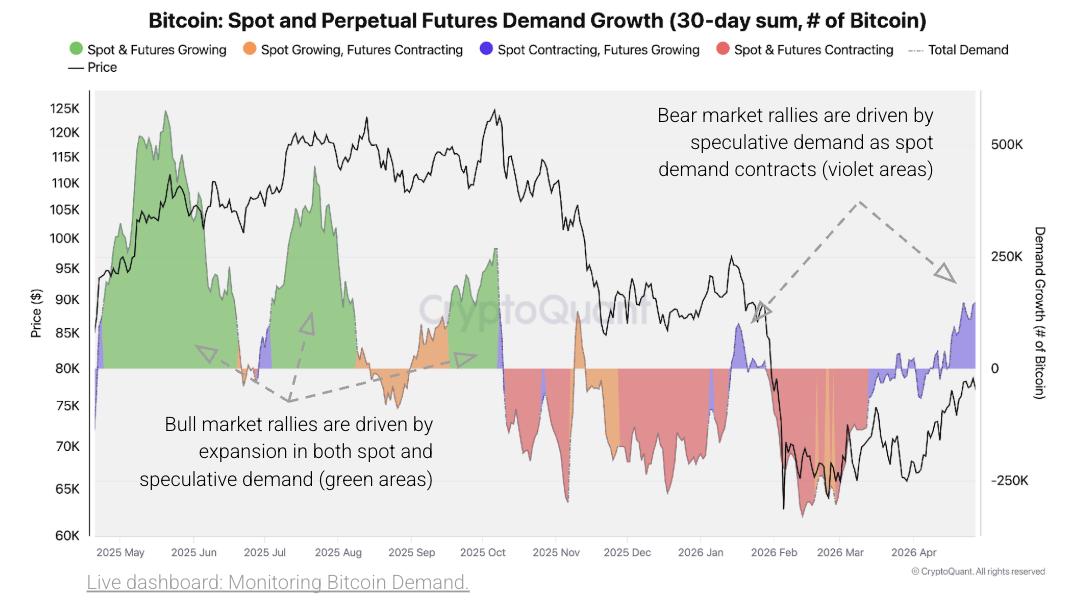
The same kind of structure appeared in 2022 before the next major leg lower in crypto markets. That historical echo is not a mechanical forecast, but it is a bearish demand signal because it suggests speculative positioning may be doing more work than real spot absorption.
Perpetual futures demand can make Bitcoin look stronger than it really is in the short term. When traders increase leveraged exposure, open interest can rise and price can move quickly, especially if liquidity is thin. That creates a fast, exciting tape, but it also increases the risk of liquidation cascades if the move fails.
Spot demand works differently. It reflects actual BTC buying for immediate settlement, which gives rallies a stronger base when accumulation is broad enough. When spot demand contracts while perps heat up, the rally becomes more dependent on leverage, funding, and positioning. That is where the risk sits now.
This is especially important because the broader market has already been dealing with thin exchange liquidity. In a lower-liquidity environment, leveraged flows can create bigger candles in both directions, but they can also make the market more fragile when demand fails to broaden.
The 2022 comparison is getting attention because Bitcoin’s previous major bear-market phase was shaped by demand weakness, forced selling, and failed rebounds. Perp-led strength did not prevent the market from turning lower when spot buying failed to absorb supply.
That is the key lesson from the current setup. A futures-driven push can still create a strong rally, but it needs spot confirmation to become more durable. Without that confirmation, each move higher can turn into a liquidity trap where late longs enter near resistance and become fuel for the next downside flush.
Bitcoin is already trading around a tense technical area after its latest rebound, with traders watching whether the market can turn strength into a sustained breakout. The latest 2022 bottoming structure comparison adds another layer to that same debate: BTC may have room for one more push, but the structure still carries downside risk if demand stays weak.
For bulls, the cleanest invalidation would be a recovery in spot demand. If direct BTC buying strengthens while perps remain active, the market structure becomes healthier because leverage is no longer carrying the move alone. That would make rallies harder to fade and reduce the risk that every upside burst becomes a liquidation setup.
Until that shift appears, the warning remains live. Rising perpetual demand can give Bitcoin a short-term spark, but contracting spot demand makes the move look less stable underneath. Traders do not need to treat the 2022 comparison as destiny, but they should treat it as a serious structural alert.
The market is not sending a quiet signal here. It is showing a split between speculative appetite and real spot absorption. If that gap widens, Bitcoin’s next dramatic move may not be the breakout bulls want.
The post Bitcoin Perp Demand Rises As Weak Spot Buying Flashes A Bearish Warning appeared first on Crypto Adventure.





