
Bitcoin is the largest crypto asset, but its base layer was not built for Ethereum-style DeFi. It does not natively support the same smart contract environment used by lending markets, DEXs, stablecoin protocols, yield vaults, or composable DeFi apps.
Bitcoin bridges solve that access problem. They move BTC exposure into another environment where smart contracts can use it. The result may be WBTC on Ethereum, cbBTC on Base, rBTC on Rootstock, sBTC on Stacks, tBTC across several chains, or another BTC representation.
The user benefit is clear. BTC can become collateral, liquidity, a trading asset, or a yield position. The trade-off is also clear. A bridge adds trust assumptions that native BTC does not have.
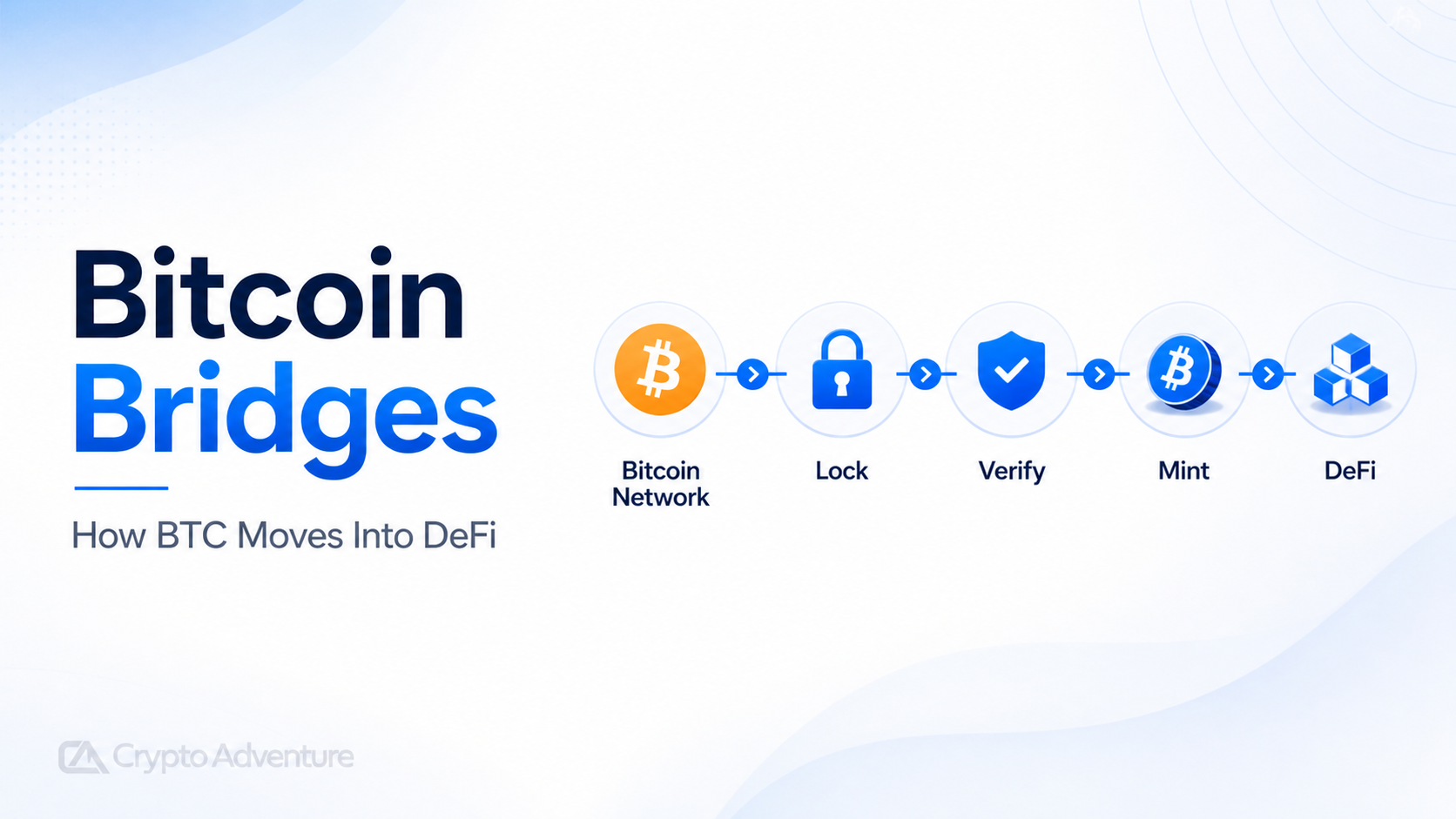
A Bitcoin bridge connects native BTC to another blockchain or execution layer. The bridge usually locks, custodies, or verifies BTC on Bitcoin, then issues a tokenized representation elsewhere. When the user exits, that representation is burned, redeemed, or processed so native BTC can be released.
That process sounds simple, but the security model can vary sharply. A custodial bridge relies on a company or custodian. A federation bridge relies on several signers. A threshold bridge relies on distributed operators. A sidechain peg relies on protocol-specific peg mechanics. A BitVM-style bridge uses optimistic verification and fraud-proof logic to reduce trust in custodians.
Users should not compare Bitcoin bridges only by fee or speed. The real comparison is who controls the BTC and how the user exits.
Custodial wrapped BTC is the simplest model to understand. A custodian holds native BTC and issues a wrapped token on another chain. Coinbase Wrapped BTC is backed 1:1 by BTC held by Coinbase. WBTC uses a custodian and merchant structure to mint and burn wrapped Bitcoin.
The strength is usability. Custodial wrapped BTC can integrate quickly with exchanges, wallets, lending markets, and DEXs. It can also benefit from institutional custody processes and clear redemption partners.
The weakness is trust. Users depend on the custodian, merchant process, legal structure, reserve management, and redemption rules. If the custodian freezes redemptions or faces legal trouble, wrapped BTC holders can be exposed even if the token contract still works.
Threshold bridges reduce reliance on one custodian by spreading control across many operators. tBTC uses Threshold Network operators and cryptographic controls to secure deposited Bitcoin and process redemptions.
This design gives users a more decentralized bridge model than a single-custodian wrapper. The system still needs operators, contracts, fees, governance, and redemption batching to work correctly. tBTC’s current fee model includes action-based mint and redemption fees, with redemption mechanics handled through the bridge system.
Threshold bridges are strongest for users who want a more decentralized BTC representation and accept additional smart contract and operator complexity.
A sidechain peg moves BTC into a separate Bitcoin-linked chain. Rootstock’s PowPeg lets users convert BTC to rBTC and back again. rBTC functions as the native asset on Rootstock, giving users access to EVM-compatible smart contracts and Bitcoin-backed DeFi.
Rootstock’s model is different from a wrapped token on Ethereum. It is a Bitcoin sidechain with its own execution environment, merged mining, and PowPeg bridge. The user locks BTC and receives rBTC for use inside Rootstock applications.
The key risk is peg trust. Users need to understand who operates the peg, how peg-ins and peg-outs work, how long finality takes, and what minimum amounts apply. Rootstock’s own help materials warn that peg-in minimums matter, and sending less than the required amount can cause loss of funds.
Stacks brings smart contracts to Bitcoin through its own chain and uses sBTC as a BTC representation. sBTC is a SIP-010 token on Stacks that can be converted back to BTC on the Bitcoin blockchain.
The goal is to make BTC usable in Stacks applications while maintaining a 1:1 peg to Bitcoin. The withdrawal flow moves sBTC back into BTC through the Stacks peg-out system.
sBTC is strongest for users who want Bitcoin-linked apps, Clarity smart contracts, and BTC movement inside the Stacks ecosystem. The key checks are peg design, signer assumptions, withdrawal timing, app liquidity, and whether the user needs Stacks-specific functionality.
BitVM is one of the most important research directions for Bitcoin bridges. BitVM lets complex computations be verified on Bitcoin without changing Bitcoin consensus rules. The idea is similar to optimistic verification: computation happens offchain, but disputes can be enforced through Bitcoin scripts.
The BitVM2 bridge paper applies this idea to Bitcoin bridges for second layers. The goal is to reduce trust in custodians and make BTC movement into rollup-like systems more secure.
BitVM bridges are promising, but they are still more complex and less mature than older bridge models. Users should separate production-ready BTC assets from research-stage or early-stage bridge infrastructure.
The first risk is custody failure. The BTC backing the token may be frozen, lost, mismanaged, or restricted.
The second risk is bridge exploit. Contract bugs, signer compromise, or verification failures can break the system.
The third risk is redemption failure. Users may not be able to convert the bridged asset back into native BTC quickly or directly.
The fourth risk is liquidity failure. The bridged token may trade below BTC if markets doubt the bridge.
The fifth risk is user error. Wrong networks, minimum amount mistakes, bad addresses, and fake bridge sites can permanently lose funds.
Users should start with a small test transaction. This is especially important for Bitcoin because confirmation times, bridge windows, and peg-out rules can differ from normal crypto transfers.
Next, users should verify the official bridge page, supported networks, minimum amounts, fees, and redemption flow. They should also check whether they receive native BTC on exit or a wrapped version of another wrapped asset.
Finally, users should match the bridge to the use case. WBTC or cbBTC may fit Ethereum and Base DeFi. tBTC may fit users who prefer threshold custody. rBTC fits Rootstock. sBTC fits Stacks. BitVM-based systems may become important as more trust-minimized Bitcoin rollups mature.
Bitcoin bridges let BTC enter DeFi by turning native Bitcoin into a usable asset on smart contract chains and Bitcoin-linked layers. The model unlocks lending, borrowing, trading, collateral, stablecoin liquidity, and BTCFi.
The cost is additional trust. Every Bitcoin bridge introduces custody, peg, operator, redemption, liquidity, or smart contract assumptions. The safest user habit is to understand who controls the BTC, how the exit works, what fees and delays apply, and whether the bridge is mature enough for the amount being moved.
The post Bitcoin Bridges: How BTC Moves Into DeFi appeared first on Crypto Adventure.





