Bitcoin Magazine
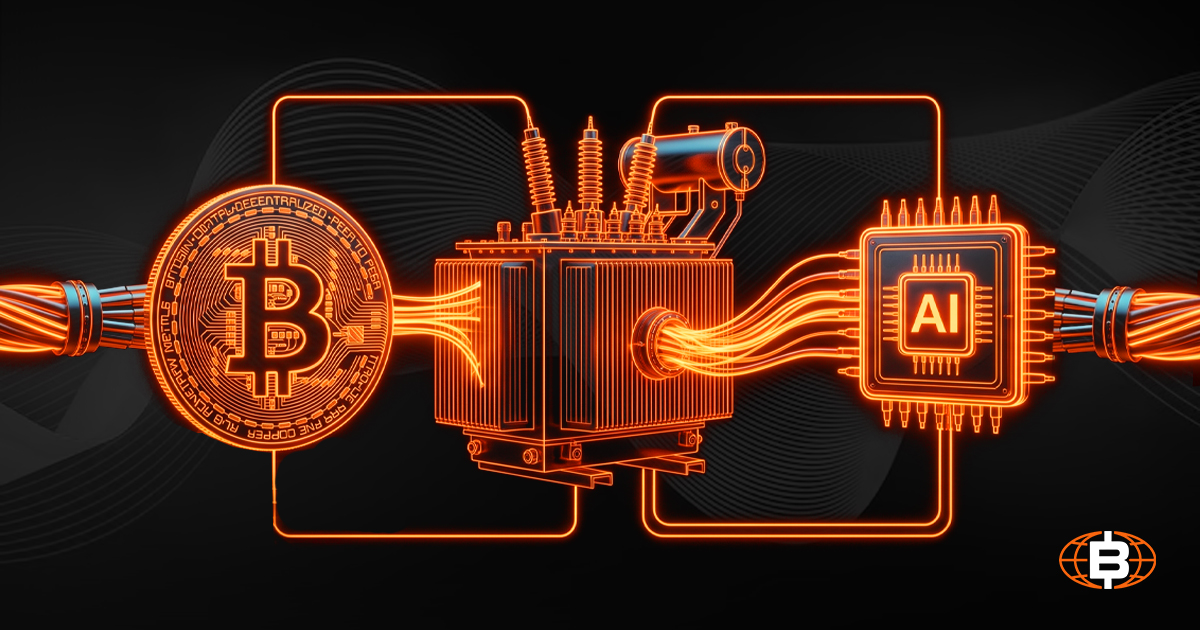
Why Bitcoin Mining and AI Are Merging, Not Colliding
If you’ve scanned headlines over the last year, you’ve likely seen the prevailing market narrative: Bitcoin miners are pivoting to AI data centers, signaling a retreat from proof-of-work.
To casual observers, this looks like a surrender, proof that Bitcoin was just a temporary placeholder until a “better” compute workload arrived.
However, through the lens of power infrastructure and energy economics, that narrative gets the reality completely backwards. The migration isn’t a sign of Bitcoin’s weakness; it is a long-overdue, structurally bullish rebalancing of capital efficiency and global energy pricing.
Here is the underlying reality the market misunderstands.
The misconception stems from assuming all digital workloads are created equal. In reality, Artificial Intelligence and Bitcoin Mining require completely opposite operational environments:
AI hyperscalers face a massive speed-to-market bottleneck: securing new 100+ megawatt grid interconnections with utilities can take 3 to 5 years. Meanwhile, Bitcoin miners spent the last decade securing high-voltage interconnections, power purchase agreements (PPAs), and physical site footprint.
Rather than AI “pricing miners off the grid,” miners are acting as pragmatic energy arbitrageurs. They don’t care about the compute payload, they care about maximizing dollar yield per megawatt.
When post-halving mining margins tighten, leasing or retrofitting prime grid-tied sites for high-margin AI workloads becomes a natural capital allocation play. Miners aren’t being evicted; they are monetizing their most valuable asset: time-to-power.
The primary structural weakness of public Bitcoin mining companies has always been balance sheet exposure during bear markets. When hash prices drop, debt-heavy miners are forced to dump mined Bitcoin reserves onto the open market to pay electricity bills and corporate overhead—creating downward price pressure.
The AI shift fundamentally alters this balance sheet dynamic:
The shift taking place across global data centers isn’t a trade-off where one technology “wins” and the other loses. It is a market optimization.
AI hyperscalers get the energized, grid-connected real estate they need to meet immediate compute demands without waiting half a decade in a utility queue. Bitcoin miners get predictable cash flows, lower cost of capital, and stronger balance sheets to navigate halving cycles.
Instead of competing for power, AI and Bitcoin infrastructure are converging into a symbiotic relationship, allocating every megawatt of global energy to its highest and best financial use.
Disclaimer: This content was prepared on behalf of Bitcoin For Corporations for informational purposes only. It reflects the author’s own analysis and opinion and should not be relied upon as investment advice. Nothing in this article constitutes an offer, invitation, or solicitation to purchase, sell, or subscribe for any security or financial product.
This post Why Bitcoin Mining and AI Are Merging, Not Colliding first appeared on Bitcoin Magazine and is written by Nick Ward.





