Bitcoin News Today brings a reversal after weeks of gains. BTC is down 1.63 percent over 24 hours, trading at $79,631, slipping back under the $80,000 mark that had held for several sessions.
The drop comes even as spot $BTC ETFs pulled in close to $1 billion this week, a split that shows how much macro sentiment is currently driving price over fund flows alone.
CoinMarketCap snapshot from September 5, 2026, shows a market that pulled back broadly:
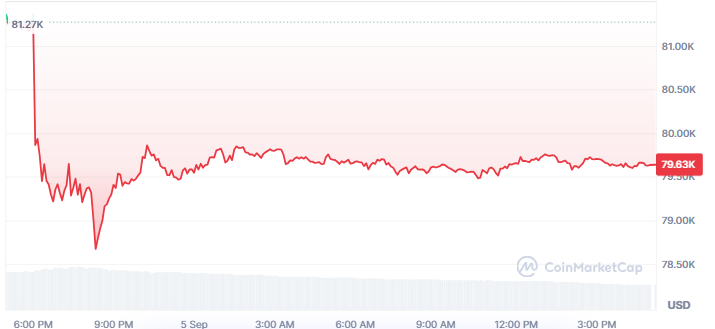
BTC price: $79,631, down 1.63 percent in 24 hours
Daily Volume: $29.63 billion, down 32.5%
Market Cap: $1.59 trillion
Overall crypto market cap: $2.69 trillion, down 1.58%
24-hours liquidation: $345.1 million
That 0.81 correlation with the S&P 500 is worth noting on its own. It shows $BTC trading less like an independent asset right now and more like a high-beta version of the broader stock market, moving on the same headlines rather than crypto-specific news.
One of the more surprising threads in Bitcoin news today is the contradiction between BTC’s price action and strong ETF market.
BTC ETFs logged roughly $986.85 million, close to $1 billion, in net inflows this week, part of the strongest three-week run of 2026 at $3.8 billion combined, according to SoSoValue data.
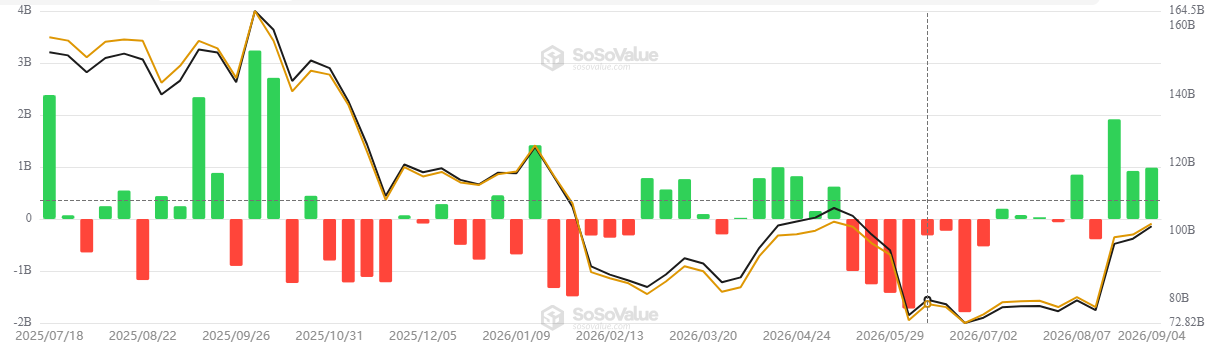
BlackRock's IBIT led the buying, pulling in $454 million on September 3 alone and another $117 million the following day while $BTC traded near $80,000. Those inflows have pushed total BTC ETF net assets above $100 billion, reversing outflows seen earlier in the year.
Weekly ETF inflows: approximately $987 million
Three-week total: $3.8 billion, the strongest stretch of 2026
BlackRock IBIT (weekly total): $691.51 million
Total BTC ETF net assets: above $100 billion
A stronger-than-expected U.S. August jobs report is the main driver behind today's pullback. The data revived expectations that the Federal Reserve could hold rates higher for longer, tightening financial conditions and pulling money out of risk assets broadly, including crypto.
A wave of long liquidations added to the pressure. Fed policy expectations tend to move faster than weekly ETF data, so today's jobs-driven repricing outweighed the steady institutional demand for now. In short, the buying was real, but the macro shift was simply bigger.
Much of the forward-looking part of Bitcoin News Today traces back to a single research note. Investment firm CoinShares has been tracking this exact tension, noting Bitcoin has traded increasingly like gold over the past two weeks. Renewed worry over U.S. fiscal sustainability, along with heavy Treasury purchases of long-dated government debt, helped push $BTC from the low $60,000s up to a high near $80,100 before this pullback.
The firm points to Fed policy as the main constraint standing between $BTC and a sustained move back above $80,000, and sees two realistic paths that could change that:
A resolution to the Iran conflict that lowers oil prices and cools inflation expectations
Further erosion in confidence around U.S. sovereign debt, which would push more demand toward non-sovereign stores of value like Bitcoins
The August inflation report and the September Fed meeting sit at the center of both scenarios. The CLARITY Act's procedural Senate vote, expected around September 15, adds a third variable that could shift sentiment again before the month is out.
The next chapter of Bitcoin News Today likely hinges on which of those events breaks first. Bitcoin's setup right now sits between two competing stories: a Fed-driven pullback below $80,000 and an ecosystem still absorbing record institutional inflows.
Neither the inflation report nor the FOMC meeting has landed yet, and both carry enough weight to move $BTC price sharply in either direction. Until then, expect Bitcoin to keep trading close to the macro headlines, with any all-time high talk on hold until the path above $80,000 looks more settled than it does today.
Disclaimer: This article is for informational purposes only and does not constitute financial or investment advice. Crypto markets carry significant risk. Always do your own research before making any investment decisions.





