Bitcoin rose 1.5% over the past 24 hours to approximately $63,800, but the move remains inside the range established after the June decline. Spot-market data shows neither renewed buying pressure nor aggressive distribution, supporting Bitwise’s argument that the current drawdown is structurally different from previous Bitcoin bear markets without yet confirming that a durable bottom has formed.
Spot Taker CVD measures the balance between aggressive spot buyers and sellers. Positive readings indicate that buyers are accepting market prices to execute immediately, while negative readings show sellers actively hitting available bids.
CryptoQuant’s 90-day view remained buy-dominant from late April through May, when Bitcoin traded above $80,000. The indicator shifted to neutral in early June and has remained there into July.
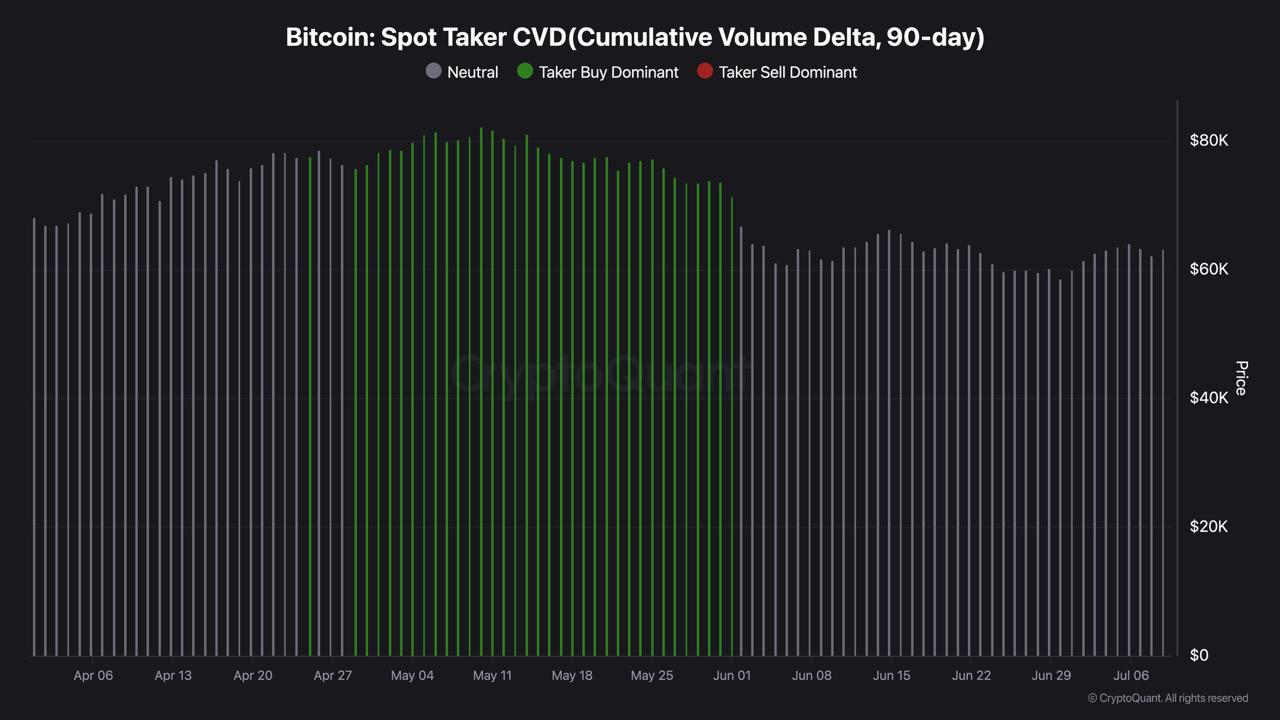
The chart does not show a single sell-dominant day during the neutral period. Bitcoin’s decline from its May highs into the upper-$50,000 range therefore developed as buying pressure weakened rather than through a sustained wave of aggressive spot selling.
That distinction helps explain why price has spent approximately five weeks consolidating instead of entering a sharper capitulation phase. The latest 1.5% increase remains a move inside that neutral environment, not evidence that buyers have regained control.
Bitwise attributes the muted spot activity to a change in the composition of Bitcoin’s investors. Senior investment strategist Juan Leon says the firm’s clients generally fall into two groups.
Existing Bitcoin allocators are using the decline to rebalance portfolios and dollar-cost average. Larger pools of capital are waiting for clearer US rules before establishing exposure.
Leon contrasted those discussions with 2022, when clients were asking whether the crypto industry would survive. In 2026, the questions focus on entry levels and position sizes. These investors may be less likely to panic-sell than the retail-heavy holder base of earlier cycles, but regulatory uncertainty also gives them little reason to chase short-term rallies.
That combination is consistent with a market that consolidates as existing holders accumulate selectively and prospective institutional buyers remain on the sidelines.
The drawdown supports Bitwise’s structural argument. Bitcoin is approximately 50% below its cycle high, compared with declines of 78% in 2022 and 84% in 2018. On that basis, the current downturn is Bitcoin’s shallowest major bear market.
Leon links the smaller decline to ownership shifting from short-term retail speculation toward professional allocation. As he put it, “the floor is rising every cycle, and that’s not an accident.”
The comparison remains incomplete because the current bear market may not be finished. A smaller drawdown after eight months does not guarantee that the final cycle low has already been established.
Bitwise does not interpret the absence of demand as evidence that Bitcoin’s fundamentals have deteriorated. It instead points to competition from the artificial-intelligence trade and a macroeconomic environment that favors caution.
Since April, memory-chip ETFs riding the AI trade have attracted approximately $12 billion, while spot Bitcoin ETFs recorded more than $4 billion in net outflows. Bitwise attributes the divergence to persistent inflation, expectations that interest rates will remain elevated, and geopolitical uncertainty.
The firm expects some of that capital to rotate back toward Bitcoin as investors compare highly valued AI-linked assets with an asset trading roughly 50% below its peak. That outcome depends on allocators viewing Bitcoin’s lower valuation as an opportunity rather than evidence of weakening demand.
The CLARITY Act is central to the institutional side of the thesis. Bitwise views clearer legislation not merely as a short-term market catalyst but as a change in the permission structure for institutions that are currently restricted from accessing the asset class. Leon does not expect the bill to pass before the August recess.
Binance founder Changpeng Zhao has made a similar cycle argument. He described the downturn as part of Bitcoin’s established four-year pattern while noting that the current low near $60,000 remains far above the approximately $16,000 bottom reached after the FTX collapse.
Zhao identified AI regulation, rather than crypto regulation, as his larger concern. His emphasis reinforces the view that crypto and artificial intelligence are competing for both investment capital and regulatory attention.
Previous Bitcoin bear markets lasted approximately 12 to 13 months, while the current decline is about eight months old. That historical duration leaves room for another leg lower even if the drawdown has been milder so far.
Bitwise points to several conditions that are consistent with a market bottom forming:
The ETF withdrawals may represent capitulation, but Bitwise does not treat them as proof that capitulation is complete. Neutral Spot Taker CVD carries the same uncertainty: the lack of aggressive selling reduces evidence of distribution, while the absence of taker-buy dominance shows that demand has not returned.
A sustained shift back into positive CVD territory would indicate that spot buyers are supporting the recovery rather than price being lifted primarily by leverage or short covering. A reclaim of the range highs alongside positive spot flow would strengthen the case that the current cycle has established a higher structural floor.
A move into sustained sell-dominant territory, particularly alongside a break below the June lows, would weaken that thesis. It would show that the apparent stability of the professional holder base is insufficient to absorb new supply.
At approximately $63,800 at the time of writing, Bitcoin remains between exhausted selling pressure and buyers waiting for clearer conditions. Lower interest-rate expectations, regulatory progress, or cooling demand for the AI trade could provide the catalyst, but none has produced a measurable shift in the spot tape.
The current data supports a narrower conclusion: Bitcoin holders are not behaving as they did during the 2022 collapse. Whether that resilience marks a durable floor or an extended pause will depend on which side of the spot market becomes aggressive first.
The information provided in this article is for educational and informational purposes only and does not constitute financial, investment, or trading advice. Cryptocurrency markets are volatile and involve substantial risk. Readers should conduct their own research and consult with a qualified financial advisor before making any investment decisions.
The post Bitcoin: Why This Bear Market Is Different appeared first on Coindoo.