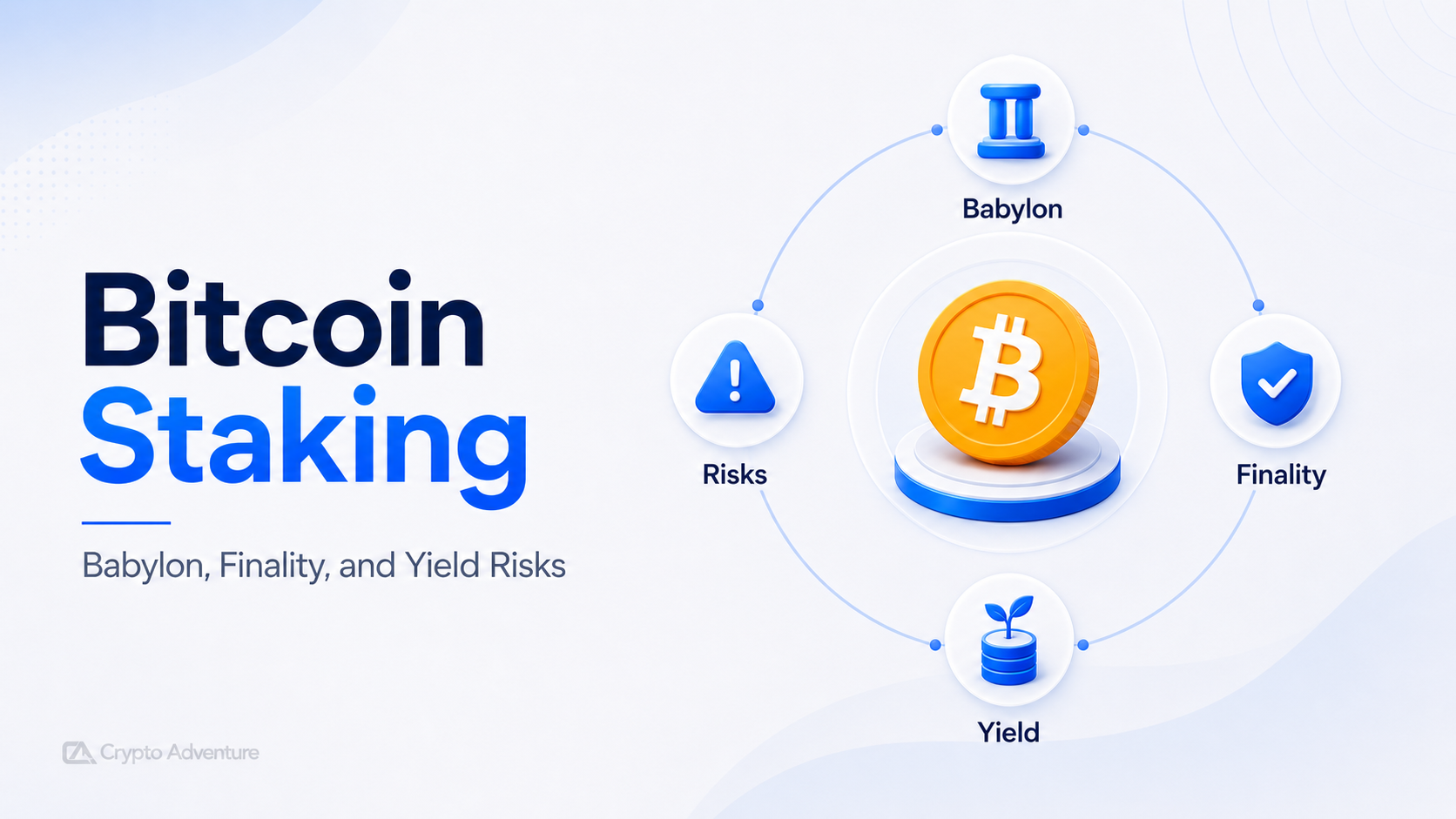
Bitcoin staking is a way to use BTC to help secure other networks and potentially earn rewards, without turning Bitcoin itself into a proof-of-stake chain. Bitcoin’s base layer remains proof-of-work. The staking activity happens through external protocols that use Bitcoin as economic security.
The best-known example is Babylon, which lets BTC holders stake Bitcoin to secure Bitcoin Supercharged Networks, including proof-of-stake systems, rollups, and other decentralized networks. The design is important because users do not need to wrap BTC, bridge it to another chain, or give up custody in the same way many DeFi strategies require.
Bitcoin staking is not the same as holding Bitcoin in cold storage. It adds protocol rules, finality providers, reward mechanics, unbonding periods, and slashing risk. The user still owns BTC exposure, but the risk profile changes once that BTC is committed to securing another system.
Babylon uses Bitcoin’s scripting and timestamping properties to let BTC holders lock coins under staking conditions. The stake remains on Bitcoin, while the economic security is used by external networks through Babylon’s protocol design.
The Babylon staking script specification defines the transaction structure used in the BTC staking protocol. The stake commits to Taproot scripts governed by Babylon Genesis parameters and the staker’s choices. This is different from a wrapped BTC system because the BTC does not need to become a synthetic token on another chain for the staking action itself.
The user chooses a staking amount, staking duration, and finality provider. The finality provider performs duties for Bitcoin Secured Networks. If the provider behaves correctly, the system can distribute rewards. If the provider breaks certain rules, slashing can apply.
Finality providers are validators in the Babylon staking system. They submit finality votes for Bitcoin Secured Networks and help those networks gain Bitcoin-backed finality. Babylon’s finality provider overview places them at the center of the protocol’s security model.
A finality provider does not simply hold user BTC. It performs network duties. That includes vote submission, key management, public randomness commitments, operational uptime, and protection against slashable behavior. The provider’s performance directly affects the risk and reward profile for users who delegate to it.
This is why finality provider selection matters. A user is not only choosing an APY. The user is choosing an operator that can keep infrastructure online, follow protocol rules, avoid double-signing, and manage upgrades safely.
Finality means a network can treat a block or state as economically irreversible. Proof-of-stake systems use validators and slashing to strengthen finality. Babylon adds Bitcoin-backed economic security to this process by letting BTC stake support finality on external networks.
That can be valuable because Bitcoin has the strongest monetary asset base in crypto. If BTC can provide economic security to other systems, those systems may reduce dependence on weaker native tokens or smaller validator sets.
The trade-off is that Bitcoin holders accept new exposure. They are no longer only exposed to BTC price. They are exposed to finality provider performance, protocol rules, and the security design of the networks being supported.
Bitcoin staking yield can come from the networks that use Bitcoin-backed security. A Bitcoin Secured Network may reward stakers in its native token, another reward asset, or future incentive structure.
That means BTC staking yield is not identical to interest paid by a bank or Treasury yield. It is compensation for providing security. The yield depends on demand for Bitcoin-backed finality, reward schedules, network adoption, token prices, and staking participation.
Users should understand whether rewards are paid in BTC, BABY, another network token, or points-like incentives. A high reward rate can become less valuable if the reward token falls, if liquidity is thin, or if claims are delayed.
Slashing is the main risk that separates Bitcoin staking from passive holding. If a finality provider commits slashable behavior, a portion of the staked BTC can be penalized under the protocol rules.
Babylon includes slashing protection for finality providers because operational errors can matter. A provider that runs duplicate signers, mishandles keys, or submits conflicting messages can create risk for delegated stake.
This is the key user lesson. BTC staking yield is not free. It exists because the stake can be used as economic security. If the security promise is broken, the system needs a penalty mechanism.
Staked Bitcoin may not be instantly liquid. Staking systems usually include an unbonding or withdrawal path so the protocol can manage security guarantees and disputes.
Exit timing matters because users may want to unstake during market volatility, operator problems, or reward changes. If unbonding is slow, users may remain exposed longer than expected.
Users should check staking duration, early unbonding rules, withdrawal timing, wallet compatibility, and whether any finality-provider behavior can affect the exit path. A staking position should not be treated like a liquid spot BTC balance.
Babylon’s self-custodial design reduces some risks of wrapped BTC and custodial yield platforms, but wallet risk remains. Users must protect private keys, understand signing flows, avoid phishing, and verify transaction details before staking.
A bad signature, wrong interface, compromised wallet, or fake staking site can still create losses. Bitcoin staking attracts scammers because it promises yield on a highly trusted asset. Users should rely on official interfaces, reputable wallets, and verified finality provider information.
Bitcoin staking fits users who want BTC-based yield and understand the added risk. It can be relevant for long-term holders who are comfortable locking a portion of BTC to secure external networks.
It is less suitable for users who want the lowest-risk form of Bitcoin ownership. Cold storage remains simpler. Staking introduces finality provider risk, protocol risk, reward-token risk, slashing risk, and exit timing.
A conservative approach separates savings BTC from active BTC. Only a portion intended for yield strategies should enter staking.
Bitcoin staking uses BTC as economic security for other networks while keeping Bitcoin’s base layer unchanged. Babylon is the leading example, using Bitcoin scripts, finality providers, and staking rules to connect BTC with external network security.
The opportunity is meaningful because Bitcoin can become productive without becoming a wrapped asset on another chain. The risk is also real. Finality provider mistakes, slashing, reward-token volatility, unbonding delays, wallet errors, and protocol complexity all matter. Bitcoin staking is best understood as an active security strategy, not a risk-free yield account.
The post Bitcoin Staking: Babylon, Finality And Yield Risks appeared first on Crypto Adventure.





