Bitcoin started the blockchain revolution as a store-of-value asset nearly 16 years ago. Since then, the revolution has branched off into altcoins, as general purpose smart contract networks aimed to displace legacy services.
One of those services included gaming. However, unlike decentralized finance (DeFI), which is now seeing resurgence to its peak in late 2021, blockchain gaming has effectively flatlined.
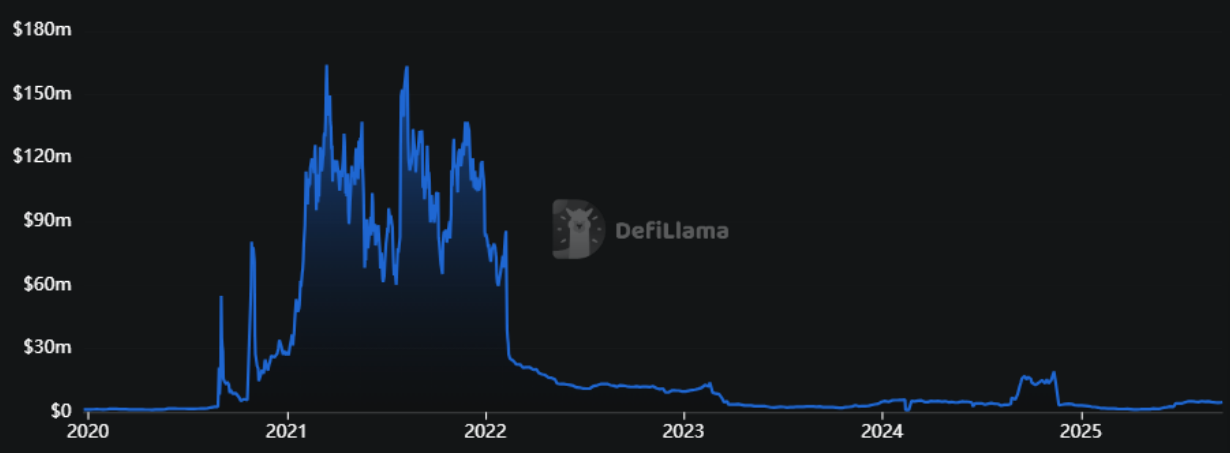
In total, gaming protocols across blockchain networks are delivering barely half a million revenue on a weekly basis – equivalent to minor dApps on any given blockchain. For Q2 2025, DappRadar reported a 93% year-over-year collapse in funding, and a 17% drop in gaming activity.
The question is: what went wrong?
When a market is so severely deflated, we first need to examine its underlying assumptions. On paper, blockchain gaming makes perfect sense. After all, gamers spend thousands of hours in-game for the purpose of asset manipulation and creation – activities that are enjoyable by the fact they are being done.
Yet, those assets are sealed off from the economy of the real-world, insulated within the publisher’s own ecosystem. For instance, while Fortnite players can earn skins, these assets are account-locked, useless to anyone but the individual gamer.
There are all kinds of assets accumulated across the genres, from vehicular combat games like Crossout to action role-playing games like Fallout 76. And all of their economies are locked. Blockchain gaming proposes to unlock them:
In short, the logic of blockchain gaming is sound. Gamers demonstrate this daily as they pour billions of hours into acquiring digital goods they don’t truly own. The aforementioned Fortnite alone churned $5.7 billion revenue (estimated) in 2024, and is projected to reach $6 billion out of total $522.46 billion games’ revenue in 2025.
So why the collapse?
Because in practice, the first generation of blockchain games failed to deliver on this promise. Instead of making gaming richer, they turned it into an exercise in speculation and grinding. Assets were sold before worlds were built, tokens were minted before gameplay existed, and economic loops came before fun.
During the heyday of blockchain gaming, Axie Infinity stood apart from the crowd. Akin to digital Pokémon, Axie Infinity pits players against each other in team battles. There, players not only collect monsters called “Axies” but also breed them.
And just like Pokémon trading cards, Axies become gamers’ personal property, but on the blockchain. In turn, players can earn tokens by winning battles and completing quests. They can then decide to spend those tokens to breed new Axies for the purpose of selling them (as NFTs) for real cash.
The comparison to Pokémon is no coincidence. After all, it is widely accepted as the highest-grossing media franchise with an estimated total revenue of $113.7 billion, nearly double that of Disney’s Mickey Mouse & Friends.
Following the same basic formula, Axie Infinity enjoyed the same success in the minor world of blockchain gaming, but where are its NFT sales now?
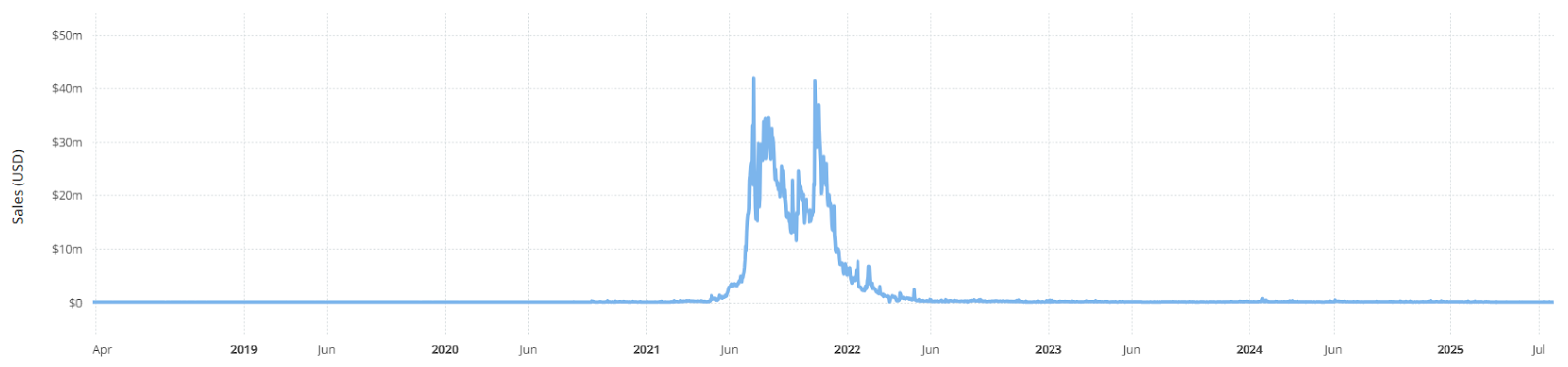
First, it bears remembering that the entire altcoin market surged in that period largely due to increased M2 money supply. The near-zero interest rate regime made capital cheap, spurring borrowing and funding of new ventures. Likewise, retail investors took a plunge into this exposure, only to be left devastated when the Federal Reserve started its rate-hiking regime in March 2022 to curtail inflation.
Consequently, the entire blockchain ecosystem, leveraged as it was, started to crumble, beginning with Terra (LUNA) and ending in the FTX crypto exchange fiasco by the year’s end. Needless to say, this soured the appetite for both retail and institutional investors, just at a time when blockchain gaming needed a delicate approach.
The complexity of video gaming cannot be overestimated. Successful franchises rely on tight coordination between art, narrative design, gameplay mechanics, and player psychology. They are finely tuned entertainment ecosystems that take years, sometimes decades, to perfect. By contrast, blockchain games often reversed this process: they began with the financial layer and attempted to graft gameplay onto it.
In the case of Axie Infinity, we saw:
In the end, Axie Infinity gained a reputation of a gimmick game that incentivised grinding for tokens, which itself dried out along with speculative demand.
In the immediate aftermath of this experiment, AI investing took nearly all attention, which made potential recovery after the FTX disaster a moot point. Moreover, gaming behaviour shifted as well.
As streaming became more popular, gamers became more passive. Specifically, according to a Midia Research report in late 2024, gamers on average spend 8.5 hours per week watching gaming streams while only spending 7.4 hours per week playing them.
This is quite concerning because attention is a finite source. There are only so many hours in a day, only so many gamers in the world, and only so many ways to monetize their attention. If even traditional AAA publishers with decades of IP struggle to maintain engagement, what chance does a fledgling blockchain title have when it competes not only with other games, but with passive viewing?
As streaming and TikTok siphon gaming time, the global market appears to be peaking in demand. June’s Ampere Analysis report put a projected growth of the market at merely 0.9% in 2025 and 2.2% in 2026.
In this macro environment, blockchain gaming is squeezed on one side by an oversaturated entertainment industry, and on the other side by a financial model that tends to collapse without continuous user growth.
Combined with AI siphoning the necessary funding, blockchain gaming is now a fragile ecosystem.
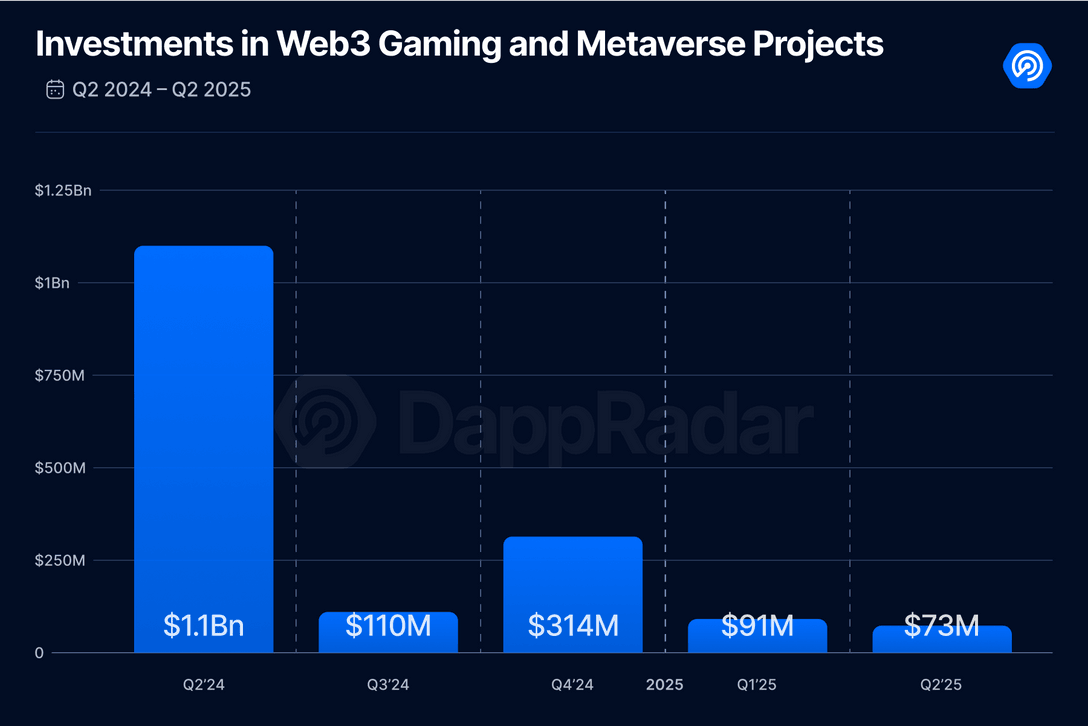
During 2022, Web3 gaming startups raised $4.49 billion, which was around 63% of total Web3 investments. Presently, Web3 gaming accounts for 25.2% of total Web3 funding. Image credit: DappRadar
The primary drivers for this slump are as follows:
The lesson is clear: fun has to be prioritized ahead of financial engineering. Yet, this is easier said than done as even AAA studios struggle to make the formula work. Case in point, when EA attempted to make Anthem a cash cow by turning it into an always-online monetisation scheme, it imploded under the weight of its own design compromises.
If one of the largest publishers in the world cannot successfully merge “fun first” with “financial sustainability,” the challenge for blockchain games – built on more fragile economics and thinner margins – is even steeper.
It is then no wonder that, in Q2 this year, over 300 gaming dApps shut down. Nonetheless, a big hit is necessary to spearhead blockchain gaming, just as VR gaming needed its breakout moment.
In the end, the inherent complexity of gaming projects is such that hits are difficult, if not impossible, to predict. The funding is still there, albeit at a drastically reduced scale. But if large publishers play their cards right, they are the most likely to push blockchain gaming to a new level.
For instance, South Korean Nexon is still seeing high activity with its MapleStory N MMORPG, having minted over 1.7 million NFTs, operating on BNB Chain (BNB) and the Avalanche (AVAX). Alongside Avalanche, investors should pay attention to another high-performing chain – Solana (SOL) – given that Sega and FIFA are still exploring blockchain gaming.
The logic of digital ownership, interoperability, and transparent economies remains as compelling as ever. For investors who prefer more established income strategies, building a dividend portfolio offers another way to align assets with long-term value.
What’s missing is not the technology but the hit – the rare alignment of fun, design, and market timing that transforms a gimmick into a franchise.
If history is any guide, the next wave won’t be led by speculative tokens or hastily launched startups, but by seasoned publishers who know how to make games people actually want to play. Until then, blockchain gaming remains a promise deferred – waiting for its Fortnite moment.
The post What Happened to Blockchain Gaming? appeared first on Crypto News Australia.





