

Bitcoin traders are sitting on their strongest unrealized profit margins since June 2025, adding a fresh pressure point as BTC struggles to reclaim its 200-day moving average.
CryptoQuant said traders’ unrealized profit margins reached 17.7%, the highest reading since June 2025. The firm warned that the setup looks similar to a prior cycle stress point, writing: “The last time margins reached these levels while Bitcoin tested the 200-day MA was March 2022.”
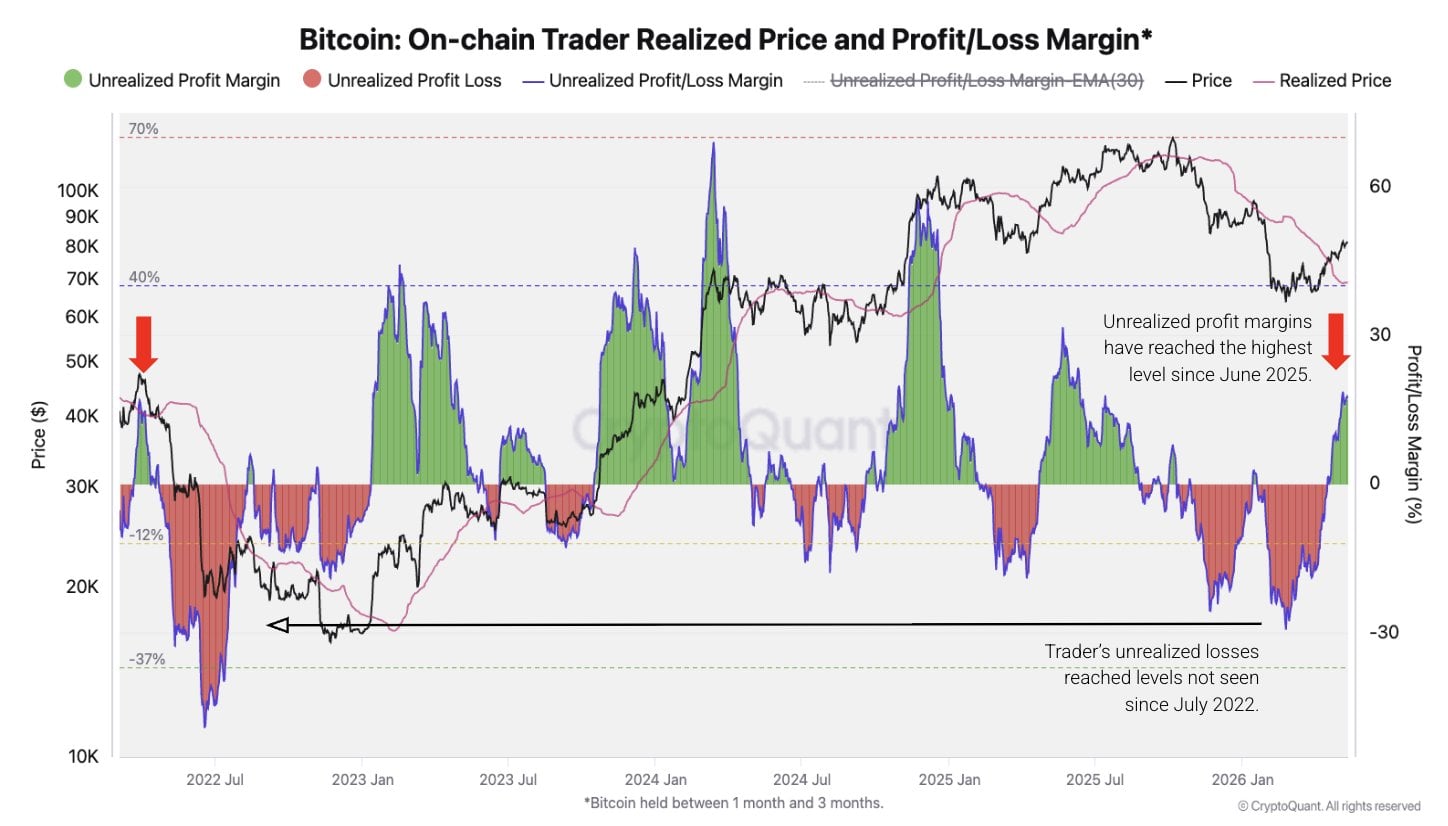
That comparison is getting attention because Bitcoin fell sharply after the March 2022 setup. BTC later dropped about 55% over the following three months as risk appetite weakened, leverage unwound, and holders who were still in profit faced more incentive to sell into failed rallies.
The current market is not a direct copy of 2022. Bitcoin recently traded near $79,200 after an intraday range between about $78,762 and $81,276, keeping price below the upper-$82,000 area that traders have treated as a major moving-average resistance zone. The profit-margin signal adds pressure because it shows more holders have gains available to realize while BTC is still failing to clear a widely watched trend line.
The 200-day moving average remains one of the market’s clearest technical checkpoints. When BTC trades below it, trend-following traders often treat rallies into the line as resistance until a daily reclaim proves otherwise.
That makes the 17.7% unrealized profit reading more important. High profit margins do not force a selloff by themselves, but they can increase the supply available for distribution if traders decide to protect gains near resistance. In that environment, spot demand, ETF flows, and derivatives positioning need to absorb selling before the market can build a cleaner breakout.
Bitcoin has already struggled with the same resistance area this week. A recent Bitcoin technical setup placed the 200-day SMA near $82,500 and the 50-day SMA near $75,000, framing the market between a breakout line and the first major downside retest area.
Leverage adds another layer. Bitcoin open interest has expanded across major exchanges, and heavy futures positioning can make a failed resistance test more violent if long positions are forced to unwind. Earlier market coverage also showed that rising open interest has loaded BTC for a larger move, especially while price remains trapped near the $80,000 zone.
The March 2022 reference is useful as a risk marker, not a guaranteed roadmap. Bitcoin’s 55% decline after that period unfolded in a different macro environment, with tightening liquidity, equity weakness, and a major crypto credit unwind still ahead.
The current setup has its own drivers. Spot Bitcoin ETFs, institutional treasury demand, and stronger exchange infrastructure can provide deeper liquidity than earlier cycles. At the same time, ETF outflows, weak macro sentiment, or a crowded long trade could still turn a failed 200-day reclaim into a faster downside move.
The immediate range is clear. A clean reclaim of the 200-day average would reduce pressure from the profit-margin signal and put the mid-$80,000 area back in play. A rejection followed by weaker spot demand would bring the $75,000 zone into focus, where the 50-day moving average and recent consolidation support become the next test.
CryptoQuant’s 17.7% reading now gives traders a specific on-chain risk level to monitor alongside price. Bitcoin does not need to repeat March 2022, but the market has less room for weak demand while profitable holders, moving-average resistance, and leverage are all pointing at the same decision zone.
The post Bitcoin Profit Margins Hit 17.7% As 200-Day Average Caps Rebound appeared first on Crypto Adventure.





