
Bitcoin’s April drawdown created visible pressure for long-term holders, but the latest onchain data suggests the move did not come close to the stress levels seen at prior cycle lows.
Glassnode said Bitcoin long-term holder relative unrealized loss peaked near 15% in early April. In the deeper bear markets that shaped earlier Bitcoin cycles, the same metric exceeded 75%. The gap is important because it shows that the latest selloff, while painful, did not push long-term holders into the same paper-loss zone that has historically accompanied full capitulation phases.
The Glassnode chart tracks the unrealized loss held by coins that have been dormant for at least 155 days and normalizes that loss against market capitalization. Its latest public value sits near 8.17%, meaning the pressure on long-term holders has already cooled from the early-April peak.
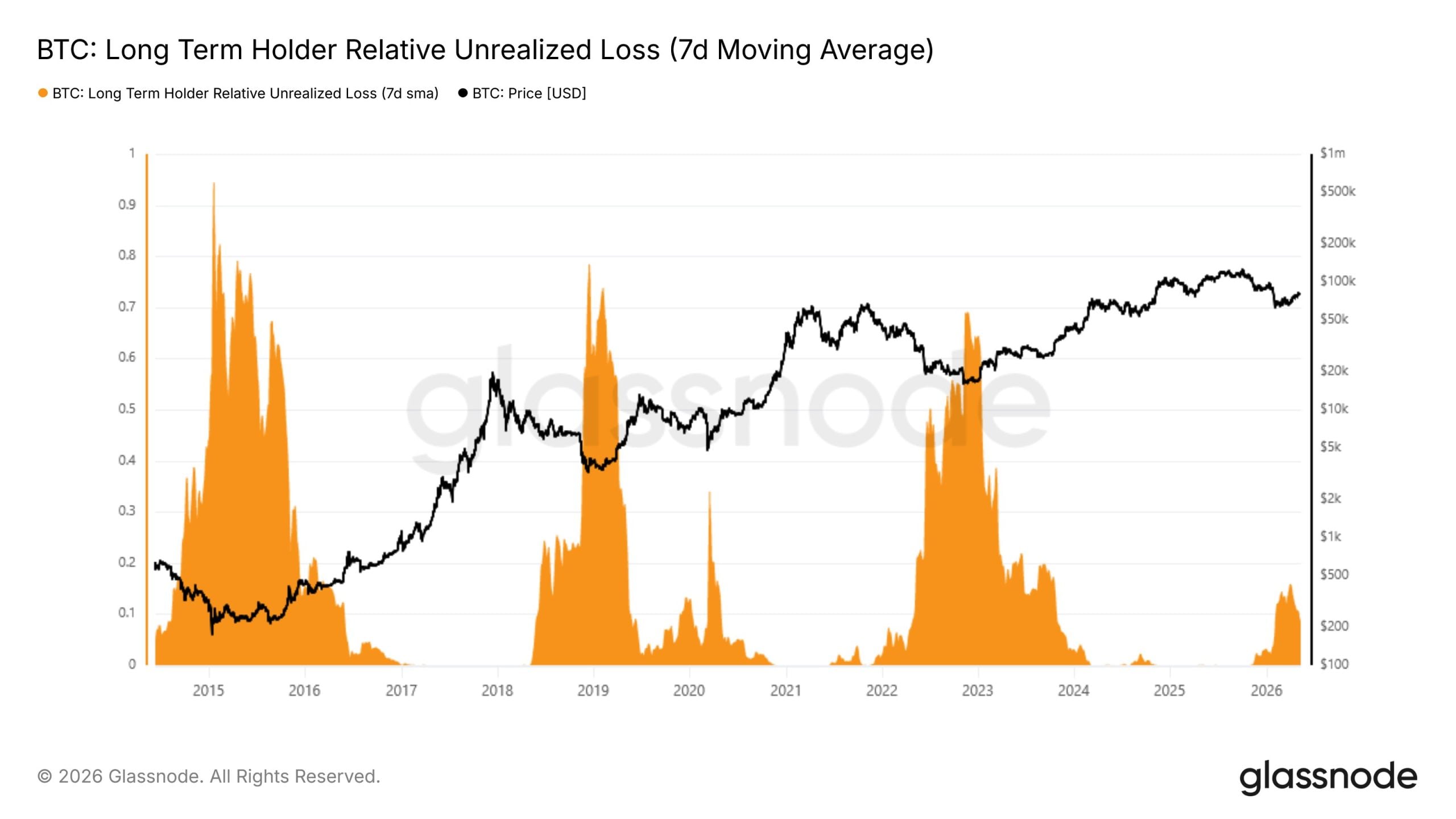
Bitcoin is trading near $80,800, leaving the market still close to the same broad zone that has defined recent price action. The difference is that long-term holder stress remains relatively contained. A deep capitulation reading would signal that older coins are sitting on heavy losses and that conviction is being tested across the investor base. The current reading points to a correction that has hurt sentiment but has not forced the strongest cohort into a cycle-low stress profile.
The long-term holder signal fits a wider market pattern. Bitcoin has struggled to turn the $80,000 area into a clean breakout base, but the coin supply held by patient investors has not shown the same strain seen in historical bear-market washouts. Earlier market data around Bitcoin long-term holder patience also pointed to a holder base that was absorbing volatility rather than rushing to exit.
That does not make the market risk-free. A low relative unrealized loss reading is not a bullish trigger by itself, and it does not guarantee that Bitcoin has already completed its correction. Price still needs spot demand, ETF support, and healthier leverage conditions to turn resilience into upside. Recent market action has already shown that Bitcoin’s open-interest build can add fuel to volatility when traders crowd back into derivatives.
The cleaner interpretation is that Bitcoin’s recent weakness has not yet produced the type of long-term holder capitulation that usually marks deep bear-market bottoms. That leaves the market in a different position from past cycle lows: holders are under pressure, but not enough to signal a broad conviction break.
The next test is price acceptance around the low-$80,000 range. If BTC keeps holding that area while long-term holder losses continue to ease, the market can rebuild from a firmer supply base. If price breaks lower and the metric starts rising again, the stress signal will become more serious because older coins would be moving deeper into unrealized loss without the same ETF and spot-demand cushion currently supporting the market.
The post Bitcoin Long-Term Holders Show Limited Stress After April Drawdown appeared first on Crypto Adventure.





