
Bitcoin’s correlation with the S&P 500 surged to about 0.74 on Friday, March 6, as geopolitical tensions and economic uncertainty pushed global markets into a new phase of volatility.
According to a Bloomberg report, the increase highlights how digital assets are increasingly behaving like macro-sensitive risk assets, moving in tandem with traditional equities during periods of global instability.
TradingView data currently shows Bitcoin trading at about $68,000 as of this writing and has dropped by about half from its peak since the recent market downtrend in the market. The increased correlation between Bitcoin and the S&P 500 indicates that investors are currently treating Bitcoin similarly to technology stocks and other speculative assets.

Source: TradingView
When global equity markets decline due to economic or geopolitical concerns, BTC declines as well. Bloomberg Intelligence ETF analyst Athanasios Psarofagis stated that this trend challenges the original narrative of the leading cryptocurrency being a volatility hedge.
“This is contrary to what is expected from Bitcoin when there is an increase in volatility,” said Psarofagis. He further said that “investors have traditionally believed that Bitcoin has always traded independently of other traditional assets.”
However, the recent market trends seem to suggest that Bitcoin is currently acting similarly to global equities in its sensitivity to macro-economic factors such as global liquidity and investor risk tolerance.
Therefore, market participants will be focused on the Fed’s next policy decisions and global liquidity trends. These two factors have historically affected the performance of both global equities and cryptocurrencies.
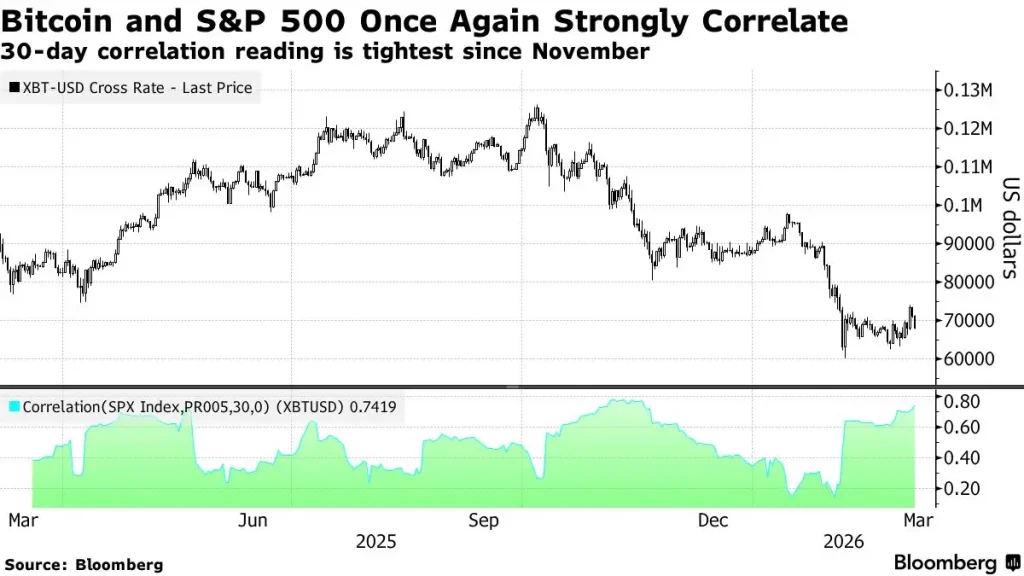
Source: Bloomberg
Also Read | Bitcoin Could Liquidate $70 million Longs If Price Hits $54,000
The most recent surge in correlation occurred concurrently with increasing global tensions and economic uncertainty. The S&P 500 declined after a lower-than-expected U.S. jobs report, and escalating geopolitical tensions in the Middle East caused oil prices to rise and heightened inflation concerns.
During the same period, the S&P 500 declined nearly 1% in one day, and Bitcoin declined by up to 5%. These price movements reflect how both markets are reacting to the same macroeconomic drivers.
Analysts say that when investors become fearful of volatility, they typically tend to reduce their exposure to volatile assets. This causes cryptocurrencies and equities to move together during risk-off environments.
According to the opinion of some analysts, this correlation will end at some point. Crypto market analyst Noelle Acheson, author of the Crypto Is Macro Now newsletter, stated that BTC’s relationship to equities can change again, depending on the evolution of global markets.
If global equities decline further, BTC may decline in the short term in conjunction with the decline in equities. However, Acheson states that the cryptocurrency may outperform equities in the longer term if structural sellers are exiting the market and long-term demand becomes stable.
As BTC continues to trade in the same direction as the broader financial markets, it continues to reinforce the increasing dominance of macroeconomic influences on the cryptocurrency space.
The rising Bitcoin–stock correlation shows that macroeconomic forces are increasingly driving cryptocurrency market movements.
Also Read | Bitcoin Prints Death Cross While BTC Trades Around $69K Support





