
Bitcoin’s fall from $126,000 has left many investors asking the same question: when will it recover? In July 2026, BTC trades near $65,000, which means it would need to almost double in value to revisit its October 2025 record. A return to $126,000 remains possible, but it may require patience. Under a realistic scenario, Bitcoin could approach its former peak between late 2027 and 2029. However, stronger ETF demand, lower interest rates, and renewed confidence could speed up the recovery. In this article, we will explain what caused the decline, what could push Bitcoin higher, and which risks may delay its next major rally. So, let’s get started!
Bitcoin climbed above $126,000 on October 6, 2025, setting the highest price in its history. An all-time high, often shortened to ATH, simply means the highest level an asset has ever reached. The Bitcoin all-time high in 2025 followed a strong rally that attracted large investors, companies, and everyday buyers.
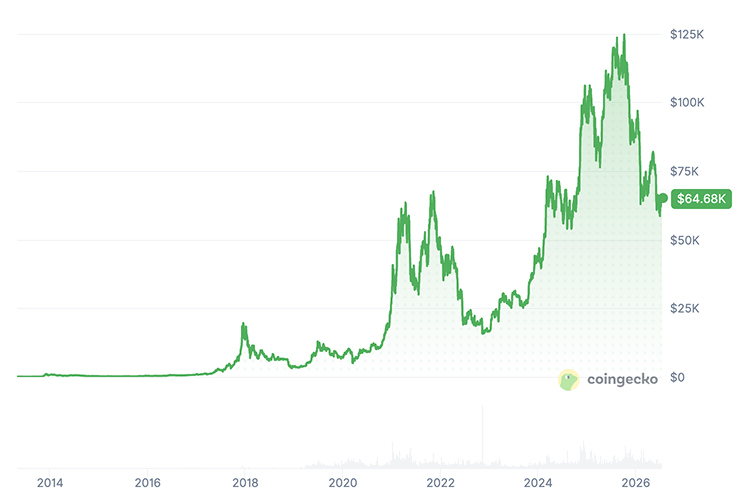
CoinGecko, July 15, 2026
Several forces supported the rise. US spot Bitcoin ETFs made the asset easier to buy through traditional investment accounts, while friendlier regulation improved confidence. A weaker dollar and rising stock markets also encouraged investors to accept more risk. In addition, the April 2024 halving reduced the number of new BTC created by miners. This limited new supply at a time when demand continued to grow.
The rally gained speed as Bitcoin moved through earlier records near $100,000 and $120,000. More traders then entered the market because they feared missing further gains. However, the final stage became overheated. Bitcoin reached its record only days before a sharp wave of selling, which showed how quickly market sentiment can change after a rapid climb.
Bitcoin fell because several sources of selling appeared at the same time. Early investors took profits after the long rally, while demand from new buyers started to weaken. The market also carried too much leverage. This means many traders had borrowed money to increase the size of their positions, leaving them vulnerable to even a small price decline.
Trade tensions between the United States and China then caused investors to reduce risk across global markets. As prices dropped, exchanges automatically closed leveraged positions. More than $19 billion in crypto positions disappeared during the October 10–11 crash, according to Reuters. These forced sales pushed Bitcoin even lower.
The weakness continued into 2026 as ETF demand slowed, interest rates remained restrictive, and geopolitical tension increased. Bitcoin, therefore, faced fewer buyers while nervous investors kept selling. The decline did not come from one event. It resulted from profit-taking, leverage, weaker confidence, and difficult economic conditions working together.
Bitcoin often moves through repeating periods of growth, excitement, decline, and recovery. The April 2024 halving reduced new supply, and the BTC peak arrived about 18 months later. This timing matched earlier cycles, although past patterns never guarantee the same result.
Volatility describes how quickly and sharply a price changes. Bitcoin can gain or lose thousands of dollars within days because it trades around the clock and reacts strongly to news. After a major rally, buyers often become exhausted, while investors who entered earlier begin taking profits. This shift can turn a normal correction into a deeper decline, especially when leveraged traders must sell automatically.
Bitcoin does not move separately from the wider economy. High interest rates make cash and bonds more attractive, while a strong dollar can reduce demand for risky assets. Inflation, wars, tariffs, and falling stock prices can also encourage investors to sell Bitcoin and protect their capital.
In June 2026, the Federal Reserve kept US rates at 3.5%–3.75%, while its July report noted that expected rates and Treasury yields had moved higher. Meanwhile, spot Bitcoin ETFs recorded roughly $8 billion of outflows over eight weeks, according to CoinShares. These conditions removed important support from the crypto market and made a fast recovery more difficult.
Yes, Bitcoin can recover to $126,000, although nobody can promise that it will happen or name an exact date. BTC has survived several major crashes and later reached new records. Its fixed maximum supply of 21 million coins, global availability, and growing access through regulated investment products continue to support its long-term case.
However, the size of the required move matters. At a price near $65,000 in July 2026, Bitcoin needs to gain about 95% to reach $126,000. Such a rise is possible in crypto, but it normally requires sustained demand rather than one positive news story. Buyers would first need to push BTC above important areas such as $80,000 and $100,000. Bitcoin would then need to hold those levels instead of falling back quickly.
For beginners asking, “will Bitcoin go back up?”, the most honest answer is that recovery depends on market conditions. Strong ETF inflows, easier monetary policy, clearer regulation, and improving investor confidence could support a new rally. In contrast, high rates, weak economic growth, or further fund outflows could keep Bitcoin below its former high for longer.
The path will probably include several corrections, even if the long-term trend turns positive. Investors should therefore view $126,000 as a possible destination, not a guaranteed outcome or deadline.
Renewed demand from spot ETFs could provide the clearest support because these funds allow institutions and traditional investors to gain Bitcoin exposure. Consistent inflows would remove BTC from the market and show that confidence has returned.
Lower interest rates could also help. When safe investments offer smaller returns, investors often move more money toward growth assets. Clearer crypto rules may encourage banks, funds, and companies to participate as well. Wider use of Bitcoin for savings, payments, or corporate reserves could add further demand.
The next halving, expected around 2028, will reduce new supply again. Previous halvings came before major rallies, although this pattern may weaken as the market grows. Any realistic Bitcoin price target should therefore consider ETF flows, global liquidity, adoption, and supply together instead of relying on the halving alone.
Persistent inflation could force central banks to keep interest rates high, which would limit demand for Bitcoin. A recession or geopolitical shock might also cause investors to sell risky assets and hold cash. Meanwhile, continued ETF outflows would remove one of the strongest sources of institutional demand.
Regulatory restrictions, exchange failures, major hacks, or forced sales by large holders could damage confidence. Excessive leverage creates another risk factor because liquidations can turn a modest decline into a rapid crash. Bitcoin may also struggle if it fails to hold important price levels after a rally. These risks do not make recovery impossible, but they could extend the process by months or years.
Bitcoin could revisit $126,000 during a powerful rally in 2026, but this is not the most likely short-term outcome. The price would need to rise almost 95% from its mid-July level, while ETF flows and economic conditions still show clear weakness. A move of that size can happen, yet it would require a fast and major change in demand.
A more balanced timeline places a possible retest between late 2027 and 2029. Bitcoin may spend the rest of 2026 building a price floor, then recover gradually as selling pressure fades. A stronger economy, lower rates, and returning ETF inflows could help BTC move back toward $80,000 and later $100,000. Once Bitcoin holds above $100,000, the distance to its former record becomes much smaller.
The next halving, expected around 2028, creates another possible recovery window. Earlier cycles often produced their strongest gains after a halving, so 2028 or 2029 may bring a more favorable environment. Still, the market has changed as ETFs and institutions now play a larger role.
Anyone asking “when will Bitcoin go back up?” should focus on conditions rather than one date. Recovery starts when demand improves consistently, not when a calendar reaches a specific month.
In the short term, Bitcoin may continue moving between strong rallies and sudden declines. A range between roughly $55,000 and $95,000 remains plausible through the end of 2026 if ETF demand stays weak and interest rates remain high. A return above $100,000 would improve momentum, but BTC would still need fresh buyers to challenge $126,000.
The long-term scenario gives Bitcoin more time to absorb selling and rebuild confidence. During 2027, improving liquidity and institutional demand could support a gradual recovery. The 2028 halving may then strengthen the supply story and create better conditions for a new cycle. Under this view, Bitcoin could retest or exceed its old record between 2027 and 2029. However, investors should expect setbacks along the way because even strong bull markets include sharp corrections and long pauses.
The Bitcoin price forecast 2026 remains unusually wide because the market faces both strong long-term support and serious short-term pressure. In mid-July, BTC trades around $65,000 after losing almost half its value from the October 2025 record. Weak ETF flows, geopolitical tension, and higher rate expectations continue to limit demand.
Forecasts from major institutions also show this uncertainty. In March 2026, Citigroup presented a $58,000 adverse scenario, a $112,000 central 12-month target, and a $165,000 bullish outcome, according to Reuters. These figures are not promises. They show how strongly regulation, ETF demand, and the economy can change the result.
For the remainder of 2026, a broad range of $50,000 to $100,000 appears more realistic than one precise number. A neutral outcome would place Bitcoin near $70,000–$90,000 by year-end as the market slowly stabilizes. Strong ETF inflows and lower rate expectations could lift BTC above $100,000. However, a return to $126,000 would require an exceptional improvement in sentiment and liquidity.
The neutral scenario currently looks more balanced because Bitcoin needs time to rebuild momentum after a decline of almost 50%. However, conditions can change quickly. Investors should watch ETF flows, inflation, central bank decisions, and Bitcoin’s ability to hold higher price levels before assuming that any scenario has become certain.
Bitcoin may fail to reach a new ATH if long-term demand stops growing. High interest rates could keep investors in cash and bonds, while persistent inflation may prevent central banks from easing policy. Continued ETF withdrawals would also weaken institutional support and leave the market more dependent on short-term traders.
Regulatory limits could make Bitcoin harder to buy, hold, or use in major markets. Exchange collapses, custody failures, or security breaches could reduce public trust. Heavy selling by governments, miners, funds, or corporate holders may create further pressure, especially during periods of low trading volume.
Market structure matters as well. If leverage grows too quickly, forced liquidations can erase a rally within hours. Bitcoin must also attract enough new capital to support a market worth trillions of dollars. Therefore, the question “how high is Bitcoin expected to go?” has no fixed answer. Bitcoin needs lasting demand, stable infrastructure, and supportive economic conditions to move beyond $126,000.
Bitcoin may go back up if demand from investors, ETFs, and institutions returns. It has recovered from large declines before, but past performance offers no guarantee. Economic conditions, regulation, and market confidence will determine how quickly a new rally can develop.
Bitcoin could hit $100,000 again in late 2026 or during 2027 if ETF inflows recover and economic pressure eases. However, weak demand or further market shocks could delay that move. BTC must gain about 55% from its mid-July 2026 price to reach this level.
Bitcoin may form its next major peak between 2028 and 2029, around the cycle connected with the expected 2028 halving. An earlier peak remains possible if institutional demand rises sharply. No cycle model can predict the exact date or price with certainty.
Bitcoin could trade between $50,000 and $100,000 during the rest of 2026 under realistic bearish and neutral conditions. A strong bullish recovery could take it toward $126,000, but this would require renewed ETF inflows, easier financial conditions, and stronger confidence.
Follow us on Medium, X, Telegram, YouTube, and Publish0x to stay updated about the latest news on StealthEX and the rest of the crypto world.
Don’t forget to do your own research before buying any crypto. The views and opinions expressed in this article are solely those of the author.
Bitcoin Bitcoin BTC Bitcoin price BTC invest in crypto




