

Bitcoin’s latest move near $80,000 is being shaped heavily by derivatives markets, as traders rebuild exposure through futures and perpetual contracts after a quieter stretch earlier in the year.
The early-May open-interest surge was real. CoinGlass-linked market snapshots placed total BTC contract open interest at about $63.2 billion on May 5, up 7.5% in 24 hours, then about $64.8 billion on May 6, up another 5.82% over the same window. Binance held the largest exchange share in those snapshots, with BTC open interest near $11.9 billion on May 6. Gate followed near $6.1 billion, Bybit near $5.3 billion, and OKX near $3.7 billion.
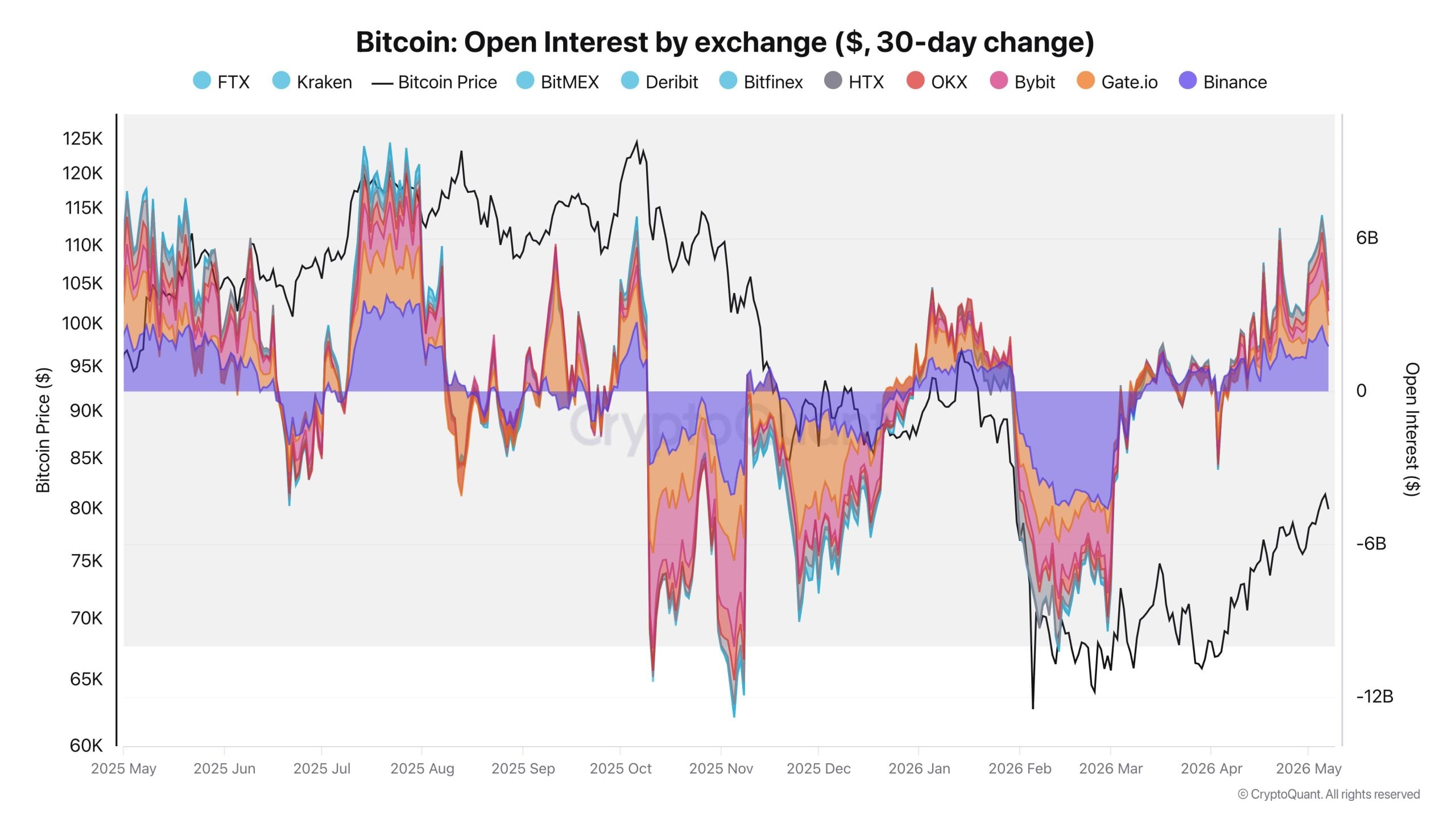
Bitcoin Open Interest. Source: CryptoQuantThat confirms a sharp return of leverage into Bitcoin markets. The early-May build-up pushed open interest beyond the levels seen around Bitcoin’s prior all-time-high formation, showing that futures traders are again taking larger directional positions as BTC holds near the $80,000 area.
The latest live picture has already softened. CoinGlass placed Bitcoin open interest near $59.7 billion, with 24-hour BTC futures volume around $64.3 billion and roughly $92 million in BTC futures liquidations. Bitcoin itself was trading near $80,100, with the intraday range sitting roughly between $79,250 and $81,159.
Rising open interest can support momentum when new buyers are adding exposure, but it also makes market structure more fragile when leverage builds faster than spot demand. That is why the funding backdrop matters.
Funding rates in perpetual futures act as a balancing mechanism between long and short positions. When they stay negative, shorts generally pay longs, which can point to bearish positioning, hedging demand, or a market where traders remain skeptical despite price strength. Funding rates can also turn into fuel for a squeeze if price moves against crowded positioning.
That makes the current Bitcoin setup less clean than a normal bullish breakout. Open interest expanded aggressively while funding remained broadly weak or mixed, suggesting traders were adding risk without full agreement on direction. This fits the recent market backdrop, where Bitcoin has held near $80,000 while ETF flows, U.S.-Iran risk, and exchange reliability headlines have kept sentiment uneven.
The role of open interest also needs context. It tracks outstanding derivative contracts, not guaranteed buying pressure. A rising OI line can mean fresh longs, fresh shorts, hedges, basis trades, or market-maker exposure. That is why open interest, volume, and CVD are stronger together than alone.
Binance remains the key derivatives exchange in the current Bitcoin setup, but the open-interest build-up has not been isolated to one platform. Gate, Bybit, and OKX all showed large BTC futures books during the early-May surge, confirming that the leverage expansion was broad across major crypto exchanges.
That breadth cuts both ways. It shows traders are returning to risk after a defensive start to the year, but it also raises liquidation risk if Bitcoin loses the $80,000 area and forced selling begins to travel across platforms. The market has already seen how fast derivatives can dominate price action when spot demand is not strong enough to absorb liquidations.
Bitcoin’s current structure is therefore more leveraged than quiet. The early-May open-interest jump confirms that futures traders are back, while the pullback from roughly $64.8 billion to the high-$50 billion area shows how quickly exposure can unwind. If Bitcoin holds above $80,000 while spot demand improves, leverage can extend the move. If price slips through nearby support, the same contracts can turn into a volatility amplifier across Binance, Gate, Bybit, and the rest of the BTC futures market.
The post Bitcoin Open Interest Surge Signals Leverage Is Back In Control appeared first on Crypto Adventure.





