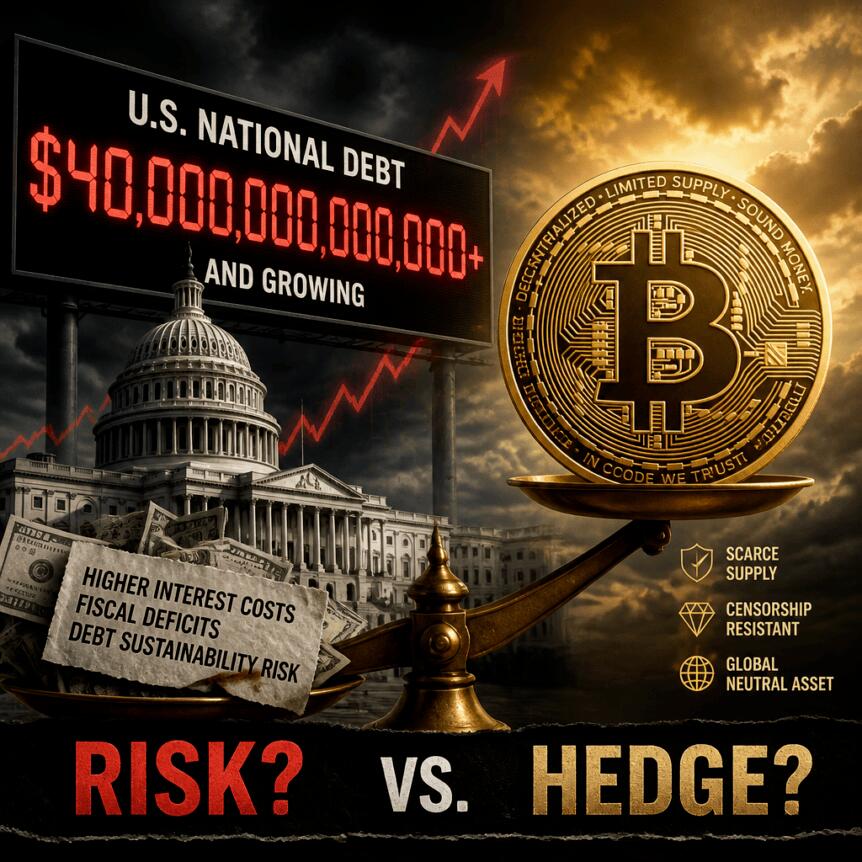
Bitcoin’s latest rally is unfolding alongside a stark escalation in US public finances, as the US federal debt pushed above $40 trillion for the first time and Treasury yields surged to their highest levels since 2007. The developments have reignited discussion among crypto market participants about whether worsening fiscal dynamics strengthen Bitcoin’s longer-term narrative as a scarce, non-sovereign asset.
At the same time, the US Treasury moved to address stress in the bond market. According to Reuters, interest costs have risen sharply, surpassing Medicare to become the federal government’s second-largest budget expense behind Social Security in the first 10 months of fiscal 2026. The debt milestone also coincided with a Treasury action designed to calm a bond selloff, pushing long-term yields higher overall before a targeted response from the department.
The $40 trillion debt milestone matters because it changes the backdrop for investors across asset classes: more borrowing typically implies greater interest expense and a bigger refinancing need over time. Reuters reported that in fiscal 2026 through the first 10 months, interest costs have climbed to become the federal government’s second-largest budget outlay behind Social Security.
At the same time, a separate Reuters report tied the timing to a Treasury effort to manage a bond selloff. That stress period has coincided with long-term yields reaching their highest point since 2007.
According to Reuters, Treasury Secretary Scott Bessent said Wednesday the department would double buybacks of 10- to 30-year debt to at least $4 billion per operation. The immediate market reaction—initially pushing yields and the US dollar lower—helped support a broader risk-on move, with Bitcoin and gold both rallying.
Bitcoin was trading around $72,600 Thursday morning, up about 6% over the previous 24 hours and roughly 15% over the past week, based on CoinGecko data. While the rally has attracted attention for potential policy implications, market observers highlighted that macro factors tied to US rates and the dollar may be playing at least as big a role.
Earlier coverage referenced by Yahoo Finance and others attributed parts of Bitcoin’s surge to optimism around friendlier US crypto policy following President Donald Trump’s meeting with industry executives at the White House on Wednesday. Still, Bloomberg-style attributions were not the only explanation. Analysts cited Treasury buybacks and fiscal conditions as additional drivers affecting the “math” investors use when allocating capital.
TrendLabs founder and chartered market technician JC Parets argued that the Treasury’s increased purchases of longer-term bonds were likely aimed at pushing back against rapidly rising long-term rates. In an analysis cited by TrendLabs, Parets suggested that if markets begin to believe the government will counter higher long-term yields, it can change the valuation assumptions for a wide range of holdings—including Bitcoin.
“If the market believes the government is going to push back against rapidly rising long-term rates, that can change the math for everything else investors own. Including Bitcoin.”
Other analysts offered a more cautious counterpoint. Bitunix analyst Dean Chen, writing in a market note cited by Cointelegraph, said the debt milestone itself is not automatically bullish for Bitcoin. Chen’s view was that Treasury buybacks may lower long-term yields temporarily and weaken the dollar, but persistent deficits and the continued build-up of financing needs could still push borrowing costs higher again over time.
In that framing, Bitcoin’s direction would depend less on the headline debt number and more on a set of observable financial variables: US dollar strength, long-term Treasury yields, and inflation expectations.
Beyond short-term rate dynamics, some analysts focused on the longer-term demand argument. Yield Basis, a DeFi protocol referenced by Cointelegraph, described continued growth in US debt as potentially increasing interest in Bitcoin as a hedge against currency debasement. Their reasoning is rooted in Bitcoin’s fixed supply and the absence of a sovereign issuer, unlike fiat currencies that can be influenced by monetary policy and fiscal financing.
“Whether it will actually become a new reserve asset remains to be seen, but as concerns around fiat currency debasement grow, it will definitely stand out more as a straightforward protective instrument (alongside more traditional assets like gold).”
That position highlights a key tension in the debate: Bitcoin may become more prominent during periods of fiscal strain and money-supply concern, but the step from “hedge” to “reserve” is still not determined by adoption narratives alone. Investors will likely look for sustained shifts in real-world demand signals, not just macro headlines.
For traders and longer-term investors, the immediate question is whether Treasury’s longer-term buyback activity can keep yields from resuming their climb—and whether the US dollar and inflation expectations stabilize. More broadly, the durability of Bitcoin’s rally may hinge on whether the market’s view of fiscal “math” changes from short-term support to persistent concern, or whether deficits ultimately translate into higher borrowing costs again.
This article was originally published as U.S. Debt Surpasses $40T, Renewing Bitcoin Risk vs. Hedge Debate on Crypto Breaking News – your trusted source for crypto news, Bitcoin news, and blockchain updates.





