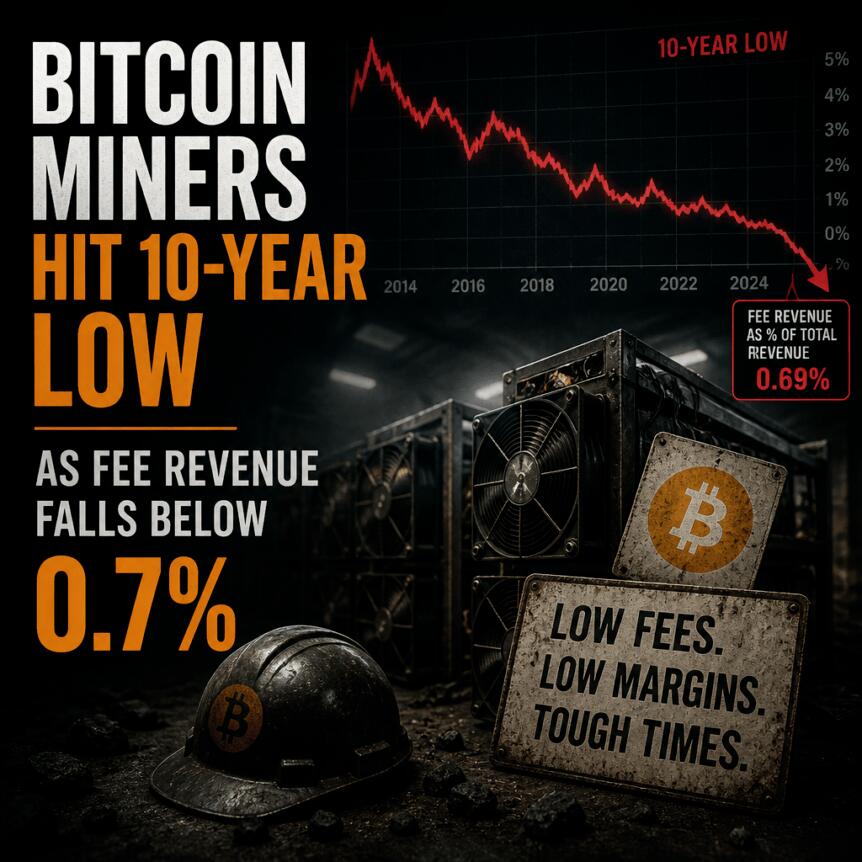
Bitcoin’s mining economics are looking increasingly subsidy-driven as transaction fees sink to levels last seen in the late stages of the decade. At the same time, multiple analysts point to a shift in miner strategy toward AI and high-performance computing (AI/HPC), coinciding with a noticeable decline in network hash rate.
Onchain analytics and mining cost estimates show fees make up just 0.69% of miner revenue, while the broader pressure on margins continues as Bitcoin’s price weakens and electricity costs remain a critical factor for operators. The resulting question for investors is whether miners’ AI pivot will stabilize long-term operations—or introduce new volatility to the network’s security parameters.
According to Glassnode, transaction fees now represent just 0.69% of miner revenue—near the lowest levels seen in years. Glassnode co-founder Rafael Schultze-Kraft previously highlighted that fees had stayed below 1% of miner revenue for almost a year, with the share falling to 0.52% in April.
In a post on X, Schultze-Kraft said that “Bitcoin was below $400 the last time fee share was this low.” While that comparison is meant to contextualize the current environment, the practical impact is straightforward: when fee revenue collapses, miners lean more heavily on the block subsidy to cover operating expenses.
That matters because the subsidy is fixed in BTC terms—currently 3.125 BTC per block—but its value in US dollars depends on Bitcoin’s price. The article notes Bitcoin has fallen nearly 50% since its October 2025 all-time high, which would reduce the USD value of each subsidy payment and squeeze margins unless operational costs fall or fee rates rebound.
The mining picture is also constrained by profitability math. Checkonchain’s mining analytics put the estimated average cost to produce one Bitcoin at $78,254 as of Tuesday—about 23% above the current spot price referenced in the source.
Even if these are “estimated” costs rather than audited figures for every operator, the direction is what counts for the market: when production costs exceed spot value, miners are incentivized to either optimize aggressively, consolidate, or exit. That dynamic tends to hit smaller players first, potentially concentrating hash rate among operators with more capital flexibility and better power procurement.
Investors should also consider that production costs are influenced by variables outside the chain itself, especially electricity prices and hardware efficiency. In periods where fees remain weak, any non-chain cost increase can accelerate the churn in mining capacity.
Network security metrics reflect the mining sector’s changing behavior. Checkonchain estimates hash rate declined from a peak of about 1.3 ZH/s in October 2025 to roughly 861 EH/s, a drop of 33%.
Hash rate is an important indicator not because it alone determines security, but because sustained decreases can signal reduced competitive participation. If the network’s mining base becomes less active, difficulty and mining economics may adjust over time—but the transition itself can be disruptive for operators and for the incentives that sustain long-run security.
Beyond the numbers, several analysts argue the decline in hash rate is linked to a strategic redeployment of compute resources. Independent analyst William Clemente, in an analysis published at the weekend and shared on X, acknowledged the downturn while arguing that automated difficulty readjustments would have offered a window for miners to increase activity. With difficulty reported as rising again, he suggested that miners’ move toward “more lucrative AI computing” has become more visible.
“There is no other way to slice it, hash rate has been in a decline,” Clemente wrote, pointing to margin compression after 2022 and higher energy prices, but also emphasizing a pivot by “many into AI/HPC.” He characterized these AI-related moves as “prudent business decisions” for publicly traded companies that pursued them.
The broader claim is not simply that miners are diversifying; it’s that the timing and direction of the shift could reduce mining participation during a period when fees are already contributing less than 1% of revenue. In an environment where the subsidy is already under pressure from Bitcoin’s price drawdown, a reduction in mining activity could widen the gap between operational realities and long-term security assumptions.
Cointelegraph previously reported that CleanSpark refocused on AI, shifting toward operating data centers after missing profit targets. Another example cited in the source is Keel Infrastructure, which shut down all US mining operations after revenue fell 50% in the second quarter. These cases support Clemente’s argument that operators facing weaker mining profitability may look to alternative compute markets.
Charles Edwards of Capriole Investments also linked hash rate declines to miners’ AI pivot, describing it as a “concerning Bitcoin development in 2026” and noting acceleration since April.
With fee revenue near decade-low levels and estimated mining costs exceeding spot value, the next signal will be whether hash rate stabilizes as difficulty adjusts—or whether additional miners continue reallocating capital toward AI/HPC. Investors may also want to monitor how quickly fee share recovers, since sustained low fees increase the network’s dependence on the subsidy at exactly the moment when operators appear to be changing how they deploy compute.
This article was originally published as Bitcoin Miners Hit 10-Year Low as Fee Revenue Falls Below 0.7% on Crypto Breaking News – your trusted source for crypto news, Bitcoin news, and blockchain updates.





