

Bitcoin’s supply on exchanges is sitting near its lowest ratio since 2018, giving traders another on-chain signal that immediately available BTC liquidity remains tight.
A Santiment chart tracking exchange balances for Bitcoin and Ethereum puts BTC supply on exchanges at approximately 5.6%, based on known exchange wallets recently updated by the analytics platform. The ratio has stayed around that level for roughly one month, making it one of the clearest long-running supply signals in the current market.
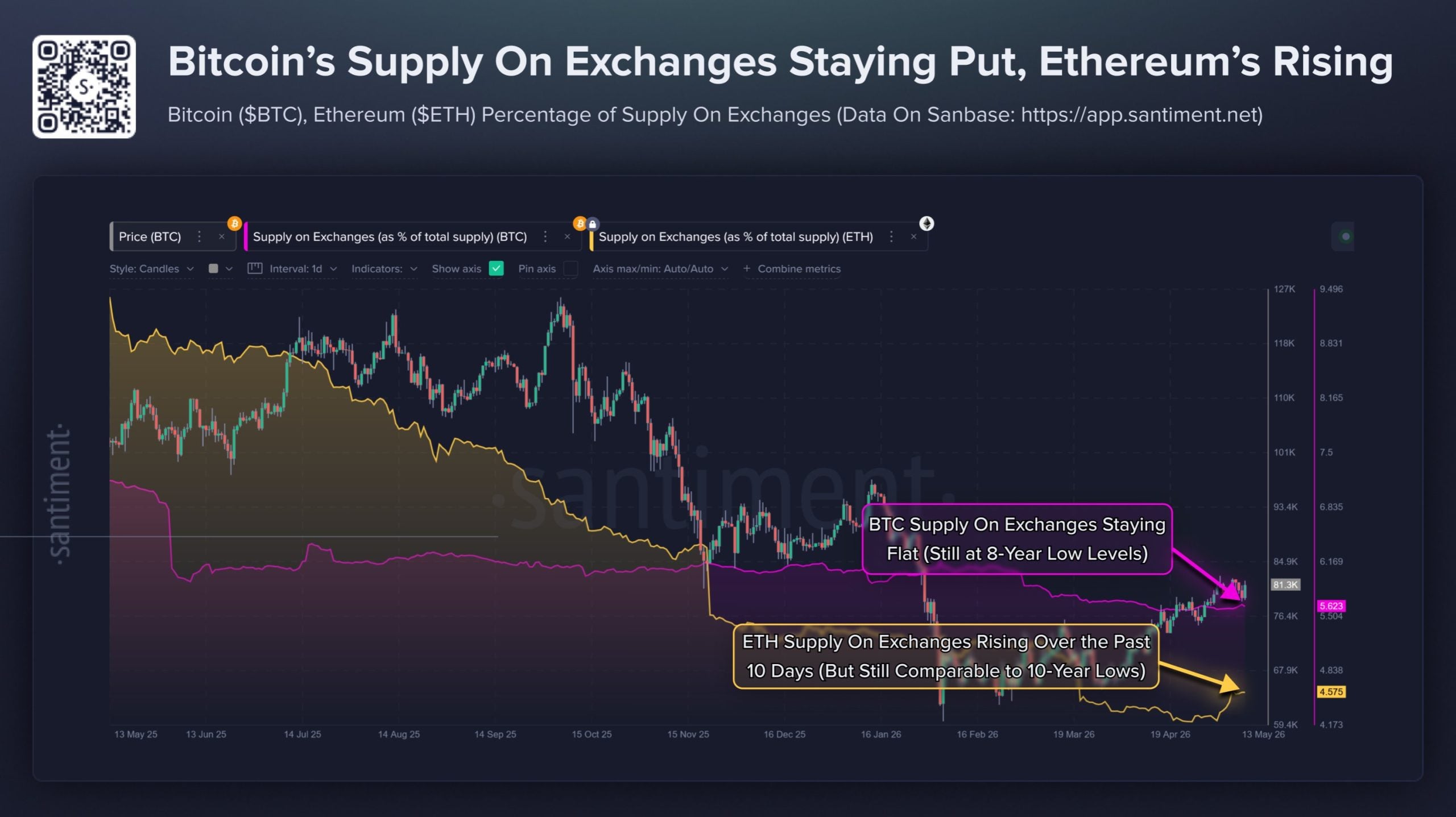
“Bitcoin’s supply on exchanges sits at approximately 5.6%,” Santiment wrote, adding that it is “the lowest ratio of BTC supply on exchanges since 2018.”
The signal supports the broader view that more BTC is sitting away from centralized exchanges, either in long-term custody, ETF-related structures, corporate treasuries, cold wallets, or self-custody. Lower exchange supply does not guarantee a price rally, but it can reduce the amount of immediately sellable BTC if demand improves.
Ethereum’s exchange-supply picture is slightly different. Santiment placed ETH supply on exchanges at 4.6%, up from 4.2% just 10 days earlier. That move suggests more ETH has returned to known exchange wallets in the short term, even though the broader ratio remains historically low compared with Ethereum’s full public trading history.
The ETH increase can reflect several different behaviors. Holders may be preparing to sell, rotate collateral, restake, provide liquidity, move assets between custodians, or reposition for derivatives and ETF-related strategies. Exchange inflows are usually watched as potential sell-side pressure, but they are not proof of selling without follow-on order-book activity or execution.
CoinGecko recently placed ETH near $2,270, with a market cap around $275 billion, while Bitcoin traded near $80,982 with a market value above $1.62 trillion. Those prices keep both assets near key decision zones, with BTC still fighting around the $80,000 area and ETH trying to avoid deeper underperformance against Bitcoin.
The low BTC exchange-supply ratio lands during a period of uneven institutional demand. U.S. spot Bitcoin ETFs recently posted their largest one-day redemption since January, while BTC continued to test a short-term support structure below major resistance. That leaves the market split between a tight spot-supply argument and weaker near-term flow data.
Recent coverage of Bitcoin’s ascending-channel support test showed BTC trying to defend the $79,000 area, while a separate Bitcoin profit-margin signal warned that unrealized gains could increase selling pressure near the 200-day moving average.
For Ethereum, the exchange-supply uptick adds a short-term caution flag, but the ratio is still near cycle lows. The more important confirmation will be whether those ETH exchange balances keep rising and whether they translate into spot selling, weaker ETF demand, or larger derivatives positioning.
The next market read is supply behavior around price. Bitcoin’s 5.6% exchange ratio points to constrained immediate liquidity, but BTC still needs stronger demand to turn scarcity into upside. Ethereum’s 4.6% exchange ratio remains low by historical standards, but the recent rise gives traders a concrete wallet-flow signal to monitor if ETH starts losing support near the low-$2,200 range.
The post Bitcoin Exchange Supply Hits Lowest Ratio Since 2018 As Ethereum Ticks Higher appeared first on Crypto Adventure.





