
Bitunix is easier to understand when it is judged for what it actually is, not for what every exchange claims to be. This is not a platform trying to win the market by looking like a one-stop financial super-app first. It is a trading-first exchange, built mainly around perpetual futures, active execution, copy trading, and a fast interface for users who care more about market access than about lifestyle branding.
Bitunix looks more compelling for someone who wants to trade than for someone who mainly wants a long-term custody venue, a passive portfolio app, or a deeply regulated fiat brokerage experience. The product feels closer to a modern derivatives exchange than to a broad retail crypto bank. That makes the review fairly simple: Bitunix is strongest where speed, trading depth, and futures tools matter. It is weaker where brand trust, regulatory transparency, and fully mature product breadth matter more.
Bitunix is built around three core lanes: spot trading, derivatives trading, and trader tools. Spot is there, and it is usable, but the center of gravity is clearly in futures. The main navigation and the platform’s own messaging make that obvious. USDT-M, USDC-M, and Coin-M perpetuals sit at the front of the product, and copy trading is presented as a core feature rather than a side tab.
That matters because it shapes the whole experience. Bitunix feels designed for someone who expects to move between charts, positions, and risk controls quickly. The exchange also supports convert, earn products, auto-invest, P2P trading, card purchases, third-party on-ramps, and fiat deposit rails such as SEPA, PIX, and QRIS, but those features still feel secondary to the trading engine rather than like the main reason to open the account.
At the base VIP tier, spot trading starts at 0.08% maker and 0.10% taker, while futures trading starts at 0.02% maker and 0.06% taker. Those numbers are competitive enough to make Bitunix a serious option for active traders, especially on the futures side. They are not just “acceptable for a smaller exchange.” They are genuinely sharp enough to matter when compared with a lot of larger exchanges.
The better reading here is not that Bitunix is the cheapest exchange in the world. It is that the platform is priced like a trading venue that understands what its core users compare first. For a derivatives-focused exchange, getting maker and taker rates wrong would be fatal. Bitunix does not get them wrong.
The other thing worth noticing is that Bitunix leans into fee discounts and VIP progression. That suits higher-volume traders more than casual users. A low-frequency spot buyer will notice the fees, but a frequent futures trader will feel them much more clearly over time.
The exchange keeps emphasizing depth, slippage control, and speed, and the interface is clearly built to support that message. The charting layer is integrated closely enough that the product feels natural for active users rather than patched together. The platform also now supports leverage up to 200x on selected perpetual markets, which tells the reader exactly who Bitunix thinks its core audience is.
That leverage ceiling is not automatically a positive. For inexperienced traders, it is mostly a risk warning disguised as a feature. But as a review point, it still matters because it confirms Bitunix is built for higher-intensity trading behavior rather than a slower wealth-app model.
The copy trading layer also makes sense in context. On a derivatives-first exchange, copy trading is not decorative. It fits the product logic. Users who do not want to manage every decision themselves can still participate in the same high-velocity environment by following lead traders. The trade-off is obvious: convenience rises, but control drops, and the actual cost structure becomes more complicated once profit sharing and funding come into view.
Bitunix has done more than many mid-tier exchanges to make its security story visible.
The strongest recent upgrade is the exchange’s December security announcement around Fireblocks and Elliptic. Fireblocks brings institutional-style MPC custody infrastructure, while Elliptic adds transaction monitoring and Know Your Transaction controls. That is not the kind of backend improvement most retail users notice immediately, but it matters because it shows the exchange is trying to become more credible for larger clients and not only for promotional traffic.
Bitunix also keeps a public reserve story in front of users. In late November, it announced publicly verifiable Bitcoin reserves had reached 500 BTC and said total reserve assets exceeded $186 million, including 123.4 million USDT and $6 million XRP. The platform says its proof-of-reserves system uses Merkle tree verification and that reserve data is visible in real time.
The protection stack goes beyond reserves. Bitunix launched a Care Fund with an initial capitalization of 30 million USDC and said it had already allocated more than $8 million in response to an October incident affecting access in some regions. More recently, the exchange introduced a Withdrawal Reversal Window that lets users add a delay of 0, 15, 30, or 60 seconds before withdrawal processing, giving them a short period to cancel a mistaken withdrawal. That is a small feature, but it is one of the more practical safety additions an exchange can make because wallet mistakes are still one of the easiest ways for users to lose money permanently.
The broad takeaway is that Bitunix is trying hard to move its safety story from “trust us” to “here is the stack.” That is a real positive.
Bitunix is not trying to present itself as a no-KYC gray-zone venue. The platform’s own support content now describes a user-friendly verification system backed by mandatory KYC. That is important because it tells the reader Bitunix is pushing toward a more formalized exchange model, not a frictionless offshore anonymity product.
That will appeal to some users and put off others. Traders who want lower-friction sign-up may find the compliance direction less attractive. Traders who want an exchange that looks more serious to partners, institutions, and larger counterparties may see the same thing as a net positive.
The bigger weakness is that Bitunix still sits in the “more transparent than before, but not yet one of the industry’s most institutionally legible brands” category. The exchange has improved its proof, custody, and compliance messaging, but it still has work to do if it wants to be read the same way the market reads the biggest global names.
Bitunix fits best for active traders who care about perpetual futures, competitive fees, copy trading access, and a platform that feels engineered around execution first. It also fits users who want a more serious security posture than the average mid-tier exchange but do not necessarily need the branding or jurisdictional footprint of the very largest venues.
It fits less well for long-term passive investors who mainly want the simplest place to buy and hold. It also fits poorly for users who want the strongest possible regulatory clarity or who are uncomfortable with high-leverage environments sitting at the center of the product.
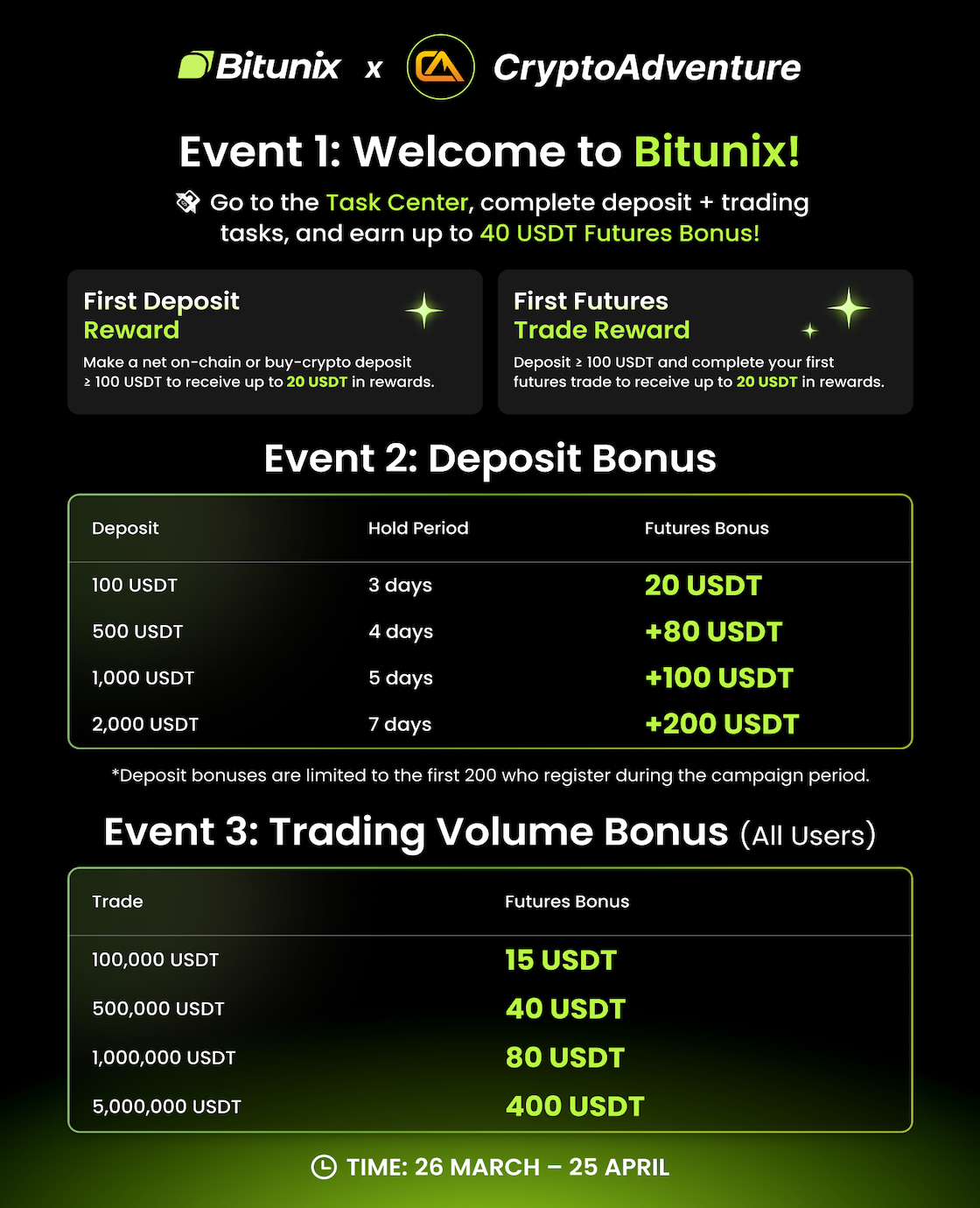
Bitunix is currently running a special campaign with Crypto Adventure built around deposits and futures trading. New users can earn up to 40 USDT in welcome rewards by completing two starter tasks: a net on-chain or buy-crypto deposit of at least 100 USDT can unlock up to 20 USDT, and making a first futures trade after depositing at least 100 USDT can unlock up to another 20 USDT.
There is also a deposit bonus ladder for users who move funds into their Futures Account and keep the net deposit in place for a set number of days. Depositing 100 USDT and maintaining it for three days earns 20 USDT, 500 USDT for four days adds 80 USDT, 1,000 USDT for five days adds 100 USDT, and 2,000 USDT for seven days adds 200 USDT. This part of the campaign is limited to the first 200 users who register during the promotion.
For more active traders, Bitunix is also offering trading-volume rewards. Trading 100,000 USDT earns 15 USDT, 500,000 USDT earns 40 USDT, 1,000,000 USDT earns 80 USDT, and 5,000,000 USDT earns 400 USDT.
Bitunix is a better exchange than its brand visibility might suggest. It has a strong derivatives core, competitive fees, credible proof-of-reserves messaging, a visible protection fund, and security improvements that go beyond cosmetic marketing. The exchange feels most convincing when judged as a trading platform, not as a catch-all crypto lifestyle product.
That is also where the final verdict lands. Bitunix is a good fit for futures traders, active users, and copy-trading participants who want a sharper product without paying top-tier venue pricing. It is a less obvious fit for passive holders or users who rank regulatory legibility above everything else. The special offer strengthens the case for users who were already planning to trade, but it should be read as a volume-driven campaign, not as free money. For the right kind of trader, Bitunix is one of the more credible mid-tier exchanges in the market right now.
The post Bitunix Review 2026: No-KYC, Fees, Futures and Security appeared first on Crypto Adventure.





